When Abraham Maslow published his theory of human motivation in 1943, he argued that human beings move through a progression of needs: physiological, safety, love and belonging, esteem, and self-actualization, in a hierarchical order (Maslow, 1943). However, there are few, if any, modern institutions in American public life that intentionally walk young men through that full journey anymore, except the United States Military. Today, we are watching an entire generation navigate the world while lacking structure, mission, identity, brotherhood, and purpose. The American military still provides all of those, and at scale.
As a soon-to-be retired U.S. Army Sergeant Major, this is not written as nostalgia or as another recruitment campaign, though critics will undoubtedly claim otherwise. Nor is this intended to be a sentimental look back at my career. It is a professional reflection on what the Department of Defense actually provides for young men, especially those between 18 and 25, who are stepping into adulthood during an era marked by uncertainty, identity crisis, social fragmentation, artificial connection, and real-world instability.
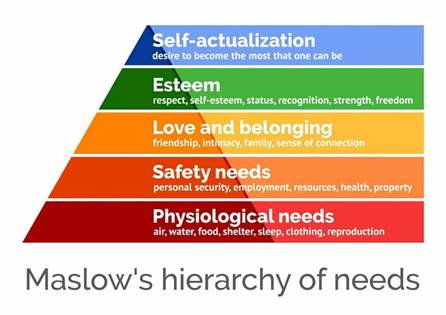
A depiction of Maslow’s hierarchy of needs from the bottom of the hierarchy upward: physiological (food and clothing), safety (job security), love and belonging (friendship), esteem, and self-actualization. https://www.simplypsychology.org/maslow.html
Physiological Needs: The Military Gives Young Men a Stable Foundation
The foundation of Maslow’s pyramid begins with the basics (food, water, shelter). Before a person can think about self-confidence, purpose, and contributing to society, they must first be able to survive. This is the first reason the military matters.
In a civilian environment, a young man often enters life struggling immediately. After leaving his childhood home, he must be prepared to pay rent, buy food, pay for healthcare/insurance, and cover transportation costs, all while receiving minimal wages and having limited support networks. In fact, many young Americans today are juggling two part-time jobs with little to no benefits. Maslow would argue that they are stuck at level one.
However, joining the military ends that instantly. On day one, albeit in basic training for a specific career, food, housing, medical care, clothing, and income are guaranteed. That type of stability offers a safety net like no other. According to Maslow, that type of stability enables higher growth. Therefore, the military provides the foundation to successfully climb the pyramid.
Safety Needs: Structure, Predictability, & a Career Pathway
The second level of Maslow’s pyramid is safety (security, employment). The United States Military is one of the last places in American society where structure is guaranteed and duty is enforceable. A young soldier does not need to fear homelessness. He does not need to fear medical bankruptcy. He does not need to wonder where his next paycheck is coming from.
Regardless of the branch of service, the Department of Defense guarantees health care access, pay, advancement opportunities, and regulations that govern behavior and discipline. In the military, “safety” is the baseline given to everyone. Once safety is secured, young men can continue to climb the pyramid.
Love and Belonging: Tribe, Identity, & Brotherhood
The third level of Maslow’s pyramid is love and belonging (friends, family, connection). This is where the military is unmatched. Unlike modern institutions and civilian careers that prioritize individualism, the military is a team. From the moment you arrive at reception, you are assigned a battle buddy.
While many young people are “connected” on social media and through their digital footprint, the truth is they are more socially isolated than those who join the military. There’s no such thing as lonely when living in a barracks, working as a member of a team, and preparing to defend those around you with your life. Shared hardship forms bonds that civilian life almost never reproduces.
When your closest friendships are built on pressure, risk, and mutual obligation, and you sweat, bleed, struggle, fail, succeed, win, and hurt with your team, you become connected to lifelong friends from around the globe. The military provides the belonging that enables people to further climb the pyramid.
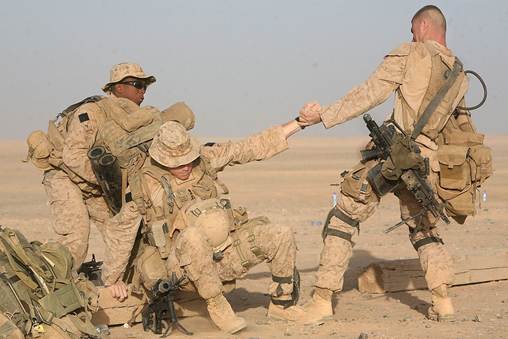
U.S. Marines helping one another stand up after being weighed down with military gear.https://www.battlebuddiessupport.com/the-road-to-recovery/
Esteem: Achievement, Recognition, Responsibility
The fourth level of Maslow’s pyramid is esteem (achievement, respect, strength, responsibility). The military is a meritocracy. When people attain promotable status, attend schools, achieve skill badges, receive commendations, and get placed in positions of increased responsibility, it is done so with trust from their leaders and subordinates alike. They represent the standard. With the foundation of physiological, safety, and love and belonging in place, esteem becomes achievable.
Responsibility is trust. Trust produces confidence. Confidence produces identity. Identity produces esteem.
The military is the profession of arms where esteem is earned, not given. In doing so, people can reach the pinnacle of Maslow’s pyramid.
Self-Actualization: Be All You Can Be
The top of Maslow’s pyramid is self-actualization (be the most you can be). This is the essence of military service. Self-actualization occurs when people are given responsibility beyond their comfort zone, when they are asked to carry weight they never imagined they could lift, and when they are forced to discover strength they didn’t know they had. It happens when they realize that fear can be pushed through, not obeyed.
In the military, young men are not sheltered from risk or responsibility. They are given responsibility early. They are trained, held accountable, and put in situations where their decisions matter. They learn that excellence is not an accident but rather the daily discipline to do what’s right even when nobody is watching.
Being in the military is being part of a team that is something larger than oneself. Maslow discusses self-actualization as requiring meaning beyond one’s own ego. The military is a meaning-making institution.
The Simple Truth
The United States Military does not need young men, young men need the Military. The military is the The United States Military does not need young men; young men need the military. The military is the only remaining institution that:
• Gives structure
• Creates identity
• Builds confidence
• Enforces discipline
• Develops leaders
• Offers purpose
• Provides transformation
Maslow’s hierarchy of needs reminds us that true fulfillment is not found solely in meeting our basic physiological or safety requirements, but in striving toward belonging, esteem, and ultimately self-actualization. The military uniquely provides this pathway: it offers young men a community where they belong, a structure that ensures security, opportunities to earn respect through discipline and achievement, and the chance to realize their fullest potential by serving a cause greater than themselves.
_____________________________
Sergeant Major (Retired) Daniel L. Dodds is a Military Police Senior Noncommissioned Officer. He has served in every leadership position from Patrolman to Battalion Command Sergeant Major. He is currently assigned as the Director of Operations Sergeant Major for the United States Disciplinary Barracks, the only Level III maximum-security prison in the Department of Defense. His civilian education includes an associate’s degree from Excelsior University and a Bachelor of Arts in Leadership and Workforce Development from the Army Command and General Staff College (CGSC). He is pursuing a Master of Public Administration from Excelsior University.
As the Voice of the Veteran Community, The Havok Journal seeks to publish a variety of perspectives on a number of sensitive subjects. Unless specifically noted otherwise, nothing we publish is an official point of view of The Havok Journal or any part of the U.S. government.
Buy Me A Coffee
The Havok Journal seeks to serve as a voice of the Veteran and First Responder communities through a focus on current affairs and articles of interest to the public in general, and the veteran community in particular. We strive to offer timely, current, and informative content, with the occasional piece focused on entertainment. We are continually expanding and striving to improve the readers’ experience.
© 2026 The Havok Journal
The Havok Journal welcomes re-posting of our original content as long as it is done in compliance with our Terms of Use.


