By Sam Yudin
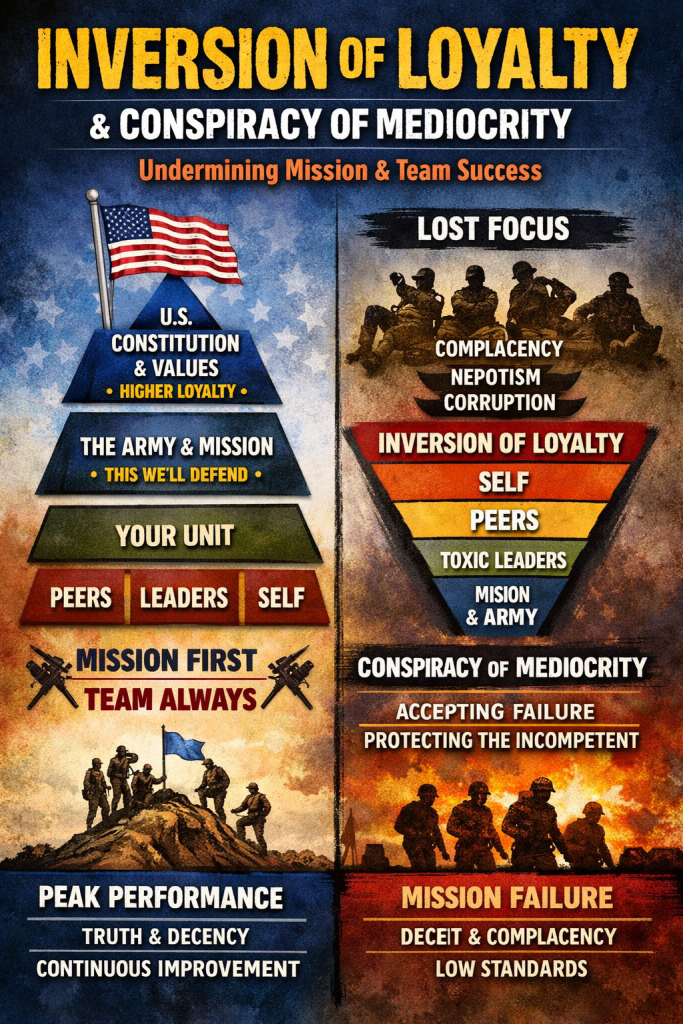
Nothing does more to corrupt and undermine mission accomplishment or team success and well-being than an inversion of loyalty or a conspiracy of mediocrity. The focus must be on the mission first and the team always. This requires loyalties to be ranked and aligned so the team can focus on continuous improvement to reach peak performance and successfully accomplish the mission.
Loyalty hierarchy
The United States Army defines loyalty as bearing true faith and allegiance to the U.S. Constitution, the Army, your unit and other Soldiers. This order creates a hierarchy where loyalty to our government, institutions, laws and way of life sits at the top. We are then loyal to the larger organization and its mission to deploy, fight and win our nation’s wars, summed up in the motto, “This We’ll Defend.” We must then be loyal to our unit, which has a specific mission that furthers the mission of the Army. Then we are loyal to those who fight beside us in the brotherhood of arms.
In Why Don’t We Learn from History?, by B.H. Liddell Hart, he adds to this hierarchy of loyalty an overarching “higher loyalty to truth and decency.” We must interact with mutual respect and shared values for loyalty to hold up. This is why the Army has a set of values, of which loyalty is one.
For the mission and team to be successful, those within it must believe in and, in good faith, be working toward the same goals. Not only that, we must be confident that our teammates beside us share the same dedication to the mission, goals and purpose. If a fellow Soldier advocates for the overthrow of the U.S. government, sabotages the mission of the unit, or violates the Army Values, and thus the higher loyalties of truth and decency, they have elected not to be a member of the team and must be removed immediately and dealt with.
Misplaced Loyalty
A pervasive phenomenon in the military and bureaucratic organizations is misplaced loyalty. Misplaced loyalty occurs when people prioritize allegiance to individuals such as peers, leaders, themselves or small units over the organizational values, ethics or the U.S. Constitution. When this occurs, the loyalty hierarchy is inverted as allegiance is misplaced.
Often this is not overt and is used to cover for deficiencies, avoid accountability, preserve an unwarranted reputation or further career opportunities. This is accomplished by introducing loyalty confusion and ambiguity, although the loyalty hierarchy is clear. This leads to catastrophic results in units where incompetent authoritarians use their positions to further their careers or cover for a peer who has violated trust, broken laws and destroyed the unit’s ability to complete the mission.
Misplaced loyalty is generally directed toward individuals or small groups at the bottom of the loyalty hierarchy: peers, leaders, self or small units over the organization and higher order loyalties. Each of these misplaced loyalties is different but stems from the same deficiency in moral character and is equally destructive to the team and mission. Loyalty is often misinterpreted as unconditional support for leaders and peers in the lower order of loyalty over higher order loyalties. Loyalty to our peers and leaders is contingent on shared allegiance to the higher order loyalties.
Misplaced Loyalty to Peers
Loyalty to peers over higher order loyalties is the most overt misplaced loyalty. We have the most connection and interaction with peers in the loyalty hierarchy. We forge deep relationships through shared struggle and growth. The result is that we love what we call in the Army our “battle buddies.” It is common to hear a Soldier describe the motivation for heroic acts as coming from love of a fellow Soldier, often saying they did it for the person to the left and right of them.
This profound love and loyalty tests the hierarchy of loyalty when a peer has violated a law, committed an unethical act or demonstrated disloyalty to a higher order loyalty. A person feels loyalty to a peer who has violated trust and loyalty and then violates that same trust and loyalty by protecting them or not reporting them even when the acts are dangerous, unlawful or immoral. This can be as simple as tolerating malingering, incompetency or unethical behavior, but as serious as covering for serious and dangerous criminal behavior that puts others at risk, such as sexual assault.
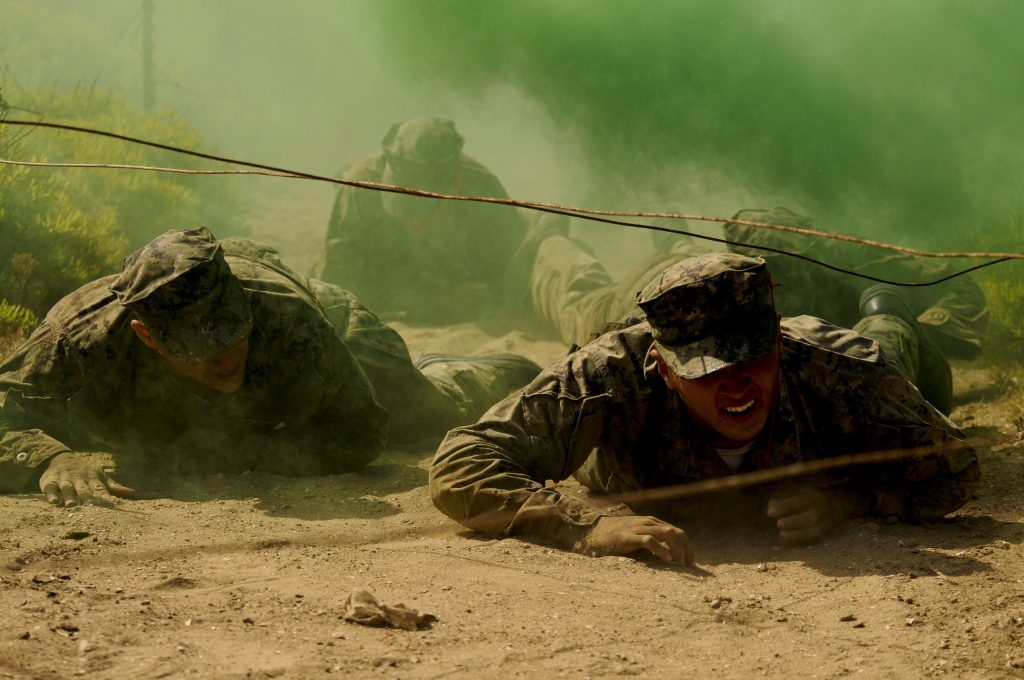
CORONADO, Calif. (June 1, 2020) Special Warfare combatant-craft crewman (SWCC) candidates from Basic Crewman Selection (BCS) Class 111 low-crawl under an obstacle during The Tour at Naval Special Warfare (NSW) Center in Coronado, Calif., June 1, 2020. The Tour is a 72-hour crucible event, which develops intelligent and highly-motivated candidates who will perform as a team under the most demanding conditions. 1 June 2020, (Photo by Petty Officer 1st Class Anthony Walker/U.S. Navy; Public Domain)
Misplaced Loyalty to Units
Many elite units have an outsized sense of loyalty to each other forged through extreme and long hours of training and shared struggle. This camaraderie is necessary for extraordinary teamwork, inspiring elite performance and mission success. This elevated level of team cohesion and loyalty often makes the difficult but necessary task of holding a member accountable to higher loyalties or moral, ethical and legal standards even harder.
In Extreme Ownership: How U.S. Navy SEALs Lead and Win, by Jocko Willink and Leif Babin, Babin describes protecting his boat crew from the instructors in an “us versus them” mentality in Basic Underwater Demolition/SEAL (BUD/S) school. He concedes that this loyalty was misguided, and that protecting underperformers who did not meet the standards could jeopardize their future teams and missions.
It is not just in elite units where this “us versus them” mentality persists. Units will demonstrate fierce loyalty to their unit at the expense of lateral units needed to accomplish the mission. They are placing loyalty to the unit above the higher order loyalties of the Army and mission.
There is a common, more nefarious phenomenon in which an unscrupulous and subversive leader has created a power pocket for cross purposes to the organization or to avoid accountability. This situation ties into misplaced loyalty to leaders and self.
Misplaced Loyalty to Leaders
This misplaced loyalty generally manifests as a quid pro quo type of relationship where a leader signals, “If you take care of me, I’ll take care of you.” The subversive leader establishing a power pocket generally sets these conditions. Liddell points out that “those who are disloyal to their own superiors are most prone to preach loyalty to their subordinates.” This upholds the power pocket but also perpetuates misplaced loyalty as a defense against accountability for those cross purposes.
This perpetuates deceit, sycophancy and flattery, all of which undermine the mission and hierarchy of loyalty. Superiors welcome this deceit, sycophancy and flattery, encouraging subordinates “to tell a superior what was likely to coincide with his desires,” according to Liddell. This leader has now propagated unethical behavior, incentivizing subordinates to be disloyal to higher order loyalties and creating an unending loop of deceit and victimization. In How to Tell a Flatterer from a Friend, by Plutarch, he points out the “flatterer labors to please rather than profit you.” This cycle of deceit does not profit the higher order loyalties but feeds into the misplaced loyalty to self for both the superior and the subordinate.
Misplaced Loyalty to Self
This is the most covert but prevalent type of misguided loyalty. This type of misplaced loyalty is largely due to what B.H. Liddell Hart describes as “a conspiracy for mutual inefficiency.” Rick Brandon and Marty Seldman describe this as a “conspiracy of mediocrity” in Survival of the Savvy: High-Integrity Political Tactics for Career and Company Success, by Rick Brandon and Marty Seldman, as does Norman Dixon in On the Psychology of Military Incompetence, by Norman Dixon.
Liddell, Brandon, Seldman and Dixon all agree that in the military and other bureaucracies average, or even mediocre, performance becomes the norm, and high performance is inadvertently or overtly discouraged or sabotaged by individuals looking out for their best interests to the detriment of the mission or team. These individuals, and often leaders, have conflicting ambitions related to personal comfort, gain such as promotions, or avoidance of accountability that do not align with organizational goals, performance or success. They protect failure and sabotage high performers to keep the status quo and avoid fulfilling their duties or being held accountable. The conspiracy comes when individuals in the organization, inspired by personal interest, protect each other by creating a culture where incompetent or destructive behavior is accepted and protected. Incompetent military leaders often show a perverse form of loyalty, prioritizing their own career and reputation, avoiding personal failure and pleasing their superiors over the lives of their troops or the success of the mission.
Standards are established to define the basic behavioral and performance thresholds of individuals and units to meet mission requirements. Standards are the minimum threshold because we are expected to achieve and maintain peak performance. Taiichi Ohno, the founder of the Toyota Production System, said, “Without standards, there can be no improvement.” When standards are not upheld, there is no accountability, no consequences, and substandard performance is accepted. The mission and team are compromised. A leader who allows this is disloyal to higher order loyalties.
In Lying to Ourselves: Dishonesty in the Army Profession, by Leonard Wong and Stephen J. Gerras, the authors point out a culture promulgated by the institution of deceit and dishonesty, violating a higher order loyalty to truth and decency in how we navigate the bureaucracy for expediency. The then-spokesman for the secretary of defense, Rear Admiral John Kirby, described this as “a breakdown in ethical behavior and in the demonstration of moral courage” and expressed concern over “the health of the strong culture of accountability and responsibility that Americans have come to expect from their military.”
I once joined a unit as the senior enlisted advisor. I was astonished that nobody understood the purpose or mission of the unit. This was apparent to me when training did not align with what we were supposed to be doing. It was apparent to me that this unit had a succession of leaders who purposefully abdicated their responsibility and mission to avoid doing the hard things: enforcing training priorities and facing accountability. Leaders who avoid confronting what must be addressed for the success of the mission or the team, and instead choose the easier path, engage in an inversion of loyalty.
Conclusion
Mission success and team peak performance require understanding, adhering to, and enforcing the loyalty hierarchy. Tolerating misplaced loyalty or a conspiracy of mediocrity is detrimental to the mission and team. Protecting underperformers, incompetent team members and unethical, dishonest actors at the expense of prioritizing peak performance, continuous improvement and ethical behavior is disloyal.

_____________________________
As the Voice of the Veteran Community, The Havok Journal seeks to publish a variety of perspectives on a number of sensitive subjects. Unless specifically noted otherwise, nothing we publish is an official point of view of The Havok Journal or any part of the U.S. government.
Buy Me A Coffee
The Havok Journal seeks to serve as a voice of the Veteran and First Responder communities through a focus on current affairs and articles of interest to the public in general, and the veteran community in particular. We strive to offer timely, current, and informative content, with the occasional piece focused on entertainment. We are continually expanding and striving to improve the readers’ experience.
© 2026 The Havok Journal
The Havok Journal welcomes re-posting of our original content as long as it is done in compliance with our Terms of Use.


