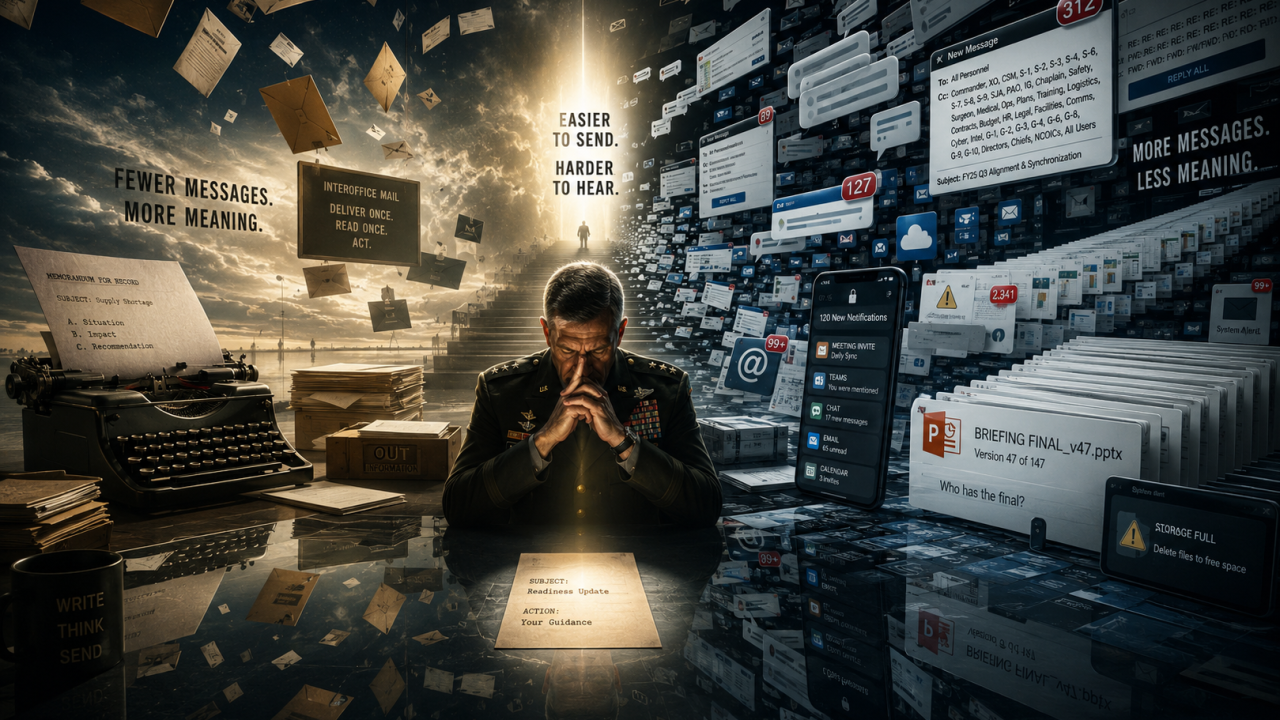
For decades, we were told that computers, email, and digital communications would create the paperless office. The promise was simple: information would move faster, organizations would become more efficient, and mountains of paperwork would become relics of a bygone era.
There was only one problem. Human nature got involved.
As someone who entered the military in 1980 and retired in 2018, I witnessed the entire transition from typewriters and carbon paper to email, smartphones, cloud storage, and digital collaboration platforms. While many things undeniably improved, one prediction never quite materialized.
Communication became easier, but communication did not become better.
In many cases, it became worse.
The Typewriter Was a Quality Control Device
In 1980, producing written communication required effort.
A memo had to be typed. If mistakes were made, portions often had to be retyped. Copies had to be produced. Documents had to be routed through organizations. Distribution required time and labor.
As a result, people thought carefully before putting something on paper.
Every memo carried a hidden question:
“Is this important enough to justify the work?”
The friction involved in creating written communication acted as a natural quality control mechanism.
Only information deemed important enough to warrant the effort usually made it into official correspondence.
That did not mean organizations were perfect. Plenty of unnecessary paperwork existed. Bureaucracies have always had a talent for generating paperwork. But the physical effort required to create and distribute information imposed limits.
Then email arrived.
Email Removed the Friction
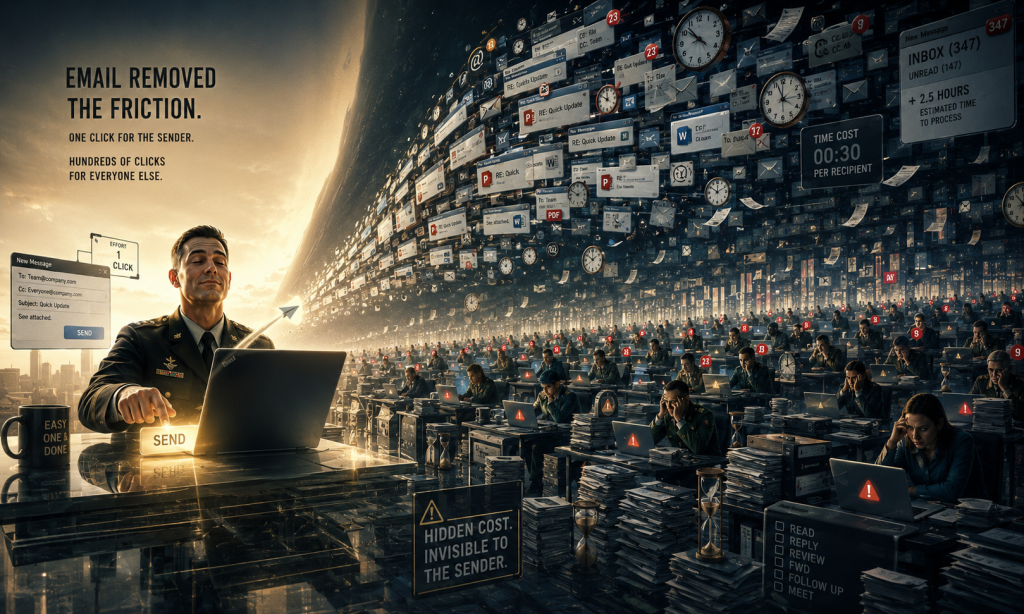
The problem with making communication nearly free is that people begin treating it as though it has no cost.
Today, an employee can create a message, attach a 50-page document, add 50 recipients, copy three supervisors, and click “Send” in less than a minute.
The sender experiences almost no burden.
The recipients experience all of it.
What once took 15 minutes to produce might now take 30 seconds.
Unfortunately, that 30-second email may consume 30 seconds from 100 recipients.
The organization just spent 50 minutes processing a message that may not have needed to exist in the first place.
The sender sees none of that cost, and the recipients absorb all of it.
The Military’s CC Culture
Military organizations unintentionally amplified this problem. Nobody wants to be the person accused of failing to inform someone.
Nobody wants to hear:
“Why wasn’t I copied on that email?”
The safest course of action became copying everyone.
Then copying everyone plus their supervisors.
Then copying everyone plus their supervisors plus three staff agencies.
Eventually, many emails resembled small telephone books.
The original purpose of communication, informing people who needed information, was gradually replaced by documenting that everyone had received information.
Those are not the same thing.
In fact, they are often opposites. The larger the distribution list becomes, the less likely any individual recipient is to feel responsible for taking action. Then everyone assumes someone else is handling it.
More Information Does Not Equal More Knowledge
One of the greatest misconceptions of the Information Age is that more information automatically creates better-informed people.
It does not.
Human attention is finite.
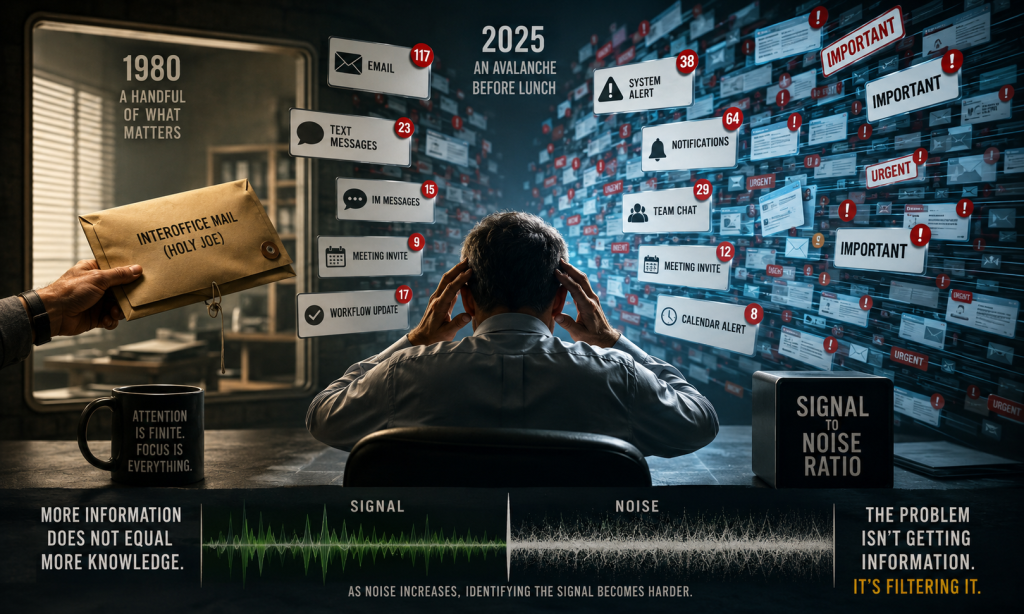
In 1980, a supervisor might receive a handful of important communications during a workday, hand-delivered in a reusable interoffice mailer envelope, often referred to as a Holy Joe.
In 2025, that same supervisor might receive more than 100 emails, text messages, instant messages, notifications, system alerts, meeting invitations, and workflow updates before lunch.
The problem is no longer obtaining information. The problem is filtering information.
When every message is labeled “important,” none of them are. When every email carries a high-priority flag, the flag becomes meaningless. When every issue is treated as urgent, genuine emergencies become difficult to distinguish from routine administrative noise.
This phenomenon has a name.
It is called signal-to-noise ratio.
As noise increases, identifying the signal becomes harder.
Many organizations have spent decades increasing the amount of information they generate while simultaneously making it more difficult to identify what actually matters.
The Paperless Office That Wasn’t
Ironically, the early years of email often increased paper consumption rather than reducing it.
People printed emails.
They printed attachments.
They printed presentations.
They printed spreadsheets.
They printed meeting agendas.
They printed training materials.
The paperless office became an office with both paper and electronic communication.
Employees now had two versions of everything.
Only in recent years, with electronic records, digital signatures, cloud storage, and mobile devices, has paper consumption meaningfully declined.
Yet the communication overload problem remains.
The paper disappeared.
The noise did not.
PowerPoint: The Other Victim
PowerPoint suffered the same fate as email.
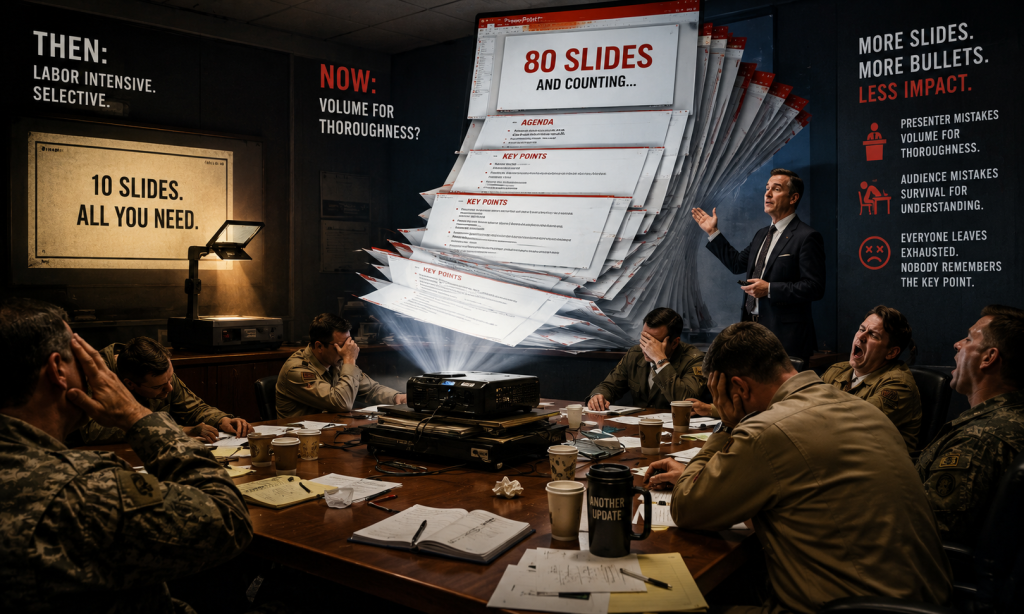
When briefing materials required significant effort to produce, presenters tended to be selective. Presentations were delivered on overhead projectors, with the image printed or drawn on acetate film and mounted in a cardboard frame. The labor required was intense.
Today, adding another slide costs virtually nothing.
The result is familiar to anyone who has survived a modern staff meeting.
What once might have been a concise 10-slide briefing becomes an 80-slide marathon containing enough bullet points to qualify as suppressive fire.
The presenter often mistakes volume for thoroughness.
The audience mistakes survival for understanding.
Everyone leaves exhausted, and nobody remembers the key point.
The Attention Economy
The Information Age created an unexpected reality.
Information is no longer the scarce resource; attention is.
Most organizations still operate as though information is scarce and attention is unlimited, but the opposite is true.
Information is abundant. It’s attention that is limited. TL;DR.
The most valuable communicators today are not the people who generate the most information. They are the people who can identify what matters and communicate it clearly.
The Lesson We Forgot
Technology solved many communication problems. It allowed messages to travel instantly across continents. It connected organizations in ways previous generations could scarcely imagine.
But technology cannot solve human nature. If anything, it amplifies it.
The typewriter forced people to think before they communicated because communication was expensive. Email removed that cost.
Unfortunately, it also removed many of the incentives to be concise, selective, and thoughtful.
The result is a world where we can communicate with thousands of people instantly and yet often struggle to ensure that anyone actually receives the message.
The paperless office may have finally arrived.
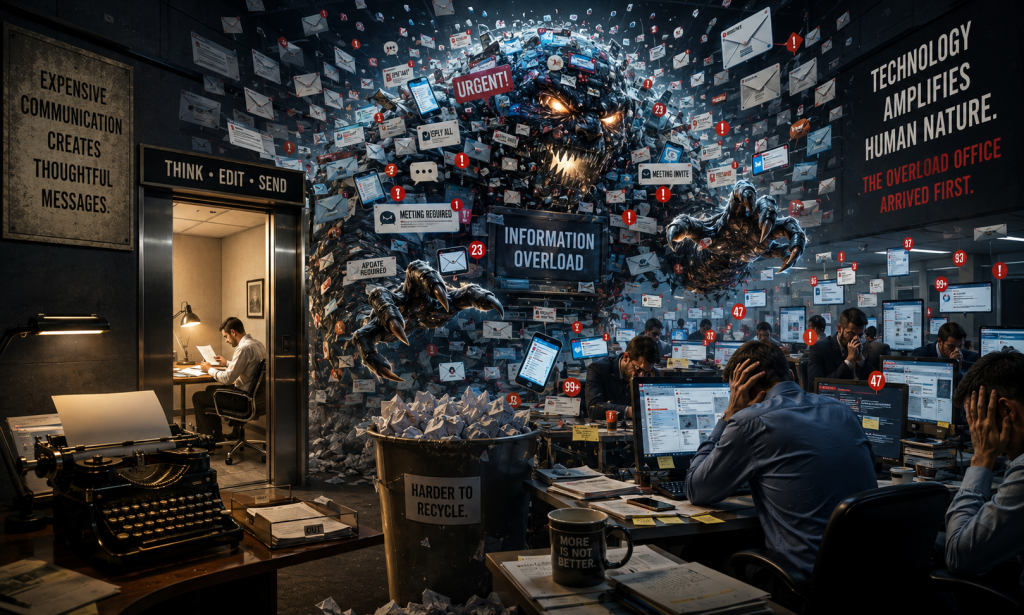
The overload office arrived first. And unlike paper, information overload is much harder to recycle.
Interestingly, even though everyone hates it, most people continue to feed the information overload monster.
_____________________________
Dave Chamberlin runs a consulting and training company and brings more than 40 years of civilian and military aviation experience to his work. He retired as a Chief Master Sergeant after 38 years as an aircraft crew chief in the U.S. Air Force and Air National Guard, and has also worked in technical, instructor, consultant, and leadership roles. He holds an FAA Airframe and Powerplant license and a master’s degree in aeronautical science, and his writing often focuses on military issues, especially those affecting aircraft maintenance personnel.
As the Voice of the Veteran Community, The Havok Journal seeks to publish a variety of perspectives on a number of sensitive subjects. Unless specifically noted otherwise, nothing we publish is an official point of view of The Havok Journal or any part of the U.S. government.
Buy Me A Coffee
The Havok Journal seeks to serve as a voice of the Veteran and First Responder communities through a focus on current affairs and articles of interest to the public in general, and the veteran community in particular. We strive to offer timely, current, and informative content, with the occasional piece focused on entertainment. We are continually expanding and striving to improve the readers’ experience.
© 2026 The Havok Journal
The Havok Journal welcomes re-posting of our original content as long as it is done in compliance with our Terms of Use.


