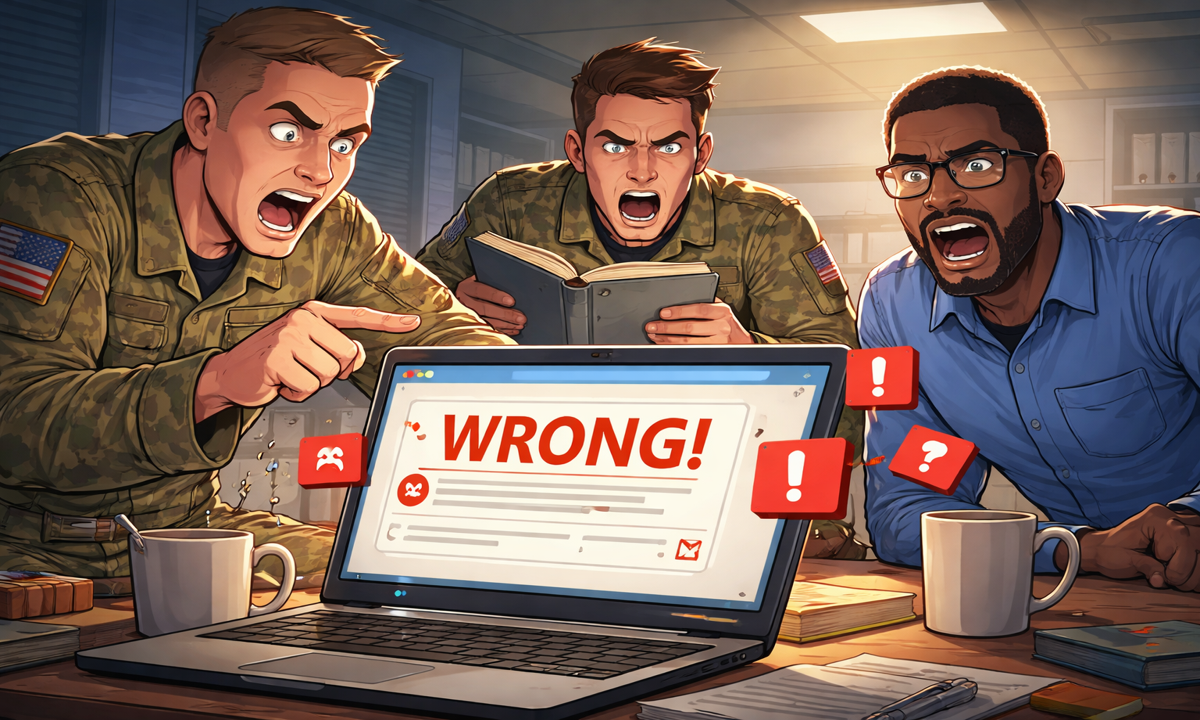
There is an old rule of the internet that every soldier, analyst, and armchair strategist eventually discovers the hard way. It’s not in any field manual, and it definitely wasn’t covered in any professional military education course.
It’s called Cunningham’s Law.
And once you understand it, you start seeing it everywhere.
Cunningham’s Law states:
“The best way to get the right answer on the internet is not to ask a question; it’s to post the wrong answer.”
The quote is widely attributed to Ward Cunningham, the programmer who invented the wiki and helped pioneer collaborative online knowledge platforms. Ironically, the exact origin of the quote itself is somewhat debated—very on-brand for a rule about internet corrections.
At first glance, the idea sounds like satire. But anyone who has spent five minutes in a comment section knows it’s not just true—it’s practically scientific.
Ask a question online and you might get silence.
Post the wrong answer with confidence and suddenly a swarm of experts appears out of nowhere to correct you.
If you really want engagement, just be confidently incorrect.
The internet will do the rest.
The Tactical Application of Being Wrong
Think about how this plays out in real life.
You post a question:
“Does anyone know how artillery fuzes work?”
Crickets.
Now try this:
“Artillery shells explode because the casing gets hot from friction in the air.”
Within seconds someone materializes to explain—in excruciating detail—the fuze mechanisms used by NATO artillery since the Cold War. You’ll get diagrams. Technical explanations. Possibly a retired EOD technician who hasn’t spoken about proximity fuzes since 1998.
Congratulations—you’ve just triggered Cunningham’s Law.
The phenomenon is so well known it even has its own entry on Wikipedia.
The reason it works is simple: people are far more motivated to correct errors than they are to answer open questions.
Soldiers and the Comment Section
Military professionals are not immune to this phenomenon.
In fact, we may be uniquely susceptible.
Spend enough time around operations planning, doctrinal debates, or social media arguments about tactics and you’ll see Cunningham’s Law in action almost immediately.
Post this:
“What’s the best way to clear a room?”
You’ll get ten vague answers and three arguments.
Post this instead:
“Room clearing is easy—you just throw a grenade and walk in.”
Now the cavalry arrives.
Infantrymen appear from the shadows. Someone quotes doctrine. Someone else insists that what you’re describing would get you relieved of duty—or worse.
Eventually someone will cite FM 3-21.8, The Infantry Rifle Platoon and Squad, and suddenly the comment section becomes an impromptu professional development session.
That’s Cunningham’s Law at work.
Here’s another example. In this case, it’s no so much that the post is wrong, it’s just kind of “no shit.”
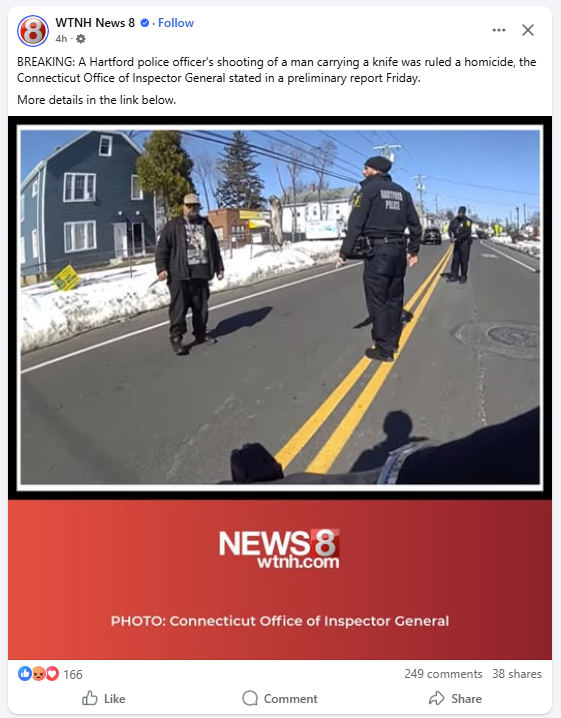
Well, yeah, of course it’s a homicide. Anytime anyone kills anyone, for whatever reason, it’s a homicide. that doesn’t mean it was criminal, or wrong, or bad, necessarily. But it sure will get the comments going and will pump up the SEO juice. And that, of course, is why this happens.
Why This Happens
There are a few reasons the law works so reliably.
1. People like correcting others
The internet is a global platform for two things:
- Sharing information
- Proving someone else wrong
Correcting someone provides a small psychological reward. Researchers studying cognitive bias have noted that people are strongly motivated to defend their existing knowledge and beliefs.
In simpler terms, fixing someone else’s mistake feels good.
2. Wrong answers create urgency
A question invites optional participation.
A wrong answer creates a problem that must be corrected immediately.
When someone posts incorrect information, readers often feel compelled to intervene before misinformation spreads further.
This dynamic is part of why online discussions often escalate so quickly.
3. Confidence attracts attention
A hesitant question can be ignored.
A confident mistake demands a response.
As programmer and essayist Paul Graham observed in his writings about online discourse, the internet often rewards bold statements—even incorrect ones—because they provoke engagement.
Confidence creates friction.
Friction generates discussion.
Discussion generates answers.
The Dark Side of the Law
Of course, Cunningham’s Law has a downside.
Deliberately posting incorrect information to provoke responses can easily drift into trolling. In an era where misinformation spreads rapidly, intentionally being wrong can create confusion rather than clarity.
There is a difference between strategic curiosity and bad-faith argument.
Used responsibly, Cunningham’s Law can be a learning tool.
Used irresponsibly, it becomes noise.
And the internet already has plenty of noise.
A Tool for Learning
Despite the risks, the underlying insight behind Cunningham’s Law is valuable.
It reminds us that knowledge is often collaborative.
The modern internet functions like a massive, chaotic staff meeting where someone always has a better answer.
Sometimes the fastest way to uncover that answer is to trigger the people who know it best.
That doesn’t mean we should intentionally spread bad information.
But it does highlight something important about how expertise spreads in online communities.
Questions invite participation.
Mistakes demand correction.
And correction travels faster.
Final Thought
Cunningham’s Law may not appear in any leadership doctrine or military handbook, but it captures something deeply human.
People care about getting things right.
Especially when someone else gets it wrong first.
So the next time you find yourself staring at an empty comment thread after asking a thoughtful question, remember the ancient wisdom of the internet:
If you really want the correct answer…
Post the wrong one.
Just be prepared for the incoming fire.
_____________________________
Charles served over 27 years in the US Army, which included seven combat tours in Iraq and Afghanistan with various Special Operations Forces units and two stints as an instructor at the United States Military Academy at West Point. He also completed operational tours in Egypt, the Philippines, and the Republic of Korea and earned a Doctor of Business Administration from Temple University as well as a Master of Arts in International Relations from Yale University. He is the owner of The Havok Journal, and the views expressed herein are his own and do not reflect those of the US Government or any other person or entity.
As the Voice of the Veteran Community, The Havok Journal seeks to publish a variety of perspectives on a number of sensitive subjects. Unless specifically noted otherwise, nothing we publish is an official point of view of The Havok Journal or any part of the U.S. government.
Buy Me A Coffee
The Havok Journal seeks to serve as a voice of the Veteran and First Responder communities through a focus on current affairs and articles of interest to the public in general, and the veteran community in particular. We strive to offer timely, current, and informative content, with the occasional piece focused on entertainment. We are continually expanding and striving to improve the readers’ experience.
© 2026 The Havok Journal
The Havok Journal welcomes re-posting of our original content as long as it is done in compliance with our Terms of Use.


