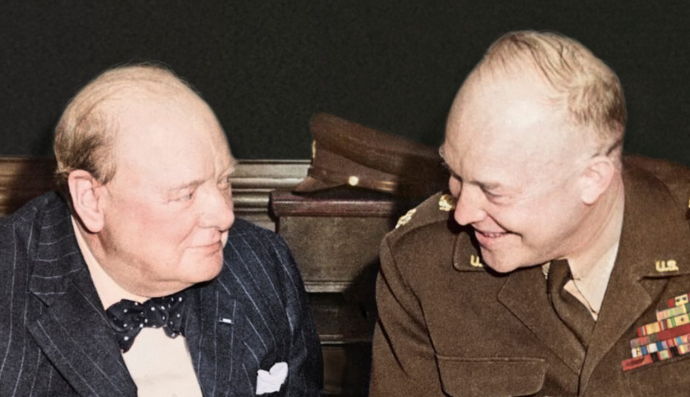
By Jonathan W. Jordan
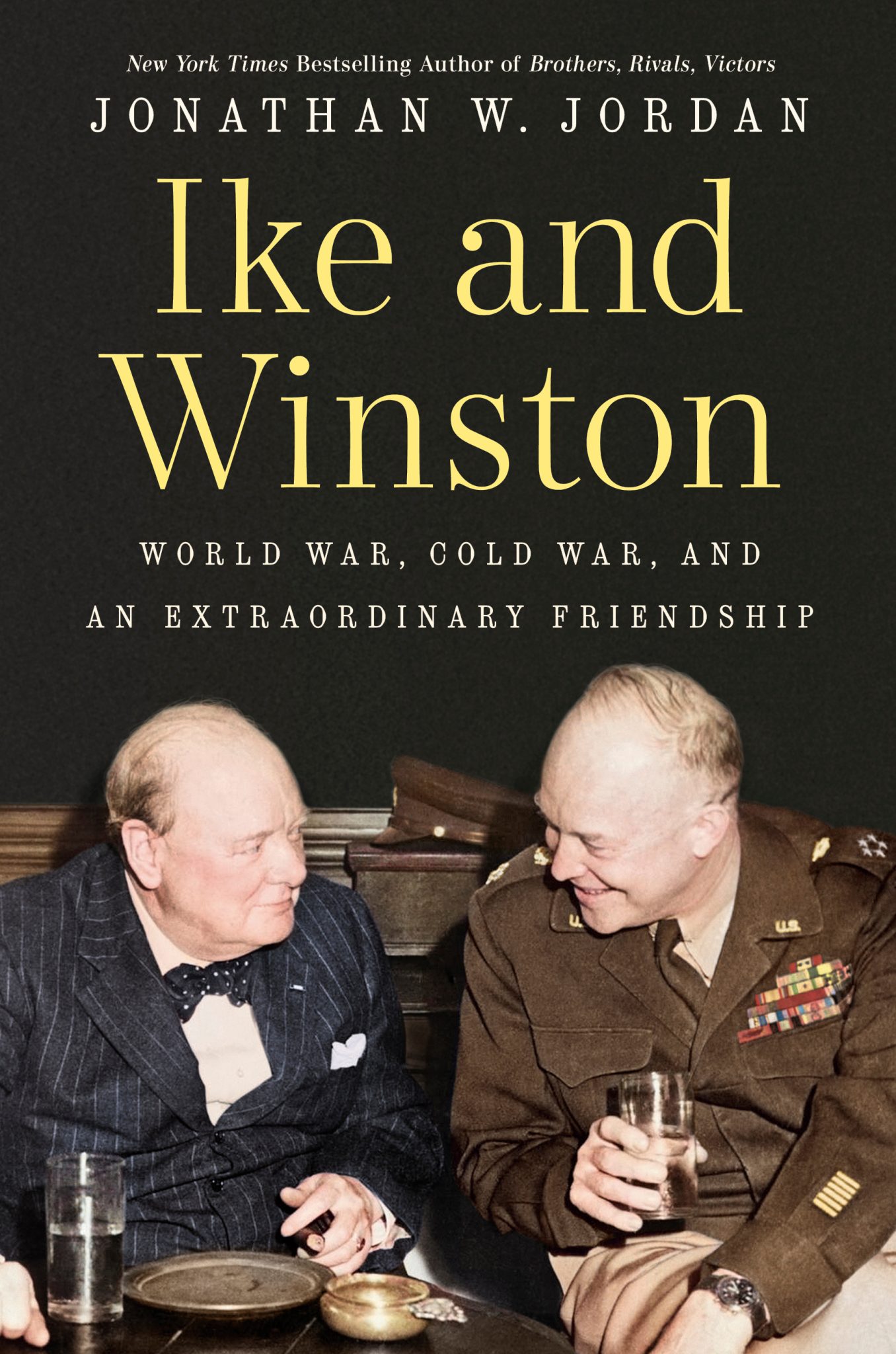
Editor’s Note: This excerpt and image from Ike and Winston by Jonathan W. Jordan are published with permission from Dutton/Penguin Random House.
_______________
Two superpowers. Two friends. Different visions.
Winston Leonard Spencer Churchill, born in the baroque splendor of Blenheim Palace, won his spurs fighting for Queen Victoria. In those swashbuckling years of Kipling and Rule Britannia, a young Dwight David Eisenhower, son of a poor Kansas pacifist, was learning to play stickball on the wrong side of Abilene’s train tracks.
When Churchill’s books filled shelves and his words rang through Parliament, “Ike” Eisenhower was fistfighting bullies and throwing fastballs. As First Lord of the Admiralty, Churchill laid plans for an invasion of Turkey, while Ike, a mediocre West Point cadet, crammed for exams. Churchill shaped the course of the Great War; Ike missed it.
By the time they shook hands, Churchill was a legend—a Teddy Roosevelt, Leonidas, and Green Hornet rolled into one. Eisenhower was a balding, middle-aged desk officer writing papers for men who mattered. Talented, but with no honest reason to think his story would be remembered, much less retold.
Through three years of war they marched together, each man stepping to a different cadence. Eisenhower found his rhythm quickly. He climbed onto the stage after the disasters of 1940 and 1941. He never had to beg an ally for weapons or break news of defeat to his countrymen.
From North Africa to Sicily, to Italy, to France, to the heart of the Third Reich, his armies conquered and his legend grew. “Divine Destiny,” his friend George Patton called him in moments of envy. Divine or not, destiny seemed to back him.
For Churchill, the road to Berlin was pitted with potholes and broken axles. The fall of France, the evacuation of Dunkirk, the Blitz. Singapore, Tobruk, Dieppe, buzz bombs, a bridge too far—Churchill fought off everything three dictators could throw at him. Head down, shoulders back, he bulled his way forward, wincing but never flinching. Clinging to an abiding faith that if the English-speaking people stood together, the world would turn out all right.
As the Nazi empire cracked and crumbled, Churchill and Eisenhower argued, sweated, and gave the struggle everything they had. And in the glint of daylight lying between battles and planning conferences, a friendship took root.
Seven years after Hitler’s death, Churchill climbed the mountain again. In the dawn of thermonuclear terror, he found himself leading Britain down another rocky path. The Empire’s great dominions had broken away, tumbling into the chaos of self-rule. Britannia, still powerful, still proud, scrambled to find its footing in a world of missiles, ideologies, and a cold war poised to become hot. Through his Indian summer premiership, Churchill would shepherd his beloved nation as it slid down the mountain’s reverse slope, digging his heels into the scree to arrest its slide.
Across the ocean, Eisenhower’s path, like America’s, led upward. The grinning face over the slogan “I Like Ike” rode a tide driven by the almighty dollar, amber waves of grain, the hydrogen bomb, and an abiding faith in American exceptionalism. Emerging from isolation, the United States took its place as the free world’s paladin.
The American advance collided with an English retreat, leaving two old friends to navigate an uneasy power exchange. Eisenhower, the cold-blooded realist, contemplated nuclear holocaust while Churchill struggled to pull his friend from the brink. Churchill, a romantic at heart, gripped fraying imperial ties as Eisenhower urged him to embrace a postcolonial world. And after Churchill retired, the genial general would take a sledgehammer to what remained of the British Empire—leaving his old comrade to help pick up the shards of a once special relationship.
The glue binding one of history’s most pivotal friendships was an extraordinary personal rapport, leavened with shared values and shared hardships. Ike relished Churchill’s company because he saw a great man—a diamond with visible flaws, to be sure, but a diamond so large, so lustrous, that even with blemishes it outshone everything in the box. Churchill could have had his pick of friendships, but he wanted Ike’s. In the beginning, he courted Ike for what Ike offered Britain. The Kansan held the trust of men like Franklin Roosevelt and George C. Marshall. This influence gave Ike the power to destroy or create—and Ike had the gambler’s nerve to use that power. London needed a friend like that.
But over time, the relationship became more than transactional. By war’s end, Churchill valued Ike’s friendship simply because he liked Ike. He liked him for who he was, not just for what he could do for Britain.
Through thirteen years of power and command, war clouds would gather and fade, tyrants would rise and fall, and the ancien régime would give way to a new and dangerous order. Through arguments over Berlin and bombers, summits and Stalin, détente and de Gaulle, they struggled to keep their friendship alive while serving countries with starkly different visions of what the world should be.
Could any friendship survive these blows? Would the chain break when duty pulled them in different directions? Could Eisenhower, the junior man, learn to lead without leaving his mentor and friend behind?
These were questions two men who knew each other as “Ike” and “Winston” would spend their years in power answering.
Adapted from Ike and Winston, by Jonathan W. Jordan (Dutton/Penguin Random House). Copyright 2026 by Jonathan W. Jordan.
_____________________________
As the Voice of the Veteran Community, The Havok Journal seeks to publish a variety of perspectives on a number of sensitive subjects. Unless specifically noted otherwise, nothing we publish is an official point of view of The Havok Journal or any part of the U.S. government.
Buy Me A Coffee
The Havok Journal seeks to serve as a voice of the Veteran and First Responder communities through a focus on current affairs and articles of interest to the public in general, and the veteran community in particular. We strive to offer timely, current, and informative content, with the occasional piece focused on entertainment. We are continually expanding and striving to improve the readers’ experience.
© 2026 The Havok Journal
The Havok Journal welcomes re-posting of our original content as long as it is done in compliance with our Terms of Use.


