Introduction
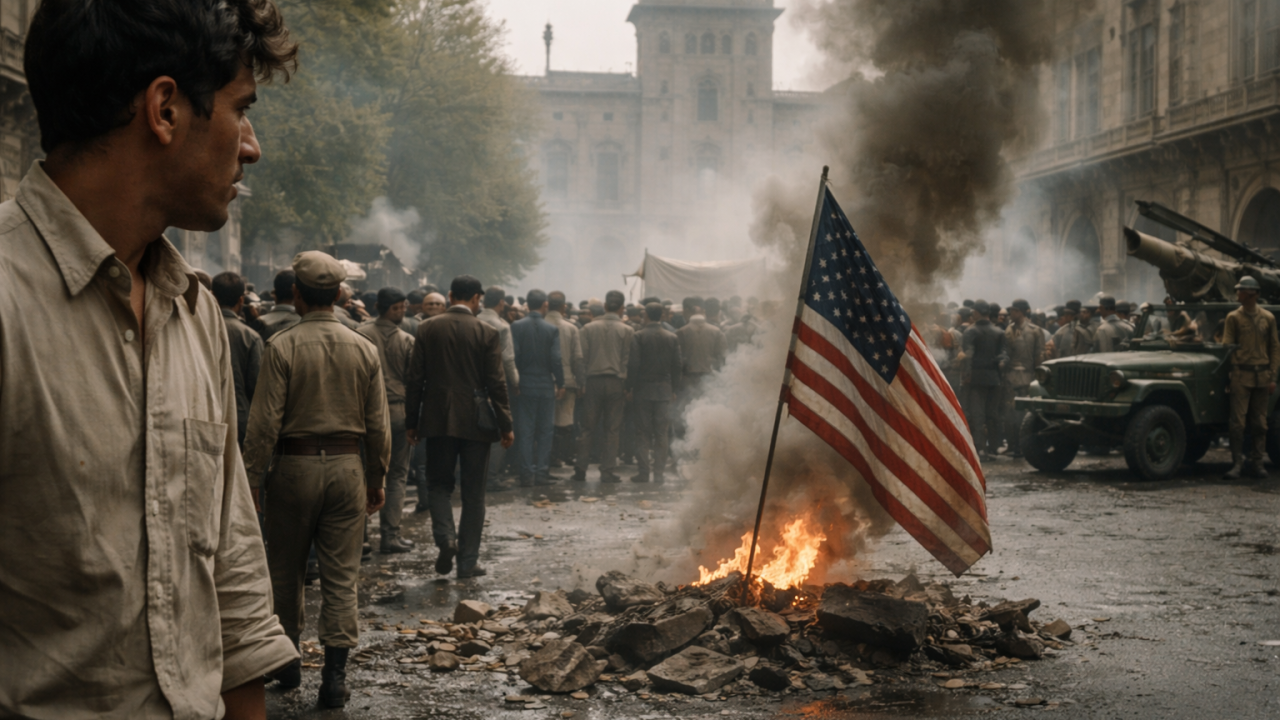
Considering the recent unpleasantness in Iran, it seems to be the proper time to ask, “How did we get to where we are today with Iran?” It is one of those times when we can learn from history or ignore it and repeat the same mistakes. But what is that history? My guess is that few Americans know what went on beyond the last decade’s events.
Every serious discussion of Iran must begin in 1953, and with oil.
Not because oil is a convenient villain. Not because covert action makes for dramatic storytelling. But because the overthrow of legally elected Prime Minister Mohammad Mossadegh permanently altered how many Iranians interpret American power. In Washington, the operation that culminated in Mossadegh’s removal was framed as a Cold War maneuver. In Tehran, it became proof that sovereignty was conditional.
The revolution of 1979 did not emerge from nowhere. Nor did the seizure of the U.S. Embassy. Those events were rooted in layered political memory shaped by foreign interference, authoritarian drift, ideological mobilization, and the kind of grievance that survives regime changes.
Today, as U.S.–Iran tensions continue to cycle between pressure, deterrence, and confrontation, the question is not simply how to counter a repressive regime. The question is whether American policy can avoid repeating the strategic miscalculations that helped produce the Iranian Revolution and the Hostage Crisis of 1979 in the first place.
To answer that, we have to go back to Truman, Eisenhower, and the early Cold War.
The Mossadegh Crisis: Nationalism, Oil, and Cold War Anxiety
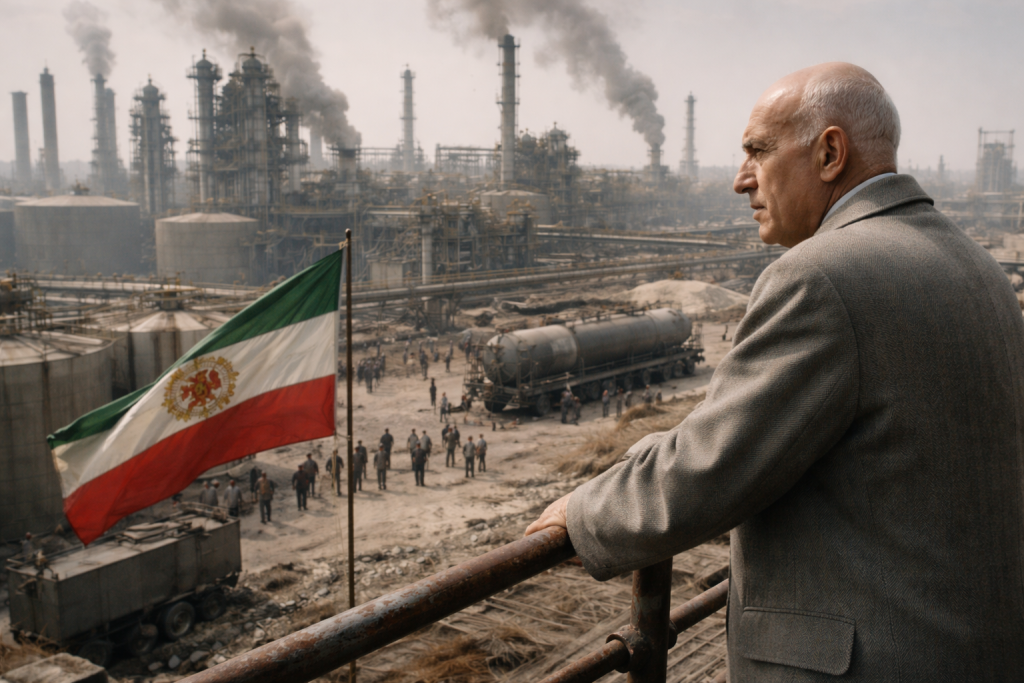
Mohammad Mossadegh was not a revolutionary cleric. He was a secular nationalist and constitutionalist who believed Iran’s oil wealth should belong to Iran. In March 1951, Iran’s parliament moved to nationalize the Anglo-Iranian Oil Company (AIOC), the British-dominated enterprise that controlled Iran’s oil production and revenue flow.
The move was wildly popular domestically. It was also explosive internationally. Britain responded with economic pressure and legal warfare, and the standoff became known as the Abadan Crisis.
Here is where a modern reader needs to resist the temptation to simplify. Oil mattered, obviously. But oil was also a gateway into something bigger: control, influence, and the strategic geometry of the Cold War.
Iran bordered the Soviet Union. The memory of Allied occupation during World War II still lingered. The communist Tudeh Party was active, organized, and viewed in the West as a potential lever for Soviet influence. By itself, that did not make Mossadegh a communist. It did not make him a Soviet proxy. But Washington’s fear was less about Mossadegh’s ideology and more about what might happen if the political center collapsed under pressure: economic crisis, instability, and opportunistic expansion by organized extremists.
Under President Harry Truman, the U.S. position was cautious and heavily oriented toward mediation and managing risk rather than toppling governments. That is not a romantic defense of Truman; it is visible in the documentary framing of the period. The State Department’s official historical record describes an early phase titled “United States Efforts to Understand Mosadeq,” followed later by “Planning and Implementation of Operation TPAJAX.”
In other words: the U.S. did not begin this crisis with a pre-written coup script. Policy hardened over time, under pressure from events, allied lobbying, and Cold War assumptions.
Then Eisenhower took office in January 1953, and the strategic temperature changed.
The Korean War was nearing its end. Stalin died in March 1953. The new administration’s worldview prioritized containment with fewer of Truman’s inhibitions about covert action. Iran, sitting on oil and bordering the USSR, looked like a place where a “loss” would be irreversible.
If you want to write this credibly, you have to say the quiet part out loud: U.S. policymakers did not need Mossadegh to be a communist to treat him as a risk.
Operation TPAJAX and the Decision to Intervene
The operation that removed Mossadegh is widely known as “Operation Ajax,” but in U.S. documentary history it appears as Operation TPAJAX. The official State Department record explicitly includes a section titled “Planning and Implementation of Operation TPAJAX, March–August 1953.”
The CIA, working with British intelligence, developed a plan that relied on propaganda, political manipulation, and coordination with elements of the Iranian military. The coup succeeded on August 19, 1953.
A key primary-source-adjacent document for understanding the mechanics is the CIA after-action history written by Donald Wilber in 1954, later published by the National Security Archive. It describes how the operation blended influence, covert funding, and psychological tactics to destabilize Mossadegh and strengthen the Shah’s position.
This matters because people still argue about “how much” the U.S. interfered. The most precise answer is not a slogan. It is a description:
The U.S. did not govern Iran day-to-day, but it did participate in determining the top-level political outcome in 1953. That fact became a long-term accelerant for anti-American narratives.
The Aftermath: Oil Returns, and So Does the Shah
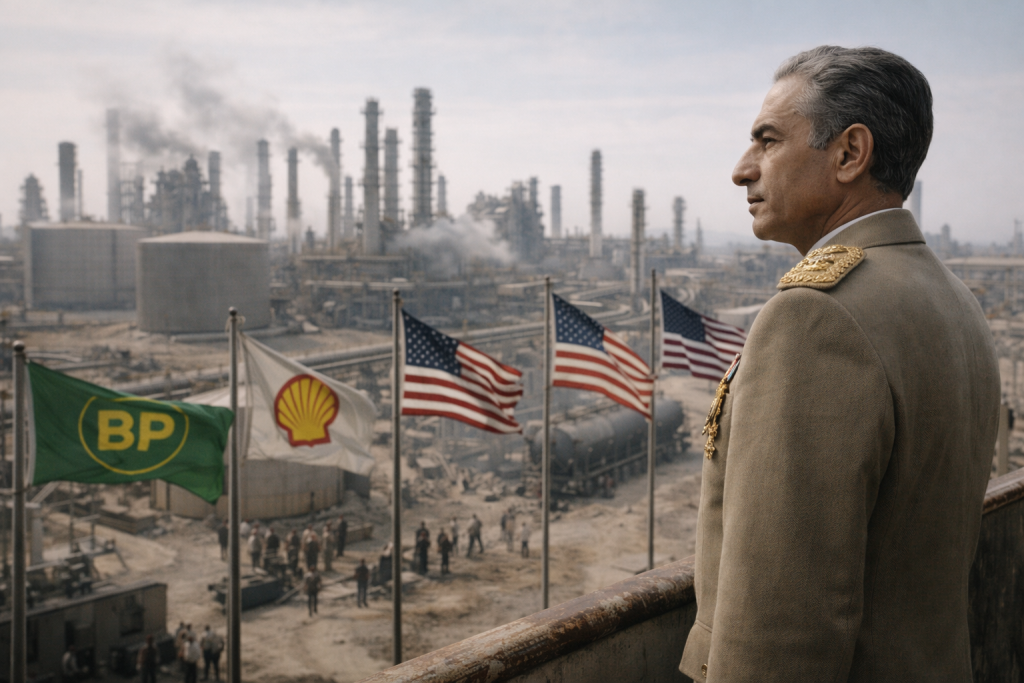
After the coup, oil production and Western access returned under a new consortium agreement in 1954. The share structure is documented in specialized historical sources: 40 percent for AIOC (later BP), 14 percent for Royal Dutch/Shell, 6 percent for the French company, and multiple U.S. firms holding significant shares.
That does not mean “the coup was only about oil.” It does mean oil and power were inseparable in the incentives, especially given Britain’s stake and America’s growing role in global energy security.
This is also where this article benefits from one subtle framing decision: describe the 1954 oil settlement as both a resolution and a political symbol. For Iranians who viewed nationalization as sovereignty, the post-coup consortium looked like sovereignty rolled back under foreign pressure.
The Shah: Modernization Without Pluralism
After 1953, Mohammad Reza Shah increasingly centralized authority. To avoid caricature, you should acknowledge both sides.
His White Revolution reforms, ratified in 1963, redistributed land, created literacy and health corps, and advanced legal reforms that enfranchised women. Britannica notes land redistribution to some 2.5 million families and the creation of rural literacy and health corps, alongside women’s emancipation and enfranchisement.
But modernization without pluralism is unstable. Political parties were weakened. Opposition voices were marginalized. Security structures grew in prominence.
SAVAK, the Shah’s intelligence and security organization, was founded in 1957 with CIA assistance.
It’s not necessary to sensationalize SAVAK to make a point. It is enough to establish the core dynamic: a modernizing monarchy increasingly dependent on coercive capacity, backed by a superpower alliance.
The United States did not administer Iranian ministries. It did not dictate domestic policy line by line. But it provided security and diplomatic backing that many Iranians interpreted as enabling the Shah’s authoritarian trajectory. That perception mattered more than nuance. This is how resentment becomes intergenerational: policy becomes memory, memory becomes identity, identity becomes politics.
Radicalization and the Long Memory of 1953
By the 1970s, dissatisfaction with the Shah had broadened beyond one faction. Opposition included religious networks, secular nationalists, leftists, students, and urban workers.
Universities were politically active spaces, but it is inaccurate to portray “university staff” as the engine of radicalization. The evidence points more toward activist networks and ideological organizations that used campuses as recruiting and organizing terrain, not faculty-led indoctrination.
Ayatollah Ruhollah Khomeini, exiled since 1964, became a rallying point. His message framed the Shah as both tyrant and foreign-backed ruler. The 1953 coup became rhetorical ammunition: proof that Iranian sovereignty could be overridden when foreign interests were threatened.
When the Shah left Iran on January 16, 1979, the revolutionary tide moved from protest to regime collapse. Khomeini returned on February 1, 1979, and the monarchy fell as the armed forces declared neutrality on February 11.
Then the revolution faced its next problem: consolidation.
The Embassy Seizure: Not Just Anti-American Rage, but Internal Power Politics
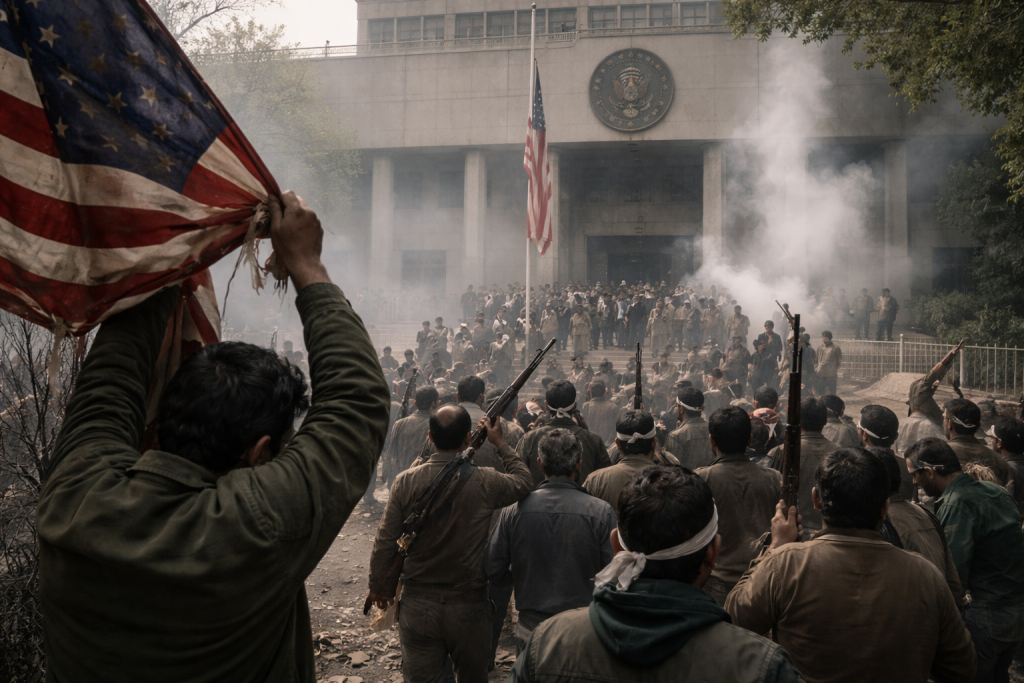
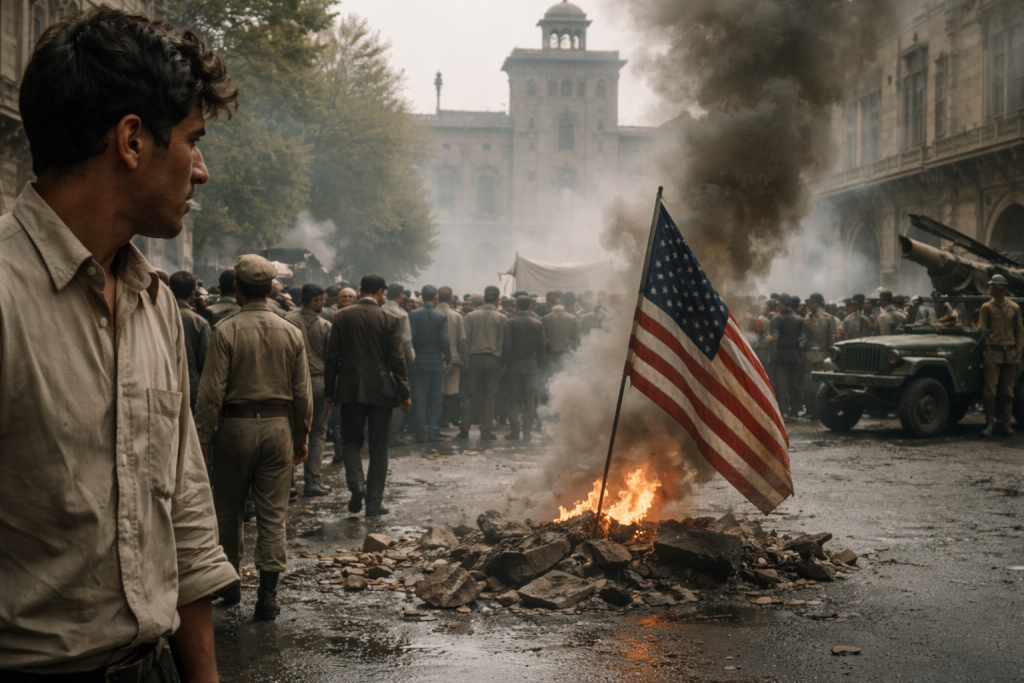
The U.S. Embassy takeover began on November 4, 1979.
The immediate trigger was the Shah’s admission to the United States for medical treatment on October 22, 1979, which many revolutionaries interpreted through the 1953 lens: a prelude to another foreign-backed restoration.
The seizure was carried out by a student group widely known as the “Muslim Student Followers of the Imam’s Line,” according to background summaries of the event and its participants.
The hostage crisis lasted 444 days, ending with the Algiers Accords signed on January 19, 1981, and the hostages released on January 20, 1981.
The embassy seizure functioned as an internal political weapon. It undermined moderates and accelerated clerical consolidation. Prime Minister Mehdi Bazargan resigned on November 6, 1979, two days after the takeover, and reporting at the time, as well as later analysis, link the resignation to the crisis and the weakening of the interim civilian government.
So the hostage crisis was not only a foreign-policy event. It was an internal purge mechanism. That is why it had endurance. It served multiple revolutionary purposes at once.
The Islamic Republic: Anti-Imperialism, Then Authoritarian Drift
The Islamic Republic was founded on a promise: independence from foreign domination and moral governance.
But in practice, power centralized in clerical and security institutions. Universities were shut down as part of the Cultural Revolution. The university system was closed on June 12, 1980, and reopened in stages over the next several years, with medical schools reopening earlier than others.
This illustrates an important point. Regimes that seize power through ideological revolution often attempt to monopolize the intellectual pipeline. Iran’s Cultural Revolution was explicitly framed as “Islamization” and, in practice, involved purges of faculty, students, and staff.
Over time, elections continued, but candidate eligibility became more tightly controlled. Reform movements periodically surged and were periodically suppressed. The Revolutionary Guard evolved into both a military force and an economic powerhouse. The regime that mobilized against foreign interference became deeply intolerant of internal dissent. It was SAVAK under a new name.
Yet external pressure never disappeared. Sanctions and regional proxy conflict reinforced a siege mentality that hardliners could use to justify internal control. That is the vicious loop: outside pressure strengthens inside repression, which provokes resistance, which triggers more pressure.
The Nuclear Era and Strategic Escalation
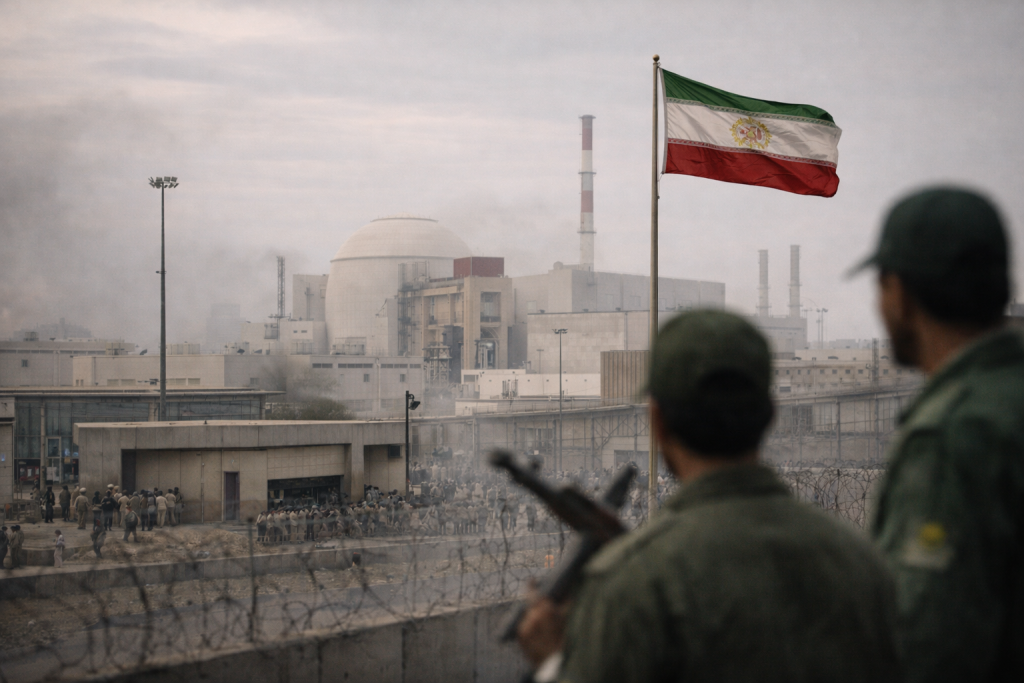
Iran’s nuclear program has been a focal point of U.S.–Iran tension for decades.
The Joint Comprehensive Plan of Action (JCPOA) in 2015 temporarily eased tensions through negotiated limits and inspections. The United States withdrew from the JCPOA on May 8, 2018, and the deal’s decline accelerated in subsequent years.
Whatever one thinks of the deal politically, your article can use it as evidence of a broader pattern: U.S.–Iran relations oscillate between narrow diplomatic bargains and confrontation, while distrust remains the constant.
The Truman–Eisenhower Lesson: Policy Isn’t Just What You Do; It’s What People Remember
The documentary structure of the U.S. historical record shows an evolution: early efforts to understand and manage Mossadegh, followed by planning and implementation of Operation TPAJAX in 1953.
Truman-era policy leaned toward mediation and political management of a difficult nationalist ally dispute.
Eisenhower-era policy, under heightened Cold War assumptions, embraced covert action as a tool of containment.
From a 1953 vantage point, intervention could be justified as preventing instability on a Soviet border.
From a 1979 vantage point, it looked like the origin story of foreign meddling.
Both interpretations can coexist because they belong to different timelines: tactical logic versus political memory.
Operation TPAJAX may have stabilized a Cold War flank. It also contributed to a revolutionary backlash that transformed the region’s political architecture.
Avoiding Another 1979: How to Compete Without Writing the Next Grievance Myth
If the United States wants to counter Iranian military ambitions or regional destabilization, it has tools: deterrence, sanctions, diplomacy, and regional partnerships.
But overt attempts to install preferred leadership or engineer regime collapse risk repeating the cycle that turned 1953 into political myth and 1979 into geopolitical rupture.
Historical memory in Iran is politically potent. It is taught, repeated, ritualized, and weaponized. If American policy reinforces the narrative that Iran’s political destiny is being dictated from the outside, it will predictably empower the factions most committed to resistance politics.
Avoiding another 1979 requires clarity:
- Oppose destabilizing behavior without attempting to dictate Iran’s internal political order.
- Support civil society cautiously and discreetly, without creating the appearance of foreign orchestration.
- Build multilateral frameworks that dilute unilateral optics.
- Maintain deterrence without occupation.
The objective is not to be liked. The objective is to avoid becoming the indispensable villain in someone else’s revolution.
Conclusion: History as Strategic Constraint
Iran’s modern political identity has been shaped by two forces: internal repression and external interference.
When those forces converge, radicalization follows.
The United States cannot ignore Iran. The region’s security dynamics make disengagement unrealistic. But history suggests that engineering Iran’s political future from the outside carries risks measured in generations.
1953 solved one problem and planted another.
1979 was not an isolated eruption. It was the culmination of grievances layered over decades.
If policymakers today seek stability, they must understand that in Iran, history is not background context. It is active political currency.
Misreading it once reshaped the Middle East.
Misreading it again could do so again.
References
- U.S. Department of State, Office of the Historian. Foreign Relations of the United States (FRUS), 1952–1954, Iran, 1951–1954 (Second Edition): table of contents sections “United States Efforts to Understand Mosadeq” and “Planning and Implementation of Operation TPAJAX.”
- National Security Archive. “The Secret CIA History of the Iran Coup, 1953” (Donald Wilber after-action history; published by NSA).
- Associated Press background on 1953 coup and Operation Ajax framing.
- Nationalization timeline (March 1951) and Mossadegh role.
- Encyclopaedia Iranica on the 1954 oil consortium structure and agreement signing.
- U.S. State Department Bulletin excerpt on consortium participation shares (five U.S. companies at 8% each).
- Encyclopaedia Britannica on the White Revolution and its reforms (1963 ratification; literacy/health corps; women’s enfranchisement; land redistribution).
- PBS glossary on SAVAK founded in 1957 with CIA assistance.
- Britannica and History.com on 1979 revolution milestones (Shah leaves Jan 16; Khomeini returns Feb 1; collapse Feb 11).
- Shah admitted to U.S. for treatment on Oct 22, 1979 (background summaries).
- PBS Frontline Tehran Bureau on Cultural Revolution closures (universities shut June 12, 1980; staged reopening).
- Bazargan resignation linked to embassy seizure (contemporary reporting and later analysis).
- U.S. National Archives chronology: Algiers Accords signed Jan 19, 1981; hostages released Jan 20, 1981.
- U.S. State Department museum item summary on Declarations of Algiers; CIA FOIA document noting adherence/signing Jan 19–20, 1981.
- JCPOA withdrawal date May 8, 2018 and aftermath.
_____________________________
Dave Chamberlin served 38 years in the USAF and Air National Guard as an aircraft crew chief, where he retired as a CMSgt. He has held a wide variety of technical, instructor, consultant, and leadership positions in his more than 40 years of civilian and military aviation experience. Dave holds an FAA Airframe and Powerplant license from the FAA, as well as a Master’s degree in Aeronautical Science. He currently runs his own consulting and training company and has written for numerous trade publications.
His true passion is exploring and writing about issues facing the military, and in particular, aircraft maintenance personnel.
As the Voice of the Veteran Community, The Havok Journal seeks to publish a variety of perspectives on a number of sensitive subjects. Unless specifically noted otherwise, nothing we publish is an official point of view of The Havok Journal or any part of the U.S. government.
Buy Me A Coffee
The Havok Journal seeks to serve as a voice of the Veteran and First Responder communities through a focus on current affairs and articles of interest to the public in general, and the veteran community in particular. We strive to offer timely, current, and informative content, with the occasional piece focused on entertainment. We are continually expanding and striving to improve the readers’ experience.
© 2026 The Havok Journal
The Havok Journal welcomes re-posting of our original content as long as it is done in compliance with our Terms of Use.


