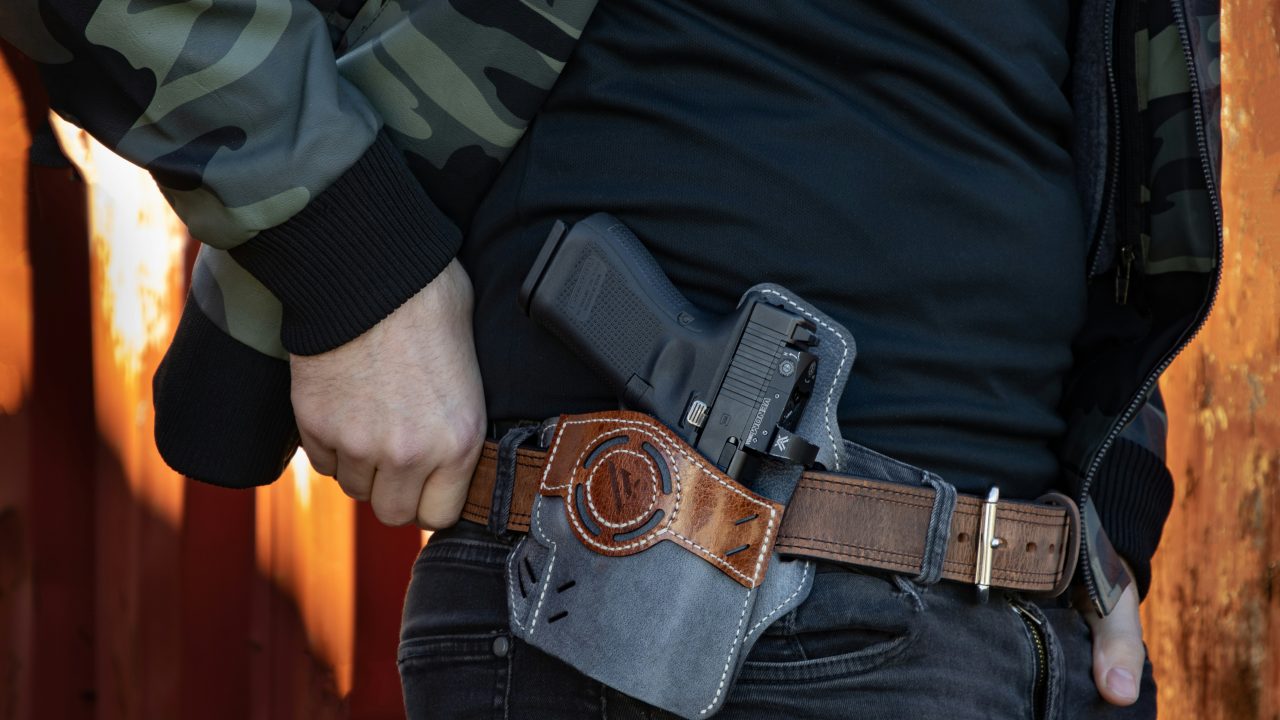
For those of us who spent years in uniform, a sidearm was a core part of our kit. Whether you were rocking a Beretta M9 or the SIG M18, your draw stroke was built on a foundation of “Open Carry” logic. You had a drop-leg rig or a stiff combat belt, clear of obstructions, designed for a high-speed draw in a high-threat environment.
But when you hang up the uniform and transition to the “Grey Man” world of civilian life, even that muscle memory can become a liability. In the military, “printing” isn’t a concern because everyone knows you’re armed. In the civilian world, the moment your weapon is spotted, you’ve lost your greatest tactical advantage: anonymity.
Bridging this gap requires more than just buying a smaller gun; it requires a complete overhaul of how we think about proper holster positioning methods and ergonomics.
The Architecture of Concealment
The most common mistake veterans first make is trying to force “duty-belt” positioning into a concealed carry (CCW) setup.
On a flat range or in a combat zone, 3 o’clock carry is king. It’s natural, fast, and stays out of the way of your plate carrier.
However, put that same 3 o’clock position under a tailored flannel or a standard t-shirt, and the grip of your pistol becomes a beacon, protruding every time you lean forward.
To stay effective, you have to understand the architecture of your own body. For some, moving to the 4 or 5 o’clock position (behind the hip) allows the natural curve of the back to “tuck” the grip into the body.
For others, particularly those with a more athletic or “V-taper” build, Appendix Carry (AIWB) is the only way to achieve true concealment. Mastering a detailed guide on concealed carry techniques is the only way to avoid the “Box of Unused Holsters” that many veterans accumulate in their first year of retirement.
Beyond the Waistband: Contextual Carry
Military life is usually pretty consistent in its gear requirements. Civilian life is not. One day you’re in a suit for a job interview. The next, you’re in gym shorts at the park with your kids.
This variability is why you must become proficient in different ways to carry a handgun.
Traditional Inside-the-Waistband (IWB) carry is the gold standard for most, but it’s not a universal solution. If you spend eight hours a day behind a desk or a steering wheel, a traditional hip holster might as well be in a safe for all the good it does you.
In these scenarios, cross-draw or even specialized shoulder rigs (yes, they still have a tactical purpose) become viable. The goal is accessibility under stress, not just “having the gun on you.” If you can’t draw your weapon while seat-belted in a vehicle, your carry method has failed the mission-readiness test.
The “Clear and Draw” Reality Check
In the service, your draw was one motion: Grip and Pull.
In CCW, your draw is at least two distinct motions: Clear and Draw.
In other words, you usually have to defeat a cover garment in CCW (like a t-shirt, a jacket, or a tucked-in button-down) before you can even establish a master grip.
This is where the transition gets dangerous. Veterans may underestimate the amount of practice required to clear a garment consistently. Under the adrenaline dump of a real-world encounter, your fine motor skills may well evaporate.
If your holster is shifting because you’re using a flimsy “civilian” leather belt instead of a dedicated gun belt, or if your positioning is inconsistent, you can fumble the draw.
Studying the various legal and practical nuances of each carry position is a prerequisite for any veteran taking their personal defense as seriously as they took their professional duty.
Final Mission Prep: Training for the Grey
The transition from “Warrior” to “Armed Citizen” isn’t a downgrade, at the end of the day. Instead, it’s better to think of it as a specialization. You are moving from a world of Rules of Engagement (ROE) to a world of state statutes and civil liability. Your gear must reflect that shift.
Don’t settle for the first kydex shell you find at the local shop. Experiment with “claws” and “wedges” that push the grip of the gun into your body.
Test your carry position by filming yourself doing everyday tasks: reaching for a top-shelf item at the grocery store, sitting down in a restaurant booth, and getting in and out of your truck. If you’re constantly “tugging” at your shirt to hide your weapon, you’re signaling your status to everyone around you.
Concealed carry is a lifestyle of quiet readiness. By mastering the technical aspects of positioning and concealment, you ensure that if the day ever comes when you need to use your skills, you’re doing it from a position of tactical superiority… and not a fumbled draw from a poorly positioned holster.
Buy Me A Coffee
The Havok Journal seeks to serve as a voice of the Veteran and First Responder communities through a focus on current affairs and articles of interest to the public in general, and the veteran community in particular. We strive to offer timely, current, and informative content, with the occasional piece focused on entertainment. We are continually expanding and striving to improve the readers’ experience.
© 2026 The Havok Journal
The Havok Journal welcomes re-posting of our original content as long as it is done in compliance with our Terms of Use.


