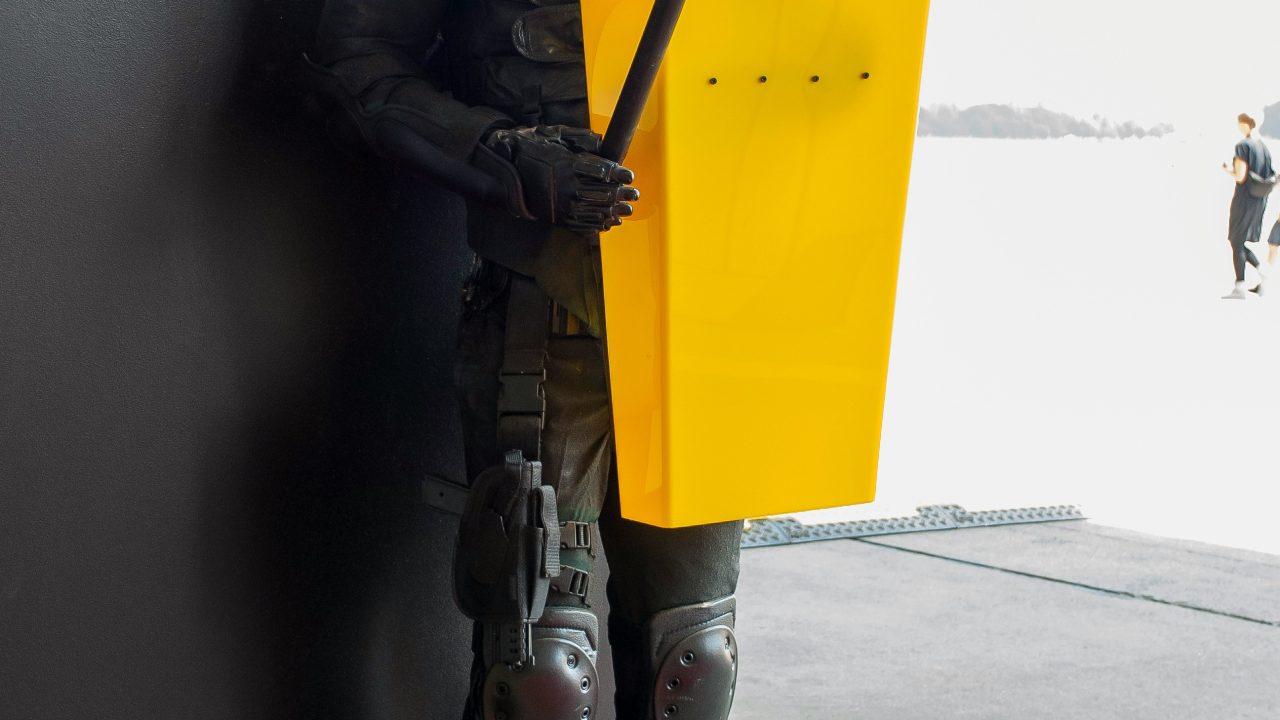
Photo by Etienne Girardet on Unsplash
When considering personal and tactical protection, body armor and helmets are typically the first other types that come to mind. However, another piece of equipment is doing as much heavy lifting in high-risk situations: the ballistic shield.
Shields are used by law enforcement, military units, and increasingly by civilian security personnel for protection. A shield doesn’t stop the user from moving, communicating, and responding as the situation escalates, unlike a fixed barrier.
In this guide, you will learn about what ballistic shields are, the numbers that determine their strength, the types of ballistic shields, and the things you should look for when purchasing a ballistic shield.
What is a Ballistic Shield?
In other words, it is a rigid, mobile barrier designed to protect against specific ballistic threats.
The shield is held in hand and moved around as opposed to being strapped to the body, like the body armor. Most are equipped with built-in handles. Some have a small window to view through as well, so the user can remain covered but can see what is in front of them.
Shields come in handy when someone has:
- Facing a threat instead of backing off
- Clearing a room
- Holding their position under fire
Hence, shields have made their way into the standard arsenal of police, tactical teams, SWAT teams, and military close-quarters teams.
Why Shields Matter When Seconds Count
In a rapid and dangerous incident, the person at the front is at the highest risk. A shield alters that math.
A team doesn’t necessarily need to use a wall or vehicle for cover, because this might not be possible every time; instead, they can use their own mobile cover and continue to move.
The shield ratings reflect the extent to which equipment is working. To pass certification, a Level III-rated shield must resist five different rifle bullets fired from approximately 2,700 to 2,800 feet per second, and each bullet must fall over two inches from the edge of the shield.
Not a marketing statement. It’s a lab test done with real ammunition.
If a shield can pass this test, it reflects that in a controlled environment, it can do what it’s supposed to do in the field: buy the person behind the shield some extra time and distance.
Know Your Shield: 4 Types of Ballistic Shields
A different shield is required for each situation. The major categories are as follows:
1. Handheld shields
The handheld shields are the most common among the four. They are lighter, designed for one-man operation and speed.
Suitable for: Room clearing, traffic stops, single-operator protection.
2. Bunker shields
Bunker shields sacrifice mobility, allowing an entire team to move behind a single shield.
Suitable for: Team advances, barricades, or hostage situations.
3. Transparent shields
Transparent shields get a polycarbonate or ballistic-rated viewport, so the user won’t have to work without sight.
Suitable for: When no extra exposure is required, and a direct line of sight is needed.
4. Curved shields
Curved Shields have a curved shape that provides better side coverage to the body and can be more comfortable to carry and hold during use.
Suitable for: Tactical operations where better side coverage is required.
Decoding NIJ Rating: What Numbers Actually Represent?
The vast majority of ballistic shields sold in the U.S. are tested in accordance with the NIJ Standard 0108.01, which categorizes shields into threat levels I, IIA, II, IIIA, III, and IV. The majority of shields are marketed at Level IIIA or III.
Let’s look at the numbers in a non-technical sense:
Level I / IIA / II – Blocks lower-velocity handgun rounds; largely legacy ratings, rarely used in shields sold today.
Level IIIA – Blocks most handgun rounds, including fast-firing pistols such as .44 Magnum.
Level III – Blocks a rifle shot, even common 7.62x51mm NATO ammunition.
Level IV – Can block armor-piercing rifle rounds, the highest level of protection.
The simple answer: The higher the level, the more it will block, but the more it will weigh.
Lighter level IIIA shields are more popular among patrol officers. Rather, tactical teams often choose to wear levels III or IV.
There is another, newer standard that you should know. ASTM E3347 is the first performance standard designed specifically for law-enforcement shields. It evaluates the resistance at the edges, viewports, and fasteners, rather than the main ballistic panel.
A shield tested against NIJ and ASTM both undergo more severe testing.
5-Step Checklist Before You Buy Ballistic Shields
Before purchasing ballistic shields, you should be able to check the following items:
- Obtain a certified copy of the certificate. Request the exact NIJ level, not just the sticker on the product.
- Correlate the real threat with the rating. Handgun risks point to Level IIIA. Rifle points to Level III or IV.
- Find a balance between protection and movement. The more coverage, the more the weight, and the faster it will fatigue for long operations.
- Check the viewport. A larger window will increase visibility while slightly decreasing the total surface area that is shielded.
- If available, verify ASTM E3347 testing. It is able to detect weak areas around the edges and fasteners where panel-only testing may fail.
For teams comparing the right options, RTS Tactical’s Ballistic Shields provide an easy-to-understand way to view ratings, size, and collections all in one place.
Final Thoughts
Ballistic shields are designed to resolve one issue: how to move, react, and safeguard others when it’s not possible to stand still.
The best shield is not necessarily the one that has the most positive ratings. It’s the one that has been proven to perform in real scenarios with the threat a team is likely to encounter.
When purchasing, verify the certification, its subject, and test against your operating environment. In the crisis, the difference between informed and guessed choices can matter a lot.
Buy Me A Coffee
The Havok Journal seeks to serve as a voice of the Veteran and First Responder communities through a focus on current affairs and articles of interest to the public in general, and the veteran community in particular. We strive to offer timely, current, and informative content, with the occasional piece focused on entertainment. We are continually expanding and striving to improve the readers’ experience.
© 2026 The Havok Journal
The Havok Journal welcomes re-posting of our original content as long as it is done in compliance with our Terms of Use.


