By A Veteran
The wind had been rising since dawn, funneling between the government towers and driving dust across the square in pale, twisting sheets. Vendors anchored their awnings with bricks, mothers held tight to the hands of small children, and office workers leaned into the gusts as they hurried toward the Ministry complex. Above them, loudspeakers fixed to the corners of the surrounding buildings repeated the morning reminders in a patient female voice: citizens were expected to observe the dress code, report suspicious conduct, attend the noon prayer observance, and carry identification at all times.
Miriam had heard the announcements so often that she no longer listened to the words. They had become part of the city’s atmosphere, as ordinary as the grinding brakes of buses or the call of merchants from the market stalls. She crossed the square with one hand holding her handbag against her side and the other keeping her head covering in place.
She was halfway to the government records office when the wind caught the cloth from behind. The knot loosened beneath her chin, and several strands of dark hair escaped across her cheek. She stopped immediately, turned away from the gust, and pushed them back beneath the scarf. The exposure lasted no more than a few seconds.
The patrol vehicle had already seen her.
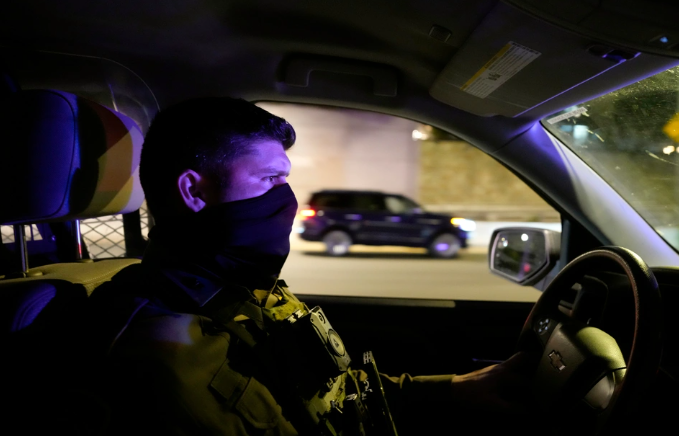
It rolled to the curb without sounding its horn. Four officers stepped out in black uniforms, their boots polished and their collars fastened despite the heat. The insignia of the Office of Public Virtue was stitched above each man’s heart: an open book crossed by a sword.
“Citizen,” the senior officer called.
Miriam continued walking. She knew that pretending not to hear would not save her, but for several steps she allowed herself the fantasy that the voice had been intended for someone else.
“Citizen in the gray coat.”
She stopped and turned.
The senior officer approached with an electronic tablet in his left hand. He was older than the others, perhaps fifty, with a neatly trimmed beard and the calm expression of a man performing a familiar duty. His tone was not angry. Anger would have suggested that something unusual had happened.
“Your head covering was not secure,” he said.
“The wind pulled it loose.”
“The law requires you to secure it against foreseeable conditions.”
“I fixed it immediately.”
“That does not erase the violation.”
People nearby began moving away. A fruit seller turned his back and rearranged a stack of oranges that did not need rearranging. Two women guided their children toward the opposite side of the square. A man seated at an outdoor café lowered his eyes to his tea.
Miriam looked at the officer’s tablet. “Are you actually writing me up because the wind moved my scarf?”
“I am documenting a violation of Article Seventeen.”
“It was an accident.”
“The statute does not distinguish between accident and negligence.”
One of the younger officers stepped behind her, close enough that she could smell his body odor. The senior officer asked for her identification, and she reached into her bag with hands that had begun to tremble. She hated that they could see it. She hated that fear had become the expected response to authority.
He entered her information into the tablet, then frowned at the screen. “You were issued a warning two years ago.”
“My sleeve was torn.”
“The record states that your forearm was exposed in public.”
“My sleeve caught on a fence.”
“The record does not mention a fence.”
“Because no one asked.”
The younger officer laughed quietly. The senior officer did not. He handed the identification card to one of his men and told Miriam that she would accompany them for corrective counseling.
“I have an appointment,” she said.
“The Republic’s concerns take priority over private appointments.”
“I work in the records office. My supervisor is expecting me.”
“Your supervisor will be informed.”
The younger officer reached for her arm.
Something in Miriam gave way.
It was not courage, at least not the kind later attributed to her by people who had never met her. Courage suggests a decision made after weighing consequences. Miriam did not weigh anything. She thought of the torn sleeve, the mandatory seminar, the written confession she had been forced to sign, the hours spent listening to officials explain that modesty was freedom and obedience was dignity. She thought of women she knew who had disappeared from their jobs after an accusation, and of neighbors who had learned not to ask what became of them.

She pulled her arm away. “Do not touch me.”
The younger officer stared at her. “What did you say?”
“I said, do not touch me.”
The square grew quiet in the peculiar way crowded places do when everyone is listening but pretending not to. Miriam could feel the attention surrounding her. The officers could feel it too.
The senior officer lowered his tablet. “You are making this more serious than it needs to be.”
“No,” she said. “You made it serious.”
She untied the scarf and let it fall to the pavement.
The fruit seller stopped moving his oranges. A woman near the bus shelter covered her mouth. Somewhere behind Miriam, a child asked a question and was immediately hushed.
The senior officer took one step forward. “Put that back on.”
Miriam removed her coat.
The younger officers moved at once, but the senior man raised his hand to stop them. He understood, perhaps before she did, that the crowd was watching and that every gesture would be remembered.
Miriam unbuttoned her blouse and let it fall to the ground. She removed her skirt and stood in the middle of the square in her underwear, the wind now moving freely through her hair. The humiliation struck her only for a moment. Then anger swallowed it.
“You wanted to inspect me,” she shouted. “Go ahead. Inspect everything.”
No one in the square spoke.
“You arrest women for hair. You beat girls for sleeves. You call it virtue because you are terrified of anything you cannot control.”
The senior officer ordered her to dress herself. Miriam kicked the fallen scarf away.
Two officers seized her by the arms. She struggled as they dragged her toward the vehicle, shouting that the law was corrupt and the government was afraid of women. The younger officer twisted her wrist until she cried out, then forced her head down as he pushed her into the rear compartment.
For one brief second, before the door slammed shut, Miriam saw the crowd.
Every face was turned toward her.
Not one person moved.
The first video appeared online forty-three minutes later. It had been recorded from a third-floor window overlooking the square, and although the image shook whenever the person filming shifted position, Miriam’s words could be heard clearly. The clip spread through encrypted channels before the Ministry could block it. By sunset, copies had reached thousands of private accounts. By midnight, they had crossed the border and appeared on foreign networks.
The government issued a statement describing the incident as “a staged act of obscenity intended to provoke civil disorder.” State television showed only three seconds of the recording, with Miriam’s body obscured and her voice removed. A commentator explained that hostile foreign organizations had recruited mentally unstable women to create propaganda against the Republic.
Miriam was released after four days.
Her mother barely recognized her when two officers left her outside the family apartment shortly before dawn. One eye was swollen shut. Her lower lip was split, and bruises circled both wrists. She moved slowly, holding one arm against her ribs.
Her mother pulled her inside and locked the door. “What did they do to you?”
Miriam glanced toward the wall vent. “Not here.”
Her father stood in the hallway in his nightclothes, pale and trembling. “They said you had confessed.”
“I did not.”
“The news said you admitted foreign agents paid you.”
“They told me to say that.”
Her mother led her to the kitchen and helped her sit. “You cannot speak about this. Do you understand me? Whatever happened, you cannot speak about it.”
Miriam gave a tired laugh that made her wince. “That is why it keeps happening.”
Her father closed the curtains even though the sun had not yet risen. “You have already done enough.”
“Enough for what?”
“To destroy this family.”
The words seemed to surprise him as soon as they left his mouth. He looked away, ashamed, but he did not take them back.
Miriam stared at him. “They arrested me.”
“I know.”
“They beat me.”
“I know.”
“And you think I did this to us?”
“I think they can take our apartment. They can take my pension. They can arrest your brother. They can decide your mother helped you. They can take all of us away. You know what they can do.”
That was the genius of the Republic. It rarely punished only the accused. It taught every citizen that resistance was selfish because the very harsh consequences would be distributed among everyone they loved.
Miriam went to her bedroom and closed the door.
That afternoon, while her parents argued quietly in the kitchen, she placed her phone on a stack of books and sat facing the camera. The bruising around her eye had darkened to purple. She did not cover it.
“My name is Miriam,” she began. “Four days ago, officers of the Office of Public Virtue arrested me because the wind exposed part of my hair.”
She described the square, the patrol vehicle, and the detention center. She named two of the officers who questioned her and gave the location of the basement room where they had kept her under bright lights for thirty-six hours. She explained how they struck the soles of her feet with cables because the bruises would be difficult to photograph. She described the confession they placed in front of her and the threats made against her parents.
“They wanted me to say that I was paid by enemies of the Republic,” she said. “No one paid me. No one ordered me to remove my clothes. I did it because I was tired of being treated as government property.”
She paused and looked directly into the lens.
“They told me that obedience is freedom. It is not. Obedience forced by fear is slavery.”
She uploaded the recording to six accounts and sent copies to people outside the country. The first account disappeared within minutes. The second lasted nearly an hour. By the time the Ministry blocked the remaining links, the video was beyond their control.
Her parents discovered what she had done when the government channel interrupted an afternoon program to denounce her. Her mother entered the bedroom crying, and her father stood behind her with both hands pressed to his face.
“You have to leave,” he said.
“The borders are watched.”
“I know someone who can take you north.”
“I will not hide.”
“This is not bravery,” her mother said. “This is suicide.”
Miriam closed the phone and placed it on the desk. “Maybe. But silence is how they make all of us help them.”
Her father stepped toward her. “You think people will stand with you? Did anyone stand with you in the square?”
Miriam had no answer.
The officers came at 4:12 the following morning. They did not knock. The apartment door burst inward, striking the wall hard enough to crack the plaster, and six armed men entered shouting commands. Miriam’s father was forced to the floor. Her mother tried to hold on to her, but an officer struck the older woman across the face and dragged Miriam into the hallway.
Neighbors watched through narrow openings in their doors. Miriam saw one of them, a retired teacher who had known her since childhood. Their eyes met for an instant. The woman slowly closed the door.
This time the government did not acknowledge the arrest.
For several weeks, Miriam’s name circulated in whispers. Foreign broadcasters demanded information. Anonymous messages claimed that she was being held at a military prison, then at a psychiatric hospital, then in the underground cells beneath the Ministry of Justice. The Republic denied all three reports.
Her parents submitted petitions to five agencies. Each office directed them elsewhere. The Office of Public Virtue claimed that her case had been transferred to national security. National security stated that no citizen by that name was in its custody. The courts refused to open a file without confirmation of detention.
After two months, a junior clerk quietly told Miriam’s mother to stop asking questions.
“She is alive,” the clerk whispered without looking up from his desk. “For now.”
“Can you tell me where?”
“No.”
“Has she been charged?”
The clerk’s hands froze above his keyboard. “Please leave.”
Miriam’s trial was conducted in a closed chamber before three judges of the High Religious Court. The government appointed an advocate who met her ten minutes before proceedings began. He advised her to confess, praise the mercy of the Republic, and request rehabilitation.
“Will that save me?” she asked.
“It may reduce the sentence.”
“To what?”
He looked down at his papers. “Life imprisonment.”
The charges filled six pages. They included public indecency, blasphemy, insulting lawful authority, corrupting the morals of minors, incitement, collaboration with foreign media, sedition, and treason against the Republic.
The chief judge asked whether she understood the accusations.
“I understand the words,” Miriam said. “I do not understand how showing my hair became treason.”
The prosecutor played selected portions of her videos. He argued that her language had encouraged citizens to question divinely authorized law and had therefore threatened the stability of the nation.
Miriam asked to speak.
Her appointed advocate begged her not to.
The judges permitted it.
“You keep saying that I threatened the Republic,” she told them. “I had no weapon. I commanded no army. I stood in a public square and removed a scarf. If that threatens your government, then your government is weaker than I thought.”
The chief judge warned her that insolence would be considered during sentencing.
“You already decided the sentence.”
The advocate pulled at her sleeve and whispered for her to stop. Miriam withdrew her arm.
The proceeding lasted forty-seven minutes.
Three weeks later, an interrogator visited her cell carrying a typed statement. The paper said that Miriam regretted her conduct, accepted the authority of religious law, and acknowledged that hostile foreign powers had manipulated her anger.
“Read it on camera,” he said, “and the court may reconsider.”
“May?”
He smiled. “Nothing is guaranteed.”
“Except the confession.”
“The confession demonstrates repentance.”
“A lie demonstrates repentance?”
“It demonstrates obedience.”
Miriam pushed the paper back across the table.
The interrogator sighed. “Your parents are old. Your father’s pension has been suspended. Your brother has lost his position at the university. Your mother was questioned again yesterday. All of this can end.”
“You will give my father his pension back?”
“If you cooperate.”
“You will restore my brother’s job?”
“That can be arranged.”
“And my mother?”
“She will be left in peace.”
Miriam studied him. He appeared almost sympathetic. Perhaps he believed himself compassionate because he was offering her a way to participate in her own destruction.
“You did those things to them,” she said. “Not me.”
“You forced the state to respond.”
“No. You chose to hurt innocent people because you could not make one woman lie.”
His expression hardened. “Everyone lies eventually.”
Miriam leaned back in the chair. “Then you should have no trouble waiting.”
The official announcement aired during the evening weather report three months later.
A male presenter in a dark suit read from a card without changing his expression. “The Ministry of Justice confirms that the sentence of death imposed upon Miriam Hassan for treason, sedition, blasphemy, and organized incitement was carried out this morning in accordance with the laws of the Republic. The case is now closed.”
He placed the card aside and continued with the forecast.
Miriam’s parents received notice two days later. The document stated that her remains had been buried at an undisclosed location for reasons of public order. Requests for the body would not be considered.
Her mother went to the Ministry every morning for twenty-three days. She sat in the lobby until guards removed her at closing. On the twenty-fourth day, officers arrested her for obstructing government operations. She was released after signing an agreement never to return.
The Republic erased Miriam methodically. Her employment file disappeared. Her school records were sealed. State-controlled search engines produced no results for her name except official statements describing her as a traitor. Possession of her videos became a criminal offense.
The fruit seller who had witnessed the first arrest was questioned after investigators discovered that his security camera faced the square. He insisted that the device had malfunctioned. An elderly shopkeeper who had turned his camera toward the wall was reported by a neighbor and sentenced to two years for concealing evidence.
Everyone learned the lesson.

The laws continued to tighten. Households were required to register every electronic device. Children received monthly instruction on recognizing disloyal language. Neighborhood committees kept records of prayer attendance, clothing violations, political remarks, and unauthorized visitors. Citizens who reported misconduct earned additional food credits and priority access to government housing.
Private ownership of firearms had been prohibited long before Miriam was born. The law had originally been promoted as a public safety measure after a series of attacks. Most citizens had supported it, believing that only criminals and extremists would object. Later amendments expanded the definition of prohibited weapons to include hunting rifles, antique firearms, and eventually ammunition components. The final collection program was described as temporary and voluntary, though households that refused inspection lost access to public services.
By the time the Republic began arresting political opponents in large numbers, the population possessed nothing capable of resisting armored patrols. Citizens had been told for generations that the government would protect them. The government eventually protected itself from them instead.
Years passed. Miriam’s parents died without learning where she had been buried. Her brother escaped the country under an assumed name and never returned. The square where she had removed her scarf was renamed in honor of the judge who sentenced her.
Her story survived only in fragments: an encrypted video stored on an obsolete device, a photograph hidden behind a loose brick, a name whispered by old people who remembered a time before silence became a civic virtue.
One winter afternoon, an old man walked through the square with his grandson. The boy was eight years old and wore the brown uniform of the National Youth Fellowship. A small embroidered badge on his sleeve identified him as a student monitor, a position awarded to children who demonstrated reliability in reporting inappropriate conduct.
The old man disliked the badge, but he had never told the boy so.
They stopped beside the weathered monument at the center of the square. Most of the original inscription had been removed decades earlier. A newer plaque praised obedience, unity, and the eternal authority of the Republic.
The boy watched two officers question a woman near the bus stop. Her head covering had slipped slightly above one ear, and she was apologizing as one of the men entered her information into a tablet.
“Grandfather,” the boy asked, “were women always bad at following the clothing laws?”
The old man looked at him. “No.”
“Teacher says the laws are necessary because women used to dress without modesty.”
“Your teacher says many things.”
The boy glanced at the student monitor badge on his sleeve. “We are supposed to report people who criticize teachers.”
“I did not criticize her. I said she says many things.”
The boy considered this distinction and apparently accepted it.
They continued around the monument. The old man moved slowly, leaning on a wooden cane, while the child stepped over cracks in the pavement and tried not to touch the dark lines between the stones.
“Was there always a Religious Court?” the boy asked.
“No.”
“Was there always an Office of Public Virtue?”
“No.”
The boy frowned. “Then who made sure people obeyed?”
“They were expected to obey the law.”
“Religious law?”
“Civil law.”
“What is that?”
The old man rested one hand on the monument. “A kind of law that applied to everyone without requiring them to believe the same things.”
The child looked genuinely puzzled. “How could people be good if the government did not tell them what to believe?”
“Some were good. Some were not. That is the nature of people.”
“Teacher says freedom made everyone selfish.”
“Freedom allowed people to choose. Some chose badly.”
The boy watched the officers escort the woman toward their vehicle. “Wouldn’t it be safer if people were not allowed to choose badly?”
The old man closed his eyes. He remembered hearing the same argument throughout his life. Each generation had surrendered some liberty in exchange for a promise of safety, order, fairness, harmony, or protection from offense. The promises changed. The surrender remained.
“Perhaps,” he said. “But when the government decides what every person must believe, choosing correctly no longer protects you. One day the government may decide that your belief is wrong.”
The boy laughed. “Mine cannot be wrong. It is the official belief.”
The old man looked toward the towers of the Ministry complex. “That is what every official belief says.”
A patrol vehicle passed through the square. The old man waited until it turned the corner.
“Grandfather, were you alive before the Republic?”
“I was a boy when it began.”
“How did it begin?”
“Not on one day.”
“But there must have been a first day.”
“There were elections. Court decisions. Emergency orders. Temporary measures that became permanent. People who wanted power promised that they would use it only against dangerous enemies. Citizens accepted rules they would have rejected if they understood those rules would someday be used against them.”
“Why didn’t they stop it?”
“Many did not vote. They said politics was unpleasant. They said all candidates were the same. They believed someone else would preserve the system for them.”
The boy listened with a seriousness unusual for his age.
“Others insisted that every belief deserved equal influence over the government, even beliefs that rejected equality, religious freedom, and the right to disagree. They confused tolerating people with surrendering the principles that allowed tolerance to exist.”
“Did people know what was happening?”
“Some did. They were called hateful, intolerant, paranoid, or dangerous. Some truly were hateful, which made it easy to dismiss anyone who raised the same concerns. Most citizens avoided the argument. Silence was more comfortable.”
The old man brushed his fingers across the side of the monument. Beneath decades of grime and the marks left by chisels, faint grooves remained in the stone.
“What used to be here?” the boy asked.
“Words.”
“What words?”
The old man knelt with difficulty and rubbed dirt from the surface. Several damaged letters appeared, barely visible beneath the newer plaque.
The boy traced them with one finger. “U-N-I-T-E-D.”
“Yes.”
“What does it mean?”
“It was part of the name of this country.”
The boy looked up. “Before the Republic?”
“Yes.”
“What was it called?”
The old man hesitated. Speaking the former name aloud was not technically illegal, though many harmless things had become dangerous without ever appearing in a statute.
“The United States of America,” he said.
The boy repeated the words slowly, as if sounding out a phrase in an ancient language. “The United States of America.”
The old man felt an ache in his chest that had nothing to do with age.
“Was it a good country?” the boy asked.
“It was imperfect.”
“That means no.”
“No. It means imperfect. It made mistakes. It sometimes failed to live according to its own principles. But the principles allowed people to identify those failures, argue about them, vote, worship, speak, and demand change without first asking the government for permission.”
The boy looked across the square at the armed officers, the surveillance cameras, and the green banners hanging from every building. “Why did people give that away?”
“They did not believe they were giving it away. Each surrender seemed too small to matter. Each compromise was called temporary. Each warning was treated as exaggeration.”
The afternoon prayer announcement began over the loudspeakers, and everyone in the square stopped moving. Shopkeepers stepped away from their stalls. Pedestrians turned toward the government mosque. Officers watched the crowd for hesitation.
The boy adjusted the cap of his youth uniform.
“Grandfather,” he whispered, “what is our country called now?”
The old man lowered his eyes as the green flag above the former capitol snapped in the winter wind.
“The Islamic Republic of America.”

_____________________________
As the Voice of the Veteran Community, The Havok Journal seeks to publish a variety of perspectives on a number of sensitive subjects. Unless specifically noted otherwise, nothing we publish is an official point of view of The Havok Journal or any part of the U.S. government.
Buy Me A Coffee
The Havok Journal seeks to serve as a voice of the Veteran and First Responder communities through a focus on current affairs and articles of interest to the public in general, and the veteran community in particular. We strive to offer timely, current, and informative content, with the occasional piece focused on entertainment. We are continually expanding and striving to improve the readers’ experience.
© 2026 The Havok Journal
The Havok Journal welcomes re-posting of our original content as long as it is done in compliance with our Terms of Use.