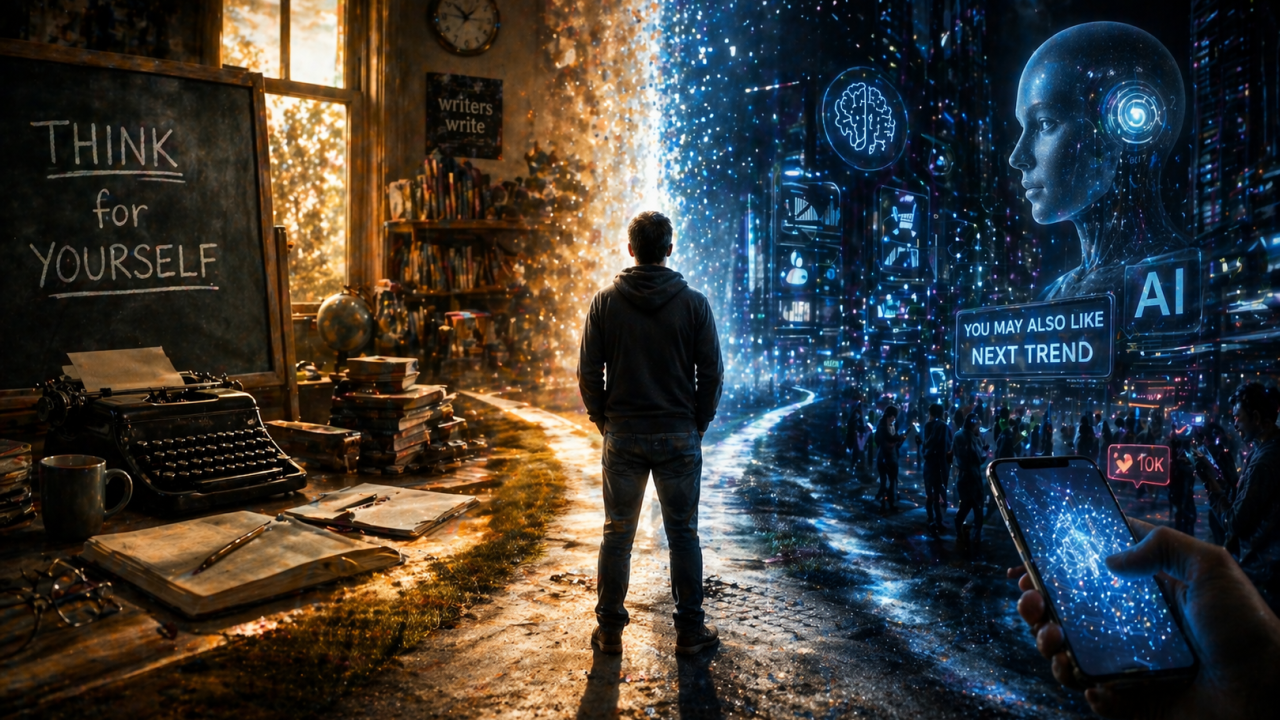
The world I grew up in no longer exists. I think about that a lot. This is what being middle-aged looks like. Who knew when we were kids that we’d have the information of the entire universe always sequestered in our pockets?
I remember having to handwrite reports for school. We didn’t have a computer, much less a printer. My mom had an old typewriter that I used to hammer out book reports on a few times in elementary school. We didn’t get our first computer until I was in the seventh or eighth grade.
My stepdad was the first person I knew who had his own computer and a mobile phone that was permanently mounted in his car. We thought he was likely the richest person we’d ever met at the time. The wonders he had access to.
Teachers scolded us to learn math without a calculator because we might not have digital aids one day. Their logic was sound, but history proved our teachers wrong. Not only do we carry calculators around every day, but we’ve also been made simultaneously dumber. As a result of all the easy computation opportunities, we stopped having to think for ourselves. We let the machines do our thinking.

In the same way many of us resisted the internet in its infancy, we are rebelling against artificial intelligence. I fear robots, with their advanced computational powers, may become our new overlords. It’s only a matter of time. I’m only half-joking here, but it is alarming how much of our lives and brainpower we have ceded to computers in all their various forms.
As a millennial, I resisted the rise of the machines with every technological advance, thanks to fictional freedom fighters like John Connor. I don’t even use self-checkout because, once humans are obsolete, our future looks dystopian. Perhaps I’ve watched the Terminator movies one too many times. Still, we seem to be losing our souls to silicon chips.
My job will likely disappear in the next few years because it makes practical sense to automate the processes I do for the federal government, thereby removing human error. I’m not worried about that as much as I am about losing our creative souls to the lifeless “art” being created in the name of laziness.
Recently, my social media feed was filled with dumb “artist renderings” of my friends, the latest AI trend. Caricatures created by ChatGPT, or some other such entity, were plastered on their profiles. Even now, as I use the dash construction in my articles, I fear I’ll be suspected of using artificial intelligence to craft these weekly musings.
Each time well-meaning folks are duped into wasting water on these stupid trends, more data is gathered about them, and more trust is lost in humanity. The machines learn, adapt, and drain more of our collective souls, attempting to replicate our essence.
I may sound like a Luddite, and on this issue, you’d likely be correct in that assumption, but when it comes to art, I wish we could draw a line in the sand and tell those robots to keep their circuits to themselves. Our stories, our creative spirit, and the core of who we are can’t be replicated, and I pray technology never fully catches up to us in that regard. Besides, a machine will never outdo me in spelling errors, misplacing commas, and the other flaws that make me human. For now, I suppose that’s the only hope I have.
I can only imagine the writers of earlier generations scoffing at my use of Microsoft Word to craft this weekly diatribe. Time and technology always march on, and we either adapt or die. Still, I’m not quite ready to submit to any digital deity just yet.

_____________________________
Stan Lake is a writer, photographer, and filmmaker based in Bethania, North Carolina. His work has appeared in Dead Reckoning Collective, The Havok Journal, Reptiles Magazine, Lethal Minds Journal, and other outlets, and he directed Hammer Down, a documentary about his 2005 deployment in support of Operation Iraqi Freedom with Alpha Battery 5-113th of the North Carolina Army National Guard. For The Havok Journal, he often writes essays and reflections about war memory, veteran life, the outdoors, and everyday experience. You can find his books, collected works, and social media at www.stanlakecreates.com.
As the Voice of the Veteran Community, The Havok Journal seeks to publish a variety of perspectives on a number of sensitive subjects. Unless specifically noted otherwise, nothing we publish is an official point of view of The Havok Journal or any part of the U.S. government.
Buy Me A Coffee
The Havok Journal seeks to serve as a voice of the Veteran and First Responder communities through a focus on current affairs and articles of interest to the public in general, and the veteran community in particular. We strive to offer timely, current, and informative content, with the occasional piece focused on entertainment. We are continually expanding and striving to improve the readers’ experience.
© 2026 The Havok Journal
The Havok Journal welcomes re-posting of our original content as long as it is done in compliance with our Terms of Use.


