Military professionals spend their careers making decisions under conditions of uncertainty. It’s an inherent part of the job.
No commander has ever possessed perfect information. No intelligence estimate has ever been complete. No battle plan has survived entirely intact. Yet decisions still have to be made. In many cases, they must be made before enough information exists to eliminate doubt. That reality makes one of history’s most famous philosophical arguments surprisingly relevant.
It is called Pascal’s Wager.
Unlike many philosophical thought experiments, Pascal’s Wager is not primarily concerned with proving whether God exists. Instead, it asks a more practical question:
Given uncertainty, what is the most rational decision?
Blaise Pascal’s Gamble
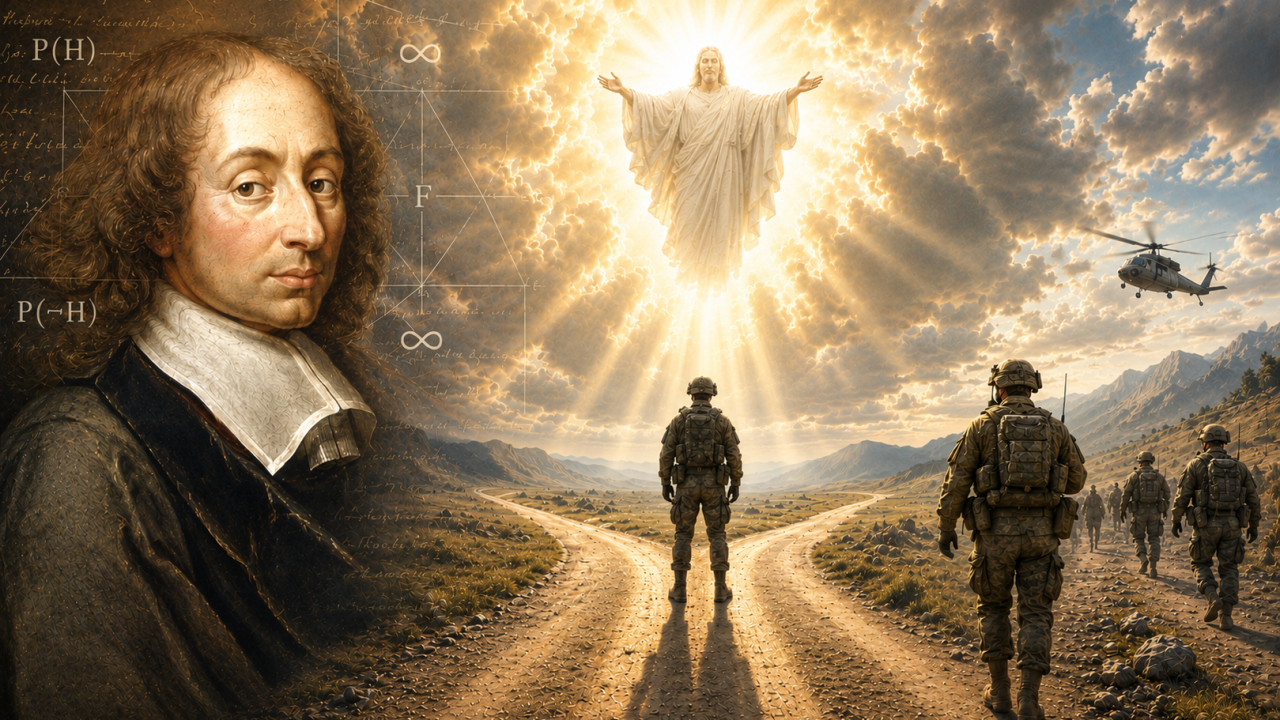
Blaise Pascal was a seventeenth-century French mathematician, physicist, inventor, and philosopher. Long before probability theory became a formal discipline, Pascal recognized that human beings routinely make decisions without certainty. We weigh risks, estimate outcomes, and choose the option that appears to offer the greatest expected benefit.
In his unfinished work Pensées, Pascal applied this reasoning to religion.
Suppose, he argued, that God’s existence cannot be conclusively proven or disproven. Every person must still decide how to live.
If God exists and one lives accordingly, the reward is infinite.
If God exists and one rejects Him, the consequence is potentially infinite loss.
If God does not exist, then the costs and benefits of belief are finite.
From a purely mathematical perspective, Pascal concluded that believing represents the rational wager because the potential upside is unlimited while the potential downside is comparatively small.
Importantly, Pascal was not claiming this proved God’s existence. He was arguing that uncertainty itself could justify belief.
Whether one finds the argument persuasive is another matter.
The genius of Pascal’s Wager lies not in its theology but in its decision theory.
The Military Makes Similar Bets Every Day
Although Pascal wrote about faith, his reasoning resembles the way military organizations routinely evaluate risk.
Consider nuclear deterrence.
No nation wants to discover whether its adversary is bluffing. The consequences of guessing incorrectly are catastrophic. As a result, countries maintain expensive deterrent forces, missile defenses, intelligence networks, and alliances that they hope never have to prove necessary.
Critics occasionally complain about the enormous costs involved.
Supporters make a Pascal-like argument. If the threat never materializes, billions of dollars may have been spent unnecessarily. If the threat does materialize and no preparation exists, the consequences may be irreversible.
The wager is obvious.
Insurance works the same way. Most homeowners never experience a house fire. Most people never total their vehicle. Most healthy adults never require expensive emergency surgery in a given year. Yet rational people continue paying insurance premiums because they are not buying certainty. They are buying protection against low-probability, high-consequence events. Military planning operates under the same logic.
Preparing for the unlikely often appears wasteful until the unlikely becomes reality.
Expected Value Matters
Modern economics calls this concept expected value.
Expected value does not ask what outcome is most likely.
It asks what outcome matters most when probability and consequence are considered together.
A one-percent chance of a trillion-dollar loss deserves more attention than a ninety-percent chance of losing ten dollars.
This is why organizations invest heavily in disaster recovery, cybersecurity, pandemic planning, and strategic reserves. Many of these capabilities appear excessive during normal times. Their value becomes obvious only after disaster strikes. Pascal understood this centuries before the mathematics became commonplace.
The Criticisms Are Just as Interesting
Like every enduring philosophical argument, Pascal’s Wager has attracted substantial criticism.
The most famous objection is known as the Many Gods Problem.
If belief is simply a rational bet, which religion should one choose? Different faith traditions promise different rewards and consequences. The wager provides no obvious method for selecting among them.
Others argue that genuine belief cannot be manufactured through calculation. Can someone sincerely believe simply because doing so appears strategically advantageous? Still others question whether faith motivated primarily by self-interest would possess any moral value. These criticisms do not eliminate Pascal’s insight. Rather, they demonstrate that the wager was never intended to settle theological questions once and for all.
Its purpose was to force readers to think differently about uncertainty.
Philosophy Is Often About Framing the Question
One reason Pascal’s Wager has endured for more than three centuries is that it shifts attention away from certainty. Most debates ask, “What is true?” Pascal instead asks, “Given that I cannot know with certainty, how should I act?”
That distinction matters.
Human beings frequently postpone difficult decisions while waiting for perfect information. Perfect information almost never arrives. Investors wait for markets to become predictable. Governments wait for crises to become obvious. Individuals wait until they are absolutely certain before changing careers, repairing relationships, or pursuing meaningful goals.
By the time certainty appears, the opportunity has often passed.
Living With Uncertainty
Military service teaches an uncomfortable lesson that extends far beyond the battlefield. Waiting for complete certainty is often indistinguishable from deciding not to act. Every operation begins with assumptions. Every plan rests on probabilities. Every commander accepts risks that cannot be eliminated.
The objective is not perfect prediction. It is making the best possible decision using incomplete information. That is precisely the world Pascal was describing. Whether one ultimately accepts or rejects his theological conclusions, his wager remains one of philosophy’s clearest demonstrations that rational decision-making is not always about knowing.
Sometimes it is about choosing wisely despite not knowing.
That may be the most enduring lesson Pascal left us. Not that faith can be reduced to mathematics, but that uncertainty is not an excuse for indecision. Every day, whether we recognize it or not, we place bets about the future.
The only real question is whether we understand the odds well enough to know what we are wagering.
_____________________________
Charles served over 27 years in the US Army, which included seven combat tours in Iraq and Afghanistan with various Special Operations Forces units and two stints as an instructor at the United States Military Academy at West Point. He also completed operational tours in Egypt, the Philippines, and the Republic of Korea and earned a Doctor of Business Administration from Temple University as well as a Master of Arts in International Relations from Yale University. He is the owner of The Havok Journal, and the views expressed herein are his own and do not reflect those of the US Government or any other person or entity.
As the Voice of the Veteran Community, The Havok Journal seeks to publish a variety of perspectives on a number of sensitive subjects. Unless specifically noted otherwise, nothing we publish is an official point of view of The Havok Journal or any part of the U.S. government.
Buy Me A Coffee
The Havok Journal seeks to serve as a voice of the Veteran and First Responder communities through a focus on current affairs and articles of interest to the public in general, and the veteran community in particular. We strive to offer timely, current, and informative content, with the occasional piece focused on entertainment. We are continually expanding and striving to improve the readers’ experience.
© 2026 The Havok Journal
The Havok Journal welcomes re-posting of our original content as long as it is done in compliance with our Terms of Use.