
By Cristóbal S. Berry-Cabán
On a quiet Sunday afternoon in East Orange, New Jersey, in December 1941, a generation of young Americans had their lives upended over radios and soda fountains. For 16-year-old Charles W. Berry, the news arrived while he was taking a quick break from the local roller skating rink.
Writing in 1990, Charles captured the sudden, jarring transition from peacetime teenage life to global conflict:
“When the Japanese baptized Pearl Harbor and the various other military bases in the vicinity, this occurred on a Sunday afternoon (Eastern U.S. time). I was at the local roller skating rink. We had taken a few minutes out to get soda at the corner drug. They had the radio on when the news broke in with word of the bombing. There were about 15 people in the store, and I happened to have been the only one who knew where Pearl Harbor was located. My cousin Richard Grodesky had done nine years in the Army and used to rave about it. Things change. FDR made the speech Monday night announcing the declaration of war against Japan and Germany.”
The world had fundamentally shifted. For Charles and his brother, Russell, the call to serve was not a matter of if, but when.
“Well, the goddamn war started. And away we go! Russ graduated HS in 1942 and went in the Marines in December 42. I left HS in my senior year and went in the Navy on March 1, 1943. Took boot camp in Newport, Rhode Island, and froze my ass off for 2 months. Then on to tech school in Memphis, Tenn., where I learned how to be an ordnance man, guns, bombs, ammo and related hardware.”
Equipped with his new technical skills, Charles was sent south, deep into the equatorial heat of South America, to service the massive, rugged flying boats guarding Allied shipping lanes.
“From there in October 43, I went to Belem, Brazil, to a PBY-5A squadron. The old Catalinas are still being used in many Latin American countries and Jacques Cousteau uses one.” In Brazil, Charles “worked the beaching crew or as an armorer or as a cook.”
After a grueling tour keeping the Catalinas armed and flight-ready, Charles was rotated back to the United States, landing at a massive naval complex on the West Coast, where he encountered an entirely unfamiliar culinary phenomenon.
“After I returned from Brazil in 1945, I was transferred to the Naval Air Station at North Island, San Diego, CA, where I stayed about 8 months. As I had been originally trained for fighter-type aircraft, it was like old home week.“
“Until 1945 in California, I had never eaten a hamburger with lettuce and tomato. I thought it was something special. Very good.”
The Mess Hall Equalizer: The Birth of S.O.S.

While a California hamburger was a revelation, military food was notoriously utilitarian. For the most part, the Army and Marines subsisted on a rotation of combat rations that were widely reviled.
“Very fortunately, in the Navy, we did not get the C-, K- and 10-in-1 rations they fed the Army and Marines. Now that was some lousy eating. Of course, some of the Navy chow left much to be desired. Yet, I never heard of anyone dying from it.”
But there was one culinary mainstay that bridged every branch of the service, a dish so pervasive, so unforgettable, that Charles carried its memory for the rest of his life.
“One of the few culinary items I brought back from the service was the good old S.O.S. Correct name being Chipped or Creamed Beef on Toast, but naturally corrupted to ‘Shit on a Shingle.’”
Long before World War II soldiers gave it its colorful, profane nickname, creamed chipped beef was born out of raw military necessity. Chipped beef, meat that had been salted, dried, pressed and thinly sliced, was a logistical dream. In an era before modern refrigeration and advanced supply chains, it was compact, completely shelf-stable and incredibly easy to transport to the front lines.
The dish originally emerged as a comforting, economical staple among European immigrants and working-class families across the Northeastern and Mid-Atlantic United States. Recognizing its utility, the military adopted it, and the earliest official recipe marched into the 1910 Manual for Army Cooks under the unassuming title “Stewed Chipped Beef.”
That original 1910 recipe was a somewhat elaborate affair. Chipped beef was slow-simmered in a rich sauce made from concentrated beef stock and evaporated milk. The sauce was thickened with flour that had been carefully browned in butter. It was finished with fresh parsley and a heavy dusting of black pepper, with the salty beef added at the very last second to keep the dish balanced.
As the military mobilized for World War II, the recipe was aggressively streamlined for mass production. By August 1944, Army Technical Manual TM 10-412 officially stripped away the beef stock and the parsley. Cooks were instructed to whip up a basic white cream sauce, a roux of fat and flour mixed with milk, dump in the chipped beef, and season it aggressively with black pepper.
It was warm, filling, salty and served with relentless regularity to millions of American troops. Faced with a ladle of thick white gravy poured over dry toast, soldiers, sailors and Marines responded with the dark humor that has long characterized military life. The meal quickly earned a nickname that would become legendary throughout the armed forces: S.O.S., or “Shit on a Shingle.”
More than just a meal, S.O.S. became a shared experience that connected service members across branches, generations and wars. Its ubiquity in mess halls transformed it into a symbol of military life itself, so recognizable that filmmakers later used it as a powerful visual shorthand for the hardships, routines and camaraderie of service.
S.O.S. on the Silver Screen
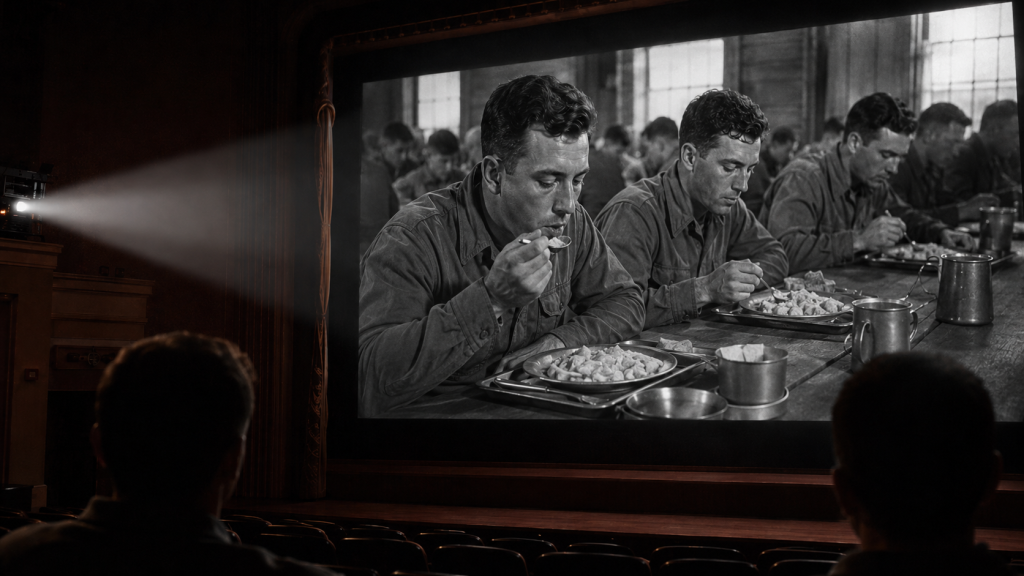
The dish became such a profound cultural touchstone for the Greatest Generation that Hollywood frequently used it as shorthand to instantly establish the gritty, monotonous reality of military life. In the classic naval drama “The Caine Mutiny” (1954), filmmakers had to navigate strict 1950s censorship and bypass the explicit “S.O.S.” moniker entirely. Instead, they relied on the raw authenticity of shipboard life to deliver the message, showing exhausted sailors and officers huddled in the galley, bitterly complaining about the endless, uninspired cycles of “creamed beef” and “slop” served on toast.
Decades later, HBO’s “Band of Brothers” (2001) used the same culinary monotony to ground its heroes. In the opening episode, “Currahee,” elite paratroopers like Captain Winters and Lieutenant Nixon are shown scooping the distinct white gravy meal out of cold metal mess kits, cementing the dish as the unglamorous, everyday fuel that powered America’s frontline troops during their brutal stateside training.
Nowhere does the dish take center stage more prominently than in the 1988 World War II comedy-drama “Biloxi Blues,” which features the most famous and explicit mess hall scene in cinema history. During basic training in 1943, a heavy ladle of the iconic slurry is slapped onto a recruit’s tray, prompting a soldier named Wykowski to look down and serve as an informal military historian: “My brother had this in the Marines. It’s S.O.S. Shit on a shingle. It’s creamed chipped beef.”
The scene quickly escalates into a high-stakes psychological standoff when the hard-line drill instructor, Sergeant Toomey, tries to force a recruit with a nervous stomach to eat the heavy meal. When the private produces a doctor’s note to get out of it, the tyrant sergeant famously orders him to swallow both the food and the note, transforming the humble comfort food into a direct battleground of military discipline.
The Postwar Legacy

When millions of veterans returned home in 1945, they brought an appetite for the dish with them. S.O.S. successfully transitioned from military mess halls into civilian life, becoming a permanent fixture on the menus of classic American diners.
It found a particularly permanent home across the Mid-Atlantic region, blending seamlessly into areas with strong Pennsylvania Dutch roots. While menus softened the blow by listing it under gentler titles like “Creamed Chipped Beef on Toast” or “Dutch Frizzled Beef,” generations of customers, and the veterans sitting at the counters, knew exactly what they were ordering.
Today, the dish survives not out of logistical necessity, but as a nostalgic, comforting reminder of resilience, serving as an edible link to the ordinary citizens who went “away we go” to face an extraordinary moment in history.
Ultimately, the journey of S.O.S. reflects the journey of the Greatest Generation itself. What began as a salted, shelf-stable solution to wartime logistics became the unvarnished, everyday fuel for millions of young American service members like Charles Berry, carrying them from local roller rinks to the humid shores of Brazil and beyond. By surviving the grim realities of the mess hall, outsmarting Hollywood censors and finding a permanent home on civilian diner counters, this famously profane dish achieved something remarkable: It transformed from a symbol of military monotony into a badge of shared endurance. Today, every plate of creamed chipped beef served is more than just a nostalgic comfort food; it is an edible monument to resilience, proving that the memories of those who answered the call to serve are kept alive not just in history books, but in the enduring, everyday traditions they brought back home.

Charles’s Creamed Ground Beef on Toast (S.O.S.)
This comforting military classic gets an upgrade by skipping the dried chipped beef in favor of fresh, seasoned ground beef.
Ingredients
• 3 tbsp butter
• 3 tbsp onion, finely minced
• 3 tbsp green pepper, finely minced
• ¾ lb hamburger meat, or ground beef
• 3 tbsp all-purpose flour
• 2 cups milk, warmed slightly, not cold from the fridge
• 1 dash Worcestershire sauce, the secret ingredient
• Salt and freshly ground black pepper, to taste
• Slices of hot, buttered toast, for serving
Instructions
- Sauté: Melt the butter in a large skillet over medium heat. Add the minced onion, green pepper and hamburger meat. Cook until the meat is browned and the vegetables are tender, breaking up the beef as it cooks.
- Build the Roux: Sprinkle the flour directly over the meat and vegetable mixture. Stir well for about 1 to 2 minutes to coat everything and cook out the raw flour taste.
- Simmer and Thicken: Gradually add the warmed milk a little at a time, stirring constantly to prevent lumps. Add the dash of Worcestershire sauce. Bring to a gentle simmer and let it cook until the gravy thickens to your liking.
- Season and Serve: Remove the skillet from the heat. Season with salt and pepper to taste. Ladle the hot creamed beef generously over slices of hot, buttered toast and serve immediately.
_____________________________
Cristóbal S. Berry-Cabán, PhD, is the son of Charles W. Berry and has more than 30 years of experience conducting military health research. He served as an epidemiologist at Womack Army Medical Center, Fort Bragg, where his work focused on health outcomes, readiness, behavioral health and preventive medicine among military populations. He currently resides in Southern Pines, North Carolina.
As the Voice of the Veteran Community, The Havok Journal seeks to publish a variety of perspectives on a number of sensitive subjects. Unless specifically noted otherwise, nothing we publish is an official point of view of The Havok Journal or any part of the U.S. government.
Buy Me A Coffee
The Havok Journal seeks to serve as a voice of the Veteran and First Responder communities through a focus on current affairs and articles of interest to the public in general, and the veteran community in particular. We strive to offer timely, current, and informative content, with the occasional piece focused on entertainment. We are continually expanding and striving to improve the readers’ experience.
© 2026 The Havok Journal
The Havok Journal welcomes re-posting of our original content as long as it is done in compliance with our Terms of Use.


