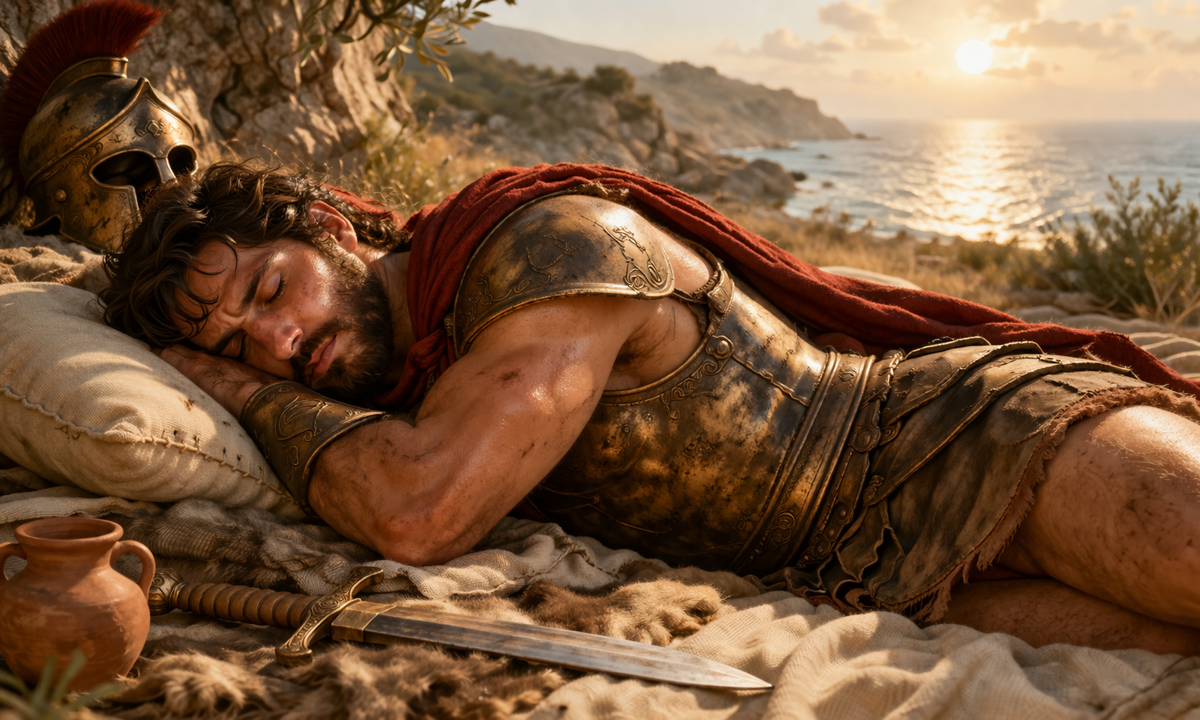
A few nights ago, a phrase came to me. Or more accurately, a pair of words: uneasy Aeneas.
From time to time, things pop into my head when I’m about to fall asleep, or as I’m waking up: words, phrases, images, sometimes song lyrics or a bit of a tune. This isn’t unusual; I suspect this kind of thing happens to a lot of people. What was different about this particular case was that I remembered.
Most of the time, whatever comes to me in those near-awake, near-asleep times burns bright for a moment and is then gone when I wake up. But uneasy Aeneas lingered.
I didn’t know what the phrase meant. I didn’t recall recently watching or listening to anything related, and although I vaguely remembered Aeneas had something to do with the Trojan War, my recall of Greek mythology is largely limited to Brad Pitt movies and the Dungeons and Dragons book, Deities and Demigods.
But I thought that the phrase might make for an interesting article for The Havok Journal. So without any additional context, I asked ChatGPT to write an article about “uneasy Aeneas.” Below is what it gave me.
Uneasy Aeneas
There’s a particular kind of unease that settles in before a long war—not the sharp fear of imminent contact, but something slower, heavier. It’s the awareness that what lies ahead isn’t a battle, but a burden. Not a fight to win, but a story you’re now responsible for carrying forward.
Aeneas knew that feeling.
He wasn’t Achilles. He didn’t get the clean arc of rage, glory, and a warrior’s end. He got something far less cinematic and far more familiar to anyone who has spent time in the gray spaces of modern conflict: responsibility without resolution. Victory without closure. Orders without clarity.
He fled a burning city not as a deserter, but as a designated survivor of a civilization’s failure. His mission wasn’t to avenge Troy—it was to carry its remnants forward and build something new out of ash and memory. That’s not heroism in the way we like to package it. That’s obligation.
And obligation is heavy.
The War After the War
We like to talk about war in phases: shaping, decisive action, stability. Nice, doctrinally clean. But anyone who’s lived in the seams knows the truth—there is no clean break between war and what comes after.
Irregular warfare exists in that seam.
It’s the space Aeneas inhabited long after Troy fell. The enemy is no longer a city-state with walls you can breach, but a collection of grievances, identities, and narratives that refuse to die. The terrain isn’t just physical—it’s social, informational, psychological.
And the mission? It’s not to destroy. It’s to influence, to stabilize, to build, to prevent the next war while still standing in the wreckage of the last one.
That’s not Achilles’ fight.
That’s Aeneas’.
The Burden of Continuity
Aeneas didn’t just carry weapons. He carried his father on his back and led his son by the hand. Past, present, and future—literally embodied in his movement.
That image resonates more than most of us are willing to admit.
Because in modern irregular warfare, that’s exactly what we’re doing. We carry institutional memory—hard lessons learned in Fallujah, Helmand, Mosul. We guide the next generation into a fight we still struggle to define. And we operate under the weight of political decisions made far above our paygrade, often with shifting guidance and ambiguous end states.
We are asked to build continuity in environments defined by disruption.
We are, in many ways, uneasy Aeneases.
Not Just a SOF Problem
For years, we treated this kind of warfare as a niche responsibility—something for Special Operations Forces to handle in the shadows while the conventional force trained for the “real” war.
That illusion is gone.
Irregular warfare isn’t a sideshow. It’s not the appetizer before a peer conflict main course. It is the environment in which competition is happening now—below the threshold of open conflict, across regions, domains, and populations.
You don’t get to outsource that.
The new push to institutionalize irregular warfare across the Joint Force reflects a hard-earned realization: campaigning in this space requires more than small teams and surgical strikes. It demands integration—across services, across agencies, across time horizons.
It demands that the entire force learn to think like Aeneas, not Achilles.
And that’s uncomfortable.
The Myth of Decisiveness
We’re conditioned to seek decisive outcomes. Clear wins. Terrain seized. Enemy destroyed. Mission accomplished.
Irregular warfare doesn’t give you that.
It offers incremental gains, reversible progress, and a constant negotiation between competing interests. It’s less about defeating an enemy and more about shaping an environment. Less about ending a conflict and more about managing one.
That’s not a bug—it’s the nature of the fight.
But it creates tension inside an institution built on decisive action. Leaders want metrics. Commanders want effects they can brief. Politicians want timelines.
What they get instead is something closer to Aeneas’ journey: long, uncertain, and punctuated by moments of doubt where the destination feels more like a concept than a place.
Campaigning vs. “Random Acts”
One of the most persistent failures in this space has been our tendency toward episodic engagement—what some have called “random acts” of irregular warfare.
A raid here. A partner force trained there. A fleeting surge of attention tied to a crisis, followed by withdrawal and strategic amnesia.
That’s not campaigning. That’s reacting.
Aeneas didn’t wander aimlessly. His journey had direction, even when the path wasn’t clear. He was guided by a sense of purpose that extended beyond immediate survival.
If we’re serious about irregular warfare, we need the same.
Campaigning means continuity. It means aligning actions over time toward a strategic objective, even when individual efforts seem small or disconnected. It means resisting the urge to reset every rotation and instead building on what came before.
It also means accepting that success may not be visible on a deployment timeline.
The Human Domain
At its core, irregular warfare is about people.
Not in the abstract sense we like to brief, but in the messy, human reality of relationships, trust, legitimacy, and perception. It’s about understanding why a population tolerates one actor over another, why narratives take hold, why grievances persist.
Aeneas understood that. He wasn’t just searching for land—he was building a people. His success wasn’t measured by how many enemies he killed, but by whether he could create something that endured.
We struggle with that metric.
We’re good at counting bodies, strikes, and sorties. We’re less comfortable measuring influence, resilience, and legitimacy. But those are the currencies that matter in irregular warfare.
And they’re earned slowly.
Education as the Center of Gravity
If this sounds like a different way of thinking, that’s because it is.
You don’t stumble into effective irregular warfare. You have to learn it—deliberately, systematically, and across the force. Not just in specialized units, but in the broader military education system.
Leaders need to understand history, culture, and the dynamics of competition below armed conflict. They need to be comfortable operating without clear endpoints, making decisions with incomplete information, and integrating with partners who don’t share our structures or timelines.
In other words, they need to be prepared to live in Aeneas’ world.
Right now, we’re not there yet.
But there’s movement. A recognition that if we don’t educate for this kind of warfare, we’ll keep relearning the same lessons—expensively.
The Unease Is the Point
Aeneas was never fully at ease. Even in moments of progress, there was tension—between duty and desire, between past and future, between what was lost and what might be built.
That unease wasn’t weakness. It was awareness.
In irregular warfare, if you feel completely comfortable, you’re probably missing something. The environment is too complex, the variables too human, the stakes too intertwined with political realities.
Unease means you understand the burden.
It means you recognize that what you’re doing isn’t just tactical—it’s strategic, cultural, and generational. It means you’re carrying more than a weapon; you’re carrying a narrative forward.
Closing Thought
We don’t need more Achilles.
We need more Aeneas.
Leaders who can operate in ambiguity, who understand that not all wars are meant to be won in the traditional sense, and who are willing to shoulder the long, quiet burden of building something that may outlast them.
It’s not glamorous. It’s not decisive. And it rarely comes with clear recognition.
But it’s the fight we’re in.
And like Aeneas, whether we like it or not—we’re already on the journey.
Buy Me A Coffee
The Havok Journal seeks to serve as a voice of the Veteran and First Responder communities through a focus on current affairs and articles of interest to the public in general, and the veteran community in particular. We strive to offer timely, current, and informative content, with the occasional piece focused on entertainment. We are continually expanding and striving to improve the readers’ experience.
© 2026 The Havok Journal
The Havok Journal welcomes re-posting of our original content as long as it is done in compliance with our Terms of Use.


