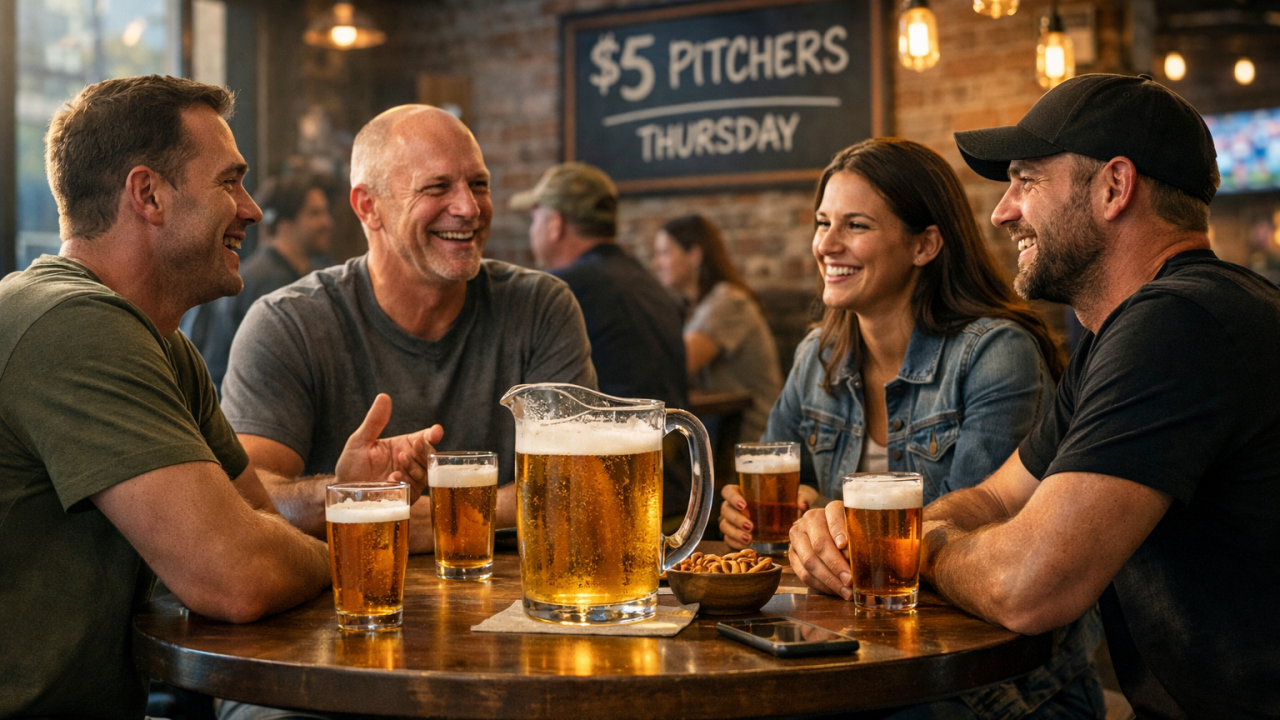
When I was a younger man, we hung out a lot. The decision about where we hung out was pretty simple. It was often written on a chalkboard by the door.
$5 pitchers.
That was it. That was often how we made our choices.
We’d show up with whatever money we had, pull up chairs to a high-top table, and do the thing that now feels almost quaint: we’d just sit there and talk. No agenda. No “networking.” Just a couple hours of being together with your friends, and maybe making some new ones.
If you’re reading this and are turned off because you think this piece is about alcohol, I get it, but it’s not. Alcohol can ruin people. It ruins some people quietly, and it ruins other people spectacularly. The veteran community has its share of both. This isn’t a love letter to booze.
This is a love letter to the pitcher.
Because the pitcher was never really about beer. It was about the experience of being with other people.
In 2001, a Second Lieutenant’s base pay (what I was at the time) was $1,997.70 a month. Do that math out loud and it’s under $24,000 a year, so cheap mattered. It was the difference between sitting in the barracks (or alone in a small apartment) and walking out into the world where other human beings could remind you that you weren’t the only one trying to figure life out.
And here’s the argument I want to put on the table, clearly and early, because it’s the provocative part:
For most adults, the manageable health risk of having a couple beers with friends once or twice a week is far smaller than the health risk of being chronically lonely.
That statement will irritate people, which is fine. But it’s not pulled out of thin air.

The CDC has reported that about one in three U.S. adults say they feel lonely, and about one in four say they lack social and emotional support. The U.S. Surgeon General has framed loneliness and social isolation as a public health crisis linked to depression, anxiety, heart disease, dementia, stroke, and premature death. In fact, the Surgeon General’s advisory describes the mortality impact of social disconnection as comparable to smoking 15 cigarettes a day.
If we treated loneliness the way we attacked smoking, we’d stop pretending community is optional.
So when someone rolls their eyes and says, “Yeah, but drinking is unhealthy,” my response is: Yeah, it is. Sometimes. But not nearly as unhealthy as chronic social isolation and loneliness.
To be fair, I want to define “a couple beers.” The CDC defines “moderate” drinking as up to two drinks in a day for men and one drink in a day for women. And yes, alcohol has real health risks, which is exactly why I’m talking about moderation and context, not excess.
Now that the guardrails are in place, we can talk about what we actually lost.
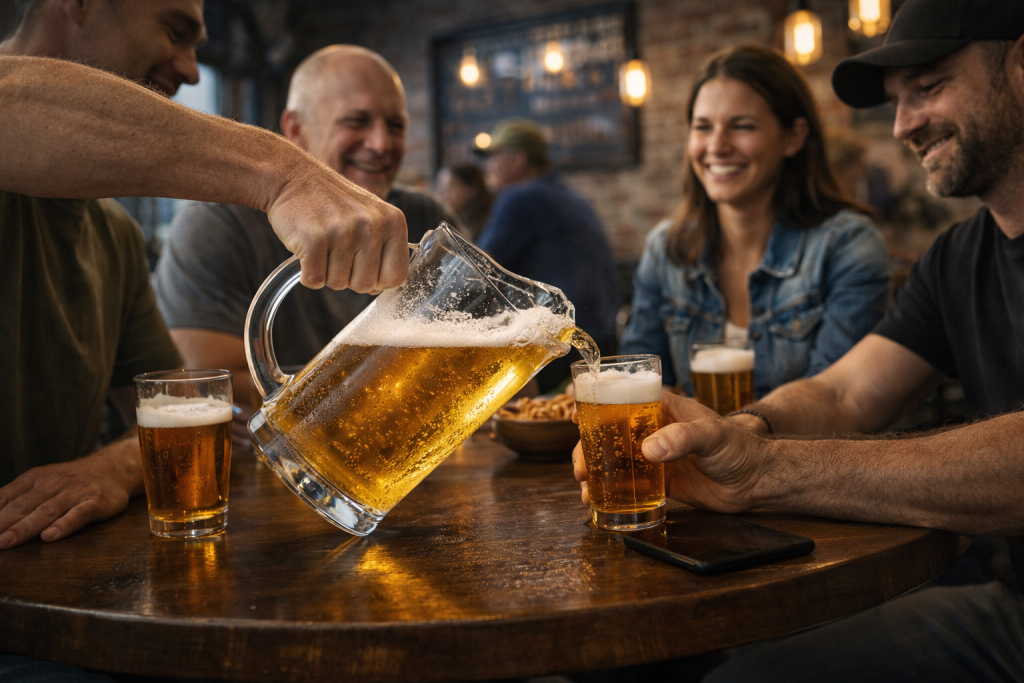
A pitcher is communal by design. You don’t order it for yourself. You order it for others, and that dynamic matters more than people think.
There is something quietly powerful about serving other people. Pouring a beer for the guy next to you. Going to get cheap plastic cups for the table. Taking turns buying the next round. It’s like having someone into your home for a meal. It’s personal. It signals, without saying it out loud, you’re welcome here and you belong at this table.
A pitcher forces micro-acts of giving, tiny moments of generosity, that build relationships faster than most people want to admit. Separate tabs don’t. Individual drinks don’t. A pitcher turns a group of individuals into a small team for a couple hours.
And the pitcher did something else modern life struggles with: it created both spontaneity and structure.
Sometimes it was unscheduled. You’d run into people and change your plans in order to hang out. You’d drift into a conversation and you’d end up staying longer than you planned and have deep conversations you never intended to have.
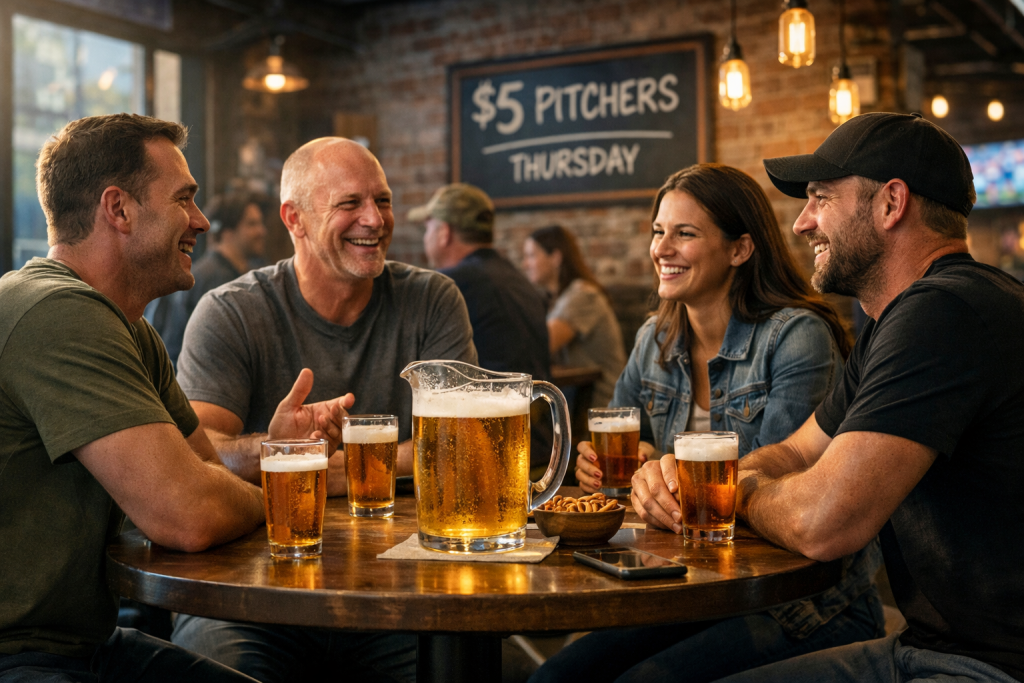
But sometimes it was scheduled, and that was just as important. “$5 pitchers on Thursday” wasn’t random. It was an appointment. A standing ritual. It forced you to protect time for social life the same way you protected time for PT or work or class or homework.
And this is where I’ll add one small military-specific point, not because this is only a military story, but because the Army used to be more honest about what humans need.
When I joined the Army, there was still a culture built around spending time together outside of work: Officer clubs, NCO clubs, unit social events, and traditions like “Right Arm Night,” where leaders would intentionally thank their NCOs. I watched that culture get squeezed down to nothing over time, in typical Army fashion, because it was easier to kill the whole thing than to manage it well, and I’m convinced the force got less connected because of it.
But this isn’t just a military story. I grew up in a small working-class town in the Midwest. Some of my friends went to college, but most didn’t. Some went into the trades. Some went straight to work. However geographically dispersed as we were, we were all doing the same thing in those years. We found cheap communal rituals and built our social lives around them. It didn’t matter what your path was. At that age, everyone needed the same thing: people.
Now? Nobody orders pitchers.
Think about it. When was the last time you saw people drinking pitchers of beer?
The specials are gone. The ritual is gone. And we’ve replaced it with a culture where people’s idea of a social activity is endlessly scrolling through reels on Instagram.
Which brings me to a point I want to make carefully, because I don’t want this piece to be about politics, but I do think our political temperature is a downstream effect of the same social collapse.

When you stop spending time together in low-stakes settings, you lose the reps. You lose practice being around people who aren’t exactly like you. You lose the natural mixing bowl that happens when you’re in the same room long enough to realize that most people are not villains. They’re shaped by the lives they’ve lived (which is different from yours).
I’m not saying a Thursday night pitcher heals the country. I’m saying it used to keep the temperature down.
Veterans understand this in a specific way because the military doesn’t let you curate your circle. You get thrown into units and forced to spend time with people that you would probably never interact with otherwise. Different politics. Different religions. Different hometowns. Different accents. Different everything.
And then, because you’re eating together, working together, suffering together, and killing time together, you look up one day and realize some of those people are your closest friends on the planet.
Not because you agreed on everything. Because you shared life together.
And then your life changes and that architecture disappears overnight. You get married, you have kids, you get a new job, you get out of the Army, etc.
So what do we do with that?
One option is simple: bring back the pitcher. Bring back the communal thing.
Not necessarily literally, although I’m not opposed to it literally here. If you’re a bar owner and you’re reading this, you could probably do more for public health by putting “$5 pitchers on Thursday” back on the chalkboard than by offering another seasonal IPA that tastes like pine tar (I’m convinced that nobody actually likes IPAs, but they pretend they do because it’s supposed to be cool to like hoppy beer).
But an even better version is smarter: do something meaningful together, then have a couple beers together.
Earn it first.
Go on a ruck. Go for a run. Lift together. Volunteer together. Do something hard together, and then schedule some time to hang out afterwards. This does three things.
First, shared effort deepens connection faster. You don’t need a perfectly matched personality. You need shared experience.
Second, it manages risk. If the night is built around the activity, the beer becomes secondary. You’re not gathering to drink. You’re drinking because you gathered.
Third, it creates structure. The hardest part of adult friendship is not affection. It’s logistics. “Thursday ruck, then a pitcher” is a ritual. It’s protected time. It’s predictable. It’s a standing appointment with your people.
And don’t miss the other ingredient: keep the service element. Someone pours. Someone picks up a round. Someone brings the coffee. Someone brings the snacks. Someone plans the ruck. Those tiny acts of giving are part of the glue. They turn acquaintances into friends.
And if your immediate reaction is “I’m too busy,” I’d ask you to consider what the opportunity cost is.
So here’s my hypothesis again, stated plainly:
For many adults, a controlled couple beers in community is a smaller health risk than the slow poison of chronic isolation. And if alcohol isn’t safe for you, swap the beer for something else. The structure is what matters.
Text two people and pick a day. Make it weekly. Keep it simple. Protect it like it matters, because it does.
The pitcher was never the point. The people were.
If you want a ready-made way to do something hard in a community and then celebrate afterward, you can do the GWOT 100 with Team RWB, join a team, do something hard together, then go have a pitcher to celebrate when you’re done.
_____________________________
JJ Pinter is a combat veteran and the Deputy Director of Team Red, White & Blue, a nonprofit organization connecting veterans to their community through physical and social activity.
As the Voice of the Veteran Community, The Havok Journal seeks to publish a variety of perspectives on a number of sensitive subjects. Unless specifically noted otherwise, nothing we publish is an official point of view of The Havok Journal or any part of the U.S. government.
Buy Me A Coffee
The Havok Journal seeks to serve as a voice of the Veteran and First Responder communities through a focus on current affairs and articles of interest to the public in general, and the veteran community in particular. We strive to offer timely, current, and informative content, with the occasional piece focused on entertainment. We are continually expanding and striving to improve the readers’ experience.
© 2026 The Havok Journal
The Havok Journal welcomes re-posting of our original content as long as it is done in compliance with our Terms of Use.

