Editor’s Note: What follows is a preview of The Adler Compound—a grounded military thriller by veteran author Andy Barker that leans hard into authenticity and consequence.

Berlin, Germany — December — Morning
Mostafa Farokhzad preferred the quiet hours—the ones before administrators arrived, before interns clogged hallways, before diplomats wandered the upper floors pretending to understand science.
Down here—three levels beneath the government research center’s public façade—the world made sense. The air-lock hum. The filtered light. The antiseptic smell baked into the concrete. The narrow corridors built not for comfort, but containment.
He stepped into the prep room and shut the outer door behind him.
Silence; controlled, familiar.
He stripped down to disposable scrubs, movements efficient; methodical, ingrained.
Inner gloves. Socks—hood liner. Each seam checked twice.
Some of the younger techs joked they could suit up in under three minutes—idiots.
Rushing was for people who believed the system would forgive them.
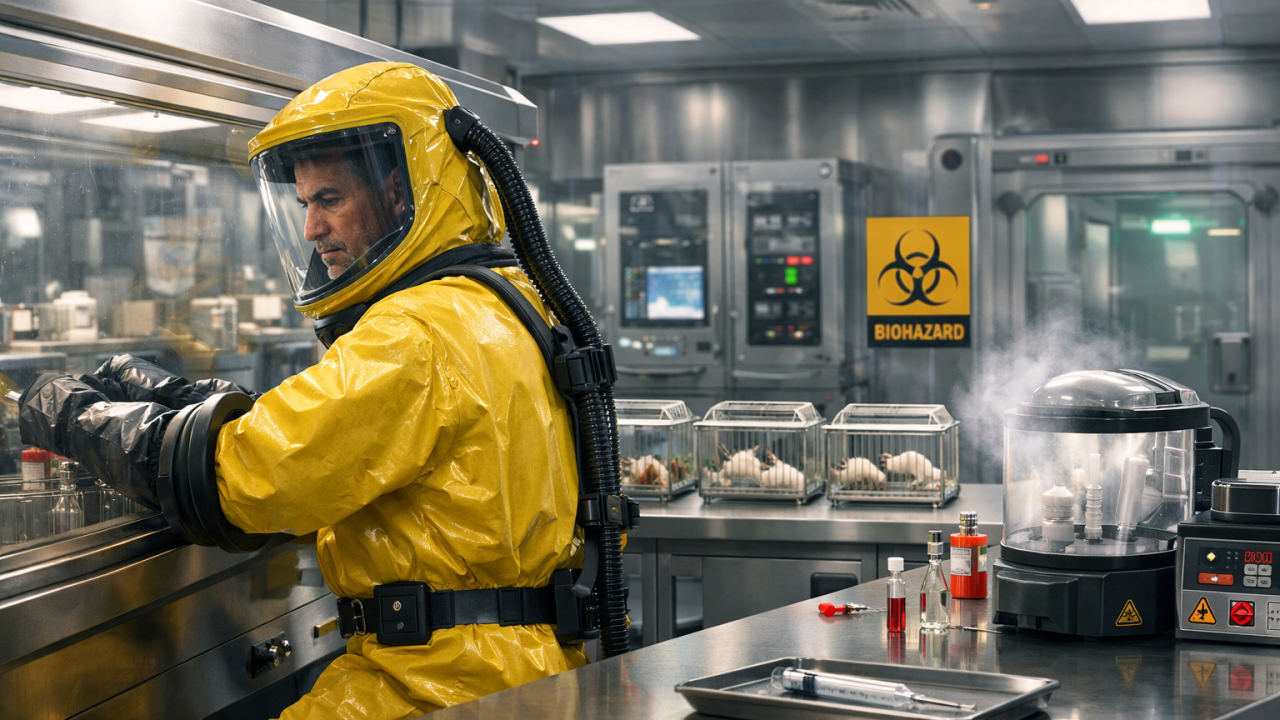
Mostafa eased his legs into the BSL-4 suit, pulled the torso up, rotated the locking ring until it clicked, then slid his arms into the stiff sleeves with their heavy gloves. He lowered the positive-pressure hood over his head and sealed it in place. A moment later the umbilical line snapped to his hip with a hollow clack, feeding him a stream of purified air.
The world softened—
Sounds muffled, breathing amplified, the hiss of airflow constant in his ears.
He pressed the intercom.
“Farokhzad. Entry to Lab Four.”
“Lab Four, entry granted. Cycling.”
The inner door unlocked. He stepped into the air lock.
Negative pressure engaged.
Lights rolled from red to amber to green.
Then the second door opened, revealing his sanctuary.
BSL-4.
Berlin’s most classified room disguised inside its most boring building.
No windows, no paper, no personal effects.
Only stainless steel, reinforced glass, sealed hoods, and surfaces designed to show every speck of contamination.
He walked to his station.
The mice rustled in their cages when he approached—tiny claws on plastic.
He spared them only a glance.
They were data points, nothing more.
The components waited inside the isolation hood—clear vials of clear liquid. No smell.
No color, no warning.
That was the point.
He slid his gloved hands into the fixed gauntlets and began.
Measured dispenses, recorded dilutions, temperature logs.
Time stamps.
“Sample A-twelve, baseline…
Sample B-nine, aerosol vector trial…
Time zero at nine thirty-eight.”
His voice sounded hollow inside the hood, half devoured by the suit.
He checked environmental readouts: perfect.
Stable.
He moved to the cages, verifying tags against the protocol sheet sealed beneath glass.
Control animals, component “A” animals, component “B” animals.
No symptoms, no distress.
Separate, the pieces were harmless. Together, they rewrote the rules.
He secured the nebulizer, checked the seals, slid the exposure chamber into place over the designated cages.
“Exposure chamber sealed. Initiating combined-agent aerosol.”
He pressed the control. For a moment—nothing.
Then the first mouse staggered.
Mostafa watched with clinical detachment as the onset began: loss of coordination, muscle failure, seizing limbs, rapid, shallow gasps. Another collapsed, then another.
He checked the timer: exactly as projected.
He cut the aerosol, let the purge cycle run.
Logged every observation with the detached clarity of someone who had long ago separated emotion from outcome.
He moved through decontamination of instruments, sample preservation, and final notations, step by step, letting the rhythm of discipline center him.
Then—
As he reached for the recording sheet—
A glint caught his eye: left sleeve, upper forearm, a hole.
Small—perfectly circular.
Barely the size of a pencil tip.
His breath froze; impossible.
He lifted his arm slowly, rotating the suit under the hood’s lights, eyes narrowing behind the visor.
The hole was real.
His chest tightened. Every hair on his body prickled.
A cold spike ran from his spine down through his gut.
He stared at it—
Not breathing, not moving, just calculating.
It could be nothing—
A superficial abrasion, a manufacturing defect, a scrape from a rack or bench.
Or it could be—
He felt the memory hit him like a blunt weapon.
Not a thought or a fear, but a flash.
A trench outside of Majnoon Islands.
Warm blood pooling near his knees.
The smell—burnt lungs, ammonia, something ferrous and rotting.
Men dropping around him, hands clawing at their throats.
Vision tunneling, light bending.
The medic’s voice fading as the mask tore from his face.
He blinked the memory away, once, hard, no panic.
No screaming, no collapse, just action.
He reached down, grabbed the atropine/2-PAM chloride auto-injector from the emergency kit mounted on the wall, flipped the safety cap free with his thumb, lined it up—
—and drove it into his right thigh, hard enough the suit dented inward around the needle.
Click—hiss.
He held it in place, five seconds, six, seven.
Then he yanked it free, dropped it into the biohazard bin, and moved.
Not walked or hurried but just moved.
Mostafa slammed the decon-panel with the heel of his hand.
The door sealed behind him, locking shut with that heavy, final sound he always trusted—except today.
The overhead jets roared to life.
He didn’t wait for the system cycle. His hands were already tearing at the suit, ripping open the heavy outer seals, twisting the blue shell off his shoulders and down his arms. It hit the floor in a wet slap.
Next came the inner gloves, then the disposable scrubs.
Then the last thin layers worn beneath.
Everything—all of it.
He stripped down to bare skin with the urgency of a man who understood exactly how contamination traveled—and how little margin existed between safe and dead.
The second he was clear of fabric, he stepped directly into the flood.
The water hammered down on him in a relentless, punishing column—hot, then cold, then hot again as the system cycled through its programmed pattern. He scrubbed hard, hands running over every inch of his body with the precision of someone performing triage on himself.
Chest, arms, neck.
Face, hair, legs.
Over and over, no shortcuts, no hesitation.
He braced his palm against the tiled wall, breathing sharp and uneven despite every effort to force it steady.
Scrub, rinse, scrub again.
The water mixed with memory—the trenches at Majnoon Islands, the quiet that wasn’t natural, the stillness before the shells came, teenage boys in salt-and-oil caked boots pretending they weren’t afraid.
He wasn’t in Berlin anymore.
He was seventeen again, lungs burning, the world tearing itself apart cell by cell.
The water kept coming.
He didn’t break, didn’t sob, didn’t panic.
He just stared forward—a thousand-yard emptiness carved into his face, the kind earned only by men who had survived the worst and learned never to speak of it.
His back hit the wall, and he slid down slowly until he sat on the tile, knees bent, water cascading over him like a storm he refused to flinch from.
He stayed like that until the shaking stopped.
Until discipline returned to his hands.
Until the world came back into focus.
Only then did he rise.
It was several minutes before his breathing evened.
Before the world stopped narrowing.
Before he convinced himself—
Logically, clinically—
That he wasn’t contaminated, the hole had been superficial.
Cosmetic—meaningless.
But the risk had been real enough.
His pulse slowed.
He eventually shut off the water and stepped out of the bay, the last of the emergency cycle still echoing off the tiled walls. He reached for a clean stack of sterile towels and dried himself fully—arms, legs, torso, hair—until no moisture remained.
He dressed in fresh facility scrubs, the fabric clinging slightly to skin still warm from the shower, and slipped into the decontamination-approved sandals waiting by the door. Only then did he leave the bay.
He walked the quiet corridor back to his office, each step controlled; measured, his breathing steady once more.
He sat, opened the secure terminal, and entered his observations.
Clinical. Precise. Stripped of anything resembling emotion.
When the log was complete, he opened the encrypted outbound channel.
A blank message waited—the kind with no visible metadata, no subject lines, no trackable fingerprints.
He typed only what was necessary.
No flourish, no explanation, just confirmation.
Progress confirmed, compound behavior matches projections. Awaiting next directive.
He encrypted the message, watched it dissolve into unreadable cipher, and sent it through the line that officially did not exist.
The confirmation ping appeared.
He powered down the terminal, the screen going black in front of him.
_____________________________
Andy Barker is a retired Naval officer with 32 years of service, including time as a Fleet Marine Force Corpsman, an Independent Duty Corpsman supporting Special Operations Forces and Surface Forces, in addition to his role as the sole medical provider aboard submarines—and ultimately ending his career as a Nurse Corps Officer specializing in Emergency and Trauma Care. Andy’s career spans combat medicine, austere operational environments, independent medical decision-making, and frontline emergency care, where precision and accountability carried immediate consequences.
Barker is the author of The Adler Compound, a military thriller shaped directly by lived experience rather than abstraction or mythology.
After an initial self-publication, he spent four years completely rewriting the book to better reflect the realities of service and its aftermath.
Following its relaunch in February 2026, The Adler Compound reached the top five in two Amazon thriller categories and the top ten in a third, surpassing the total sales of its original edition within days. His writing prioritizes authenticity, technical accuracy, and the human toll of conflict, aiming to portray the realities of service without spectacle or simplification.
Andy lives in Missouri with his wife, two children, and his Service Dog Alma, a six-year veteran of Operation Iraqi Freedom who saved countless lives as an Explosive Ordnance Disposal Military Working Dog.
As the Voice of the Veteran Community, The Havok Journal seeks to publish a variety of perspectives on a number of sensitive subjects. Unless specifically noted otherwise, nothing we publish is an official point of view of The Havok Journal or any part of the U.S. government.
Buy Me A Coffee
The Havok Journal seeks to serve as a voice of the Veteran and First Responder communities through a focus on current affairs and articles of interest to the public in general, and the veteran community in particular. We strive to offer timely, current, and informative content, with the occasional piece focused on entertainment. We are continually expanding and striving to improve the readers’ experience.
© 2026 The Havok Journal
The Havok Journal welcomes re-posting of our original content as long as it is done in compliance with our Terms of Use.


