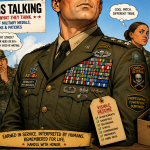
America is finally tracking blast exposure. It still has to own what that exposure costs after the uniform comes off.
There is a phrase in military life that has caused more trouble than it should.
“It should be in the system.”
Orders should be in the system. Medical referrals should be in the system. Travel vouchers should be in the system. The household goods claim that somebody uploaded twice, emailed once, and discussed with three different people should certainly be in the system.
There are houses near military installations all over the country with some version of the same plastic tote, file box, or overstuffed accordion folder. Orders. Medical records. School paperwork. Receipts. Old evaluations. Copies of documents that allegedly exist somewhere else.
People learn to keep them because eventually somebody will ask for something from eight years and three duty stations ago, and “it should be in the system” is not especially useful when the system says otherwise.
That habit is irritating when the missing record involves a reimbursement.
It becomes more serious when the missing record involves what happened to a human body.
The military has always understood cumulative wear when the subject is equipment. We track rounds, flight hours, maintenance intervals, inspections, and service life because machinery does not emerge unchanged from repeated use. Nobody accuses a gun tube of malingering because it wore out after being fired too many times.
People have been more complicated.
In August 2024, the deputy secretary of defense issued department-wide requirements for managing brain-health risks from blast overpressure. The memo acknowledged possible effects on brain health and cognitive performance from both acute and chronic exposure, including headaches, decreased reaction time, attention difficulties, and memory loss. It also established an interim 4 pounds-per-square-inch threshold for triggering risk-management measures while the science continues to develop.
The Pentagon also did something that may prove just as important as any particular threshold. It started demanding better records.
The Ledger Starts Late

The 2024 policy ordered baseline cognitive assessments, stand-off distances for trainers and range personnel, protective measures for people at increased risk, fewer unnecessary personnel around blast-producing events, and greater use of simulation when appropriate. It called for reassessing blast hazards from legacy weapon systems and directed components to identify and track personnel potentially exposed to blast overpressure, collect exposure information, and establish recordkeeping procedures for blast-sensor data.
Those are sensible measures; but were implemented in 2024. That’s awfully late for someone who spent the previous 15 or 20 years standing near things designed to create violent pressure.
Health.mil now identifies armor, artillery and gunnery, breaching, shoulder-mounted weapons, explosive ordnance disposal, military instructor training, .50-caliber weapons, and indirect-fire weapons as occupations or systems that may expose service members to low-level blast.
The Pentagon’s own memo identifies occupational specialties at increased risk, including field artillery crews, infantry, combat engineers, special operations forces, EOD personnel, and a range of weapons and training specialties across the services.
None of that will surprise those who worked in those communities. The government is now formally recognizing exposure worth measuring.
The science still requires some restraint. Low-level blast exposure isn’t the same thing as a concussion or traumatic brain injury. The Defense Health Agency says that explicitly. A person can experience blast exposure without sustaining a clinically diagnosable mild TBI, and research into the long-term effects of low-level blast remains incomplete.
There’s no reason to pretend we know more than we do. And there’s no reason to pretend we know nothing.
For years, an artilleryman could finish a firing table knowing exactly how many rounds the gun fired and having no comparable record of how much blast exposure the crew absorbed.
A breacher can remember the charges but probably not reconstruct every pressure wave.
An instructor might know how many years were spent on the range but not how many thousands of firing events happened within a few yards.
A mortar crewman can produce an MOS, units, deployments, and training history. Producing a meaningful blast-exposure history is harder because, for much of his career, nobody was keeping one for him.
Now we’ve decided those histories may matter. That creates a problem for everybody who served before the sensors.
What We Already Know

The Traumatic Brain Injury Center of Excellence’s 2025 annual report gives some scale to the brain injuries we have documented. As of November 2025, it reported 533,519 first-time TBIs among service members since 2000. About 81.9% were classified as mild.
That number is not a blast-exposure count. Military TBIs happen in combat and training, but they also happen in vehicle accidents, falls, sports, and other circumstances.
Still, more than half a million documented first-time TBIs is not an obscure occupational-health issue.
At the same time, the military is paying closer attention to people who may experience repeated low-level blast without ever having a diagnosable concussion. That’s where the accounting gets difficult.
No serious person is suggesting that military training can be made harmless. Artillery units have to fire artillery. Breachers have to breach. Infantrymen have to train with actual weapons. People who may be required to fight a war cannot be prepared for it entirely through simulators, PowerPoint, and increasingly specific safety briefs. Readiness requires risk.
The obligation is to understand that risk, remove what serves no useful purpose, mitigate what can be mitigated, and own the consequences of what remains. That last part tends to get murky after the person leaves active service.
The Handoff

While somebody is serving, the military owns the training requirement. It owns the weapon system, the range, the standards, and the readiness produced by all of it.
Then the person separates or retires.
Years later, the VA may see headaches, tinnitus, sleep problems, pain, cognitive changes, or other concerns. The benefits side may see a disability claim. Somewhere at home, somebody may still be keeping track of appointments, paperwork, passwords, and the folder containing the medical record from a clinic that changed names years ago. Nothing about the original exposure changed.
The office dealing with it changed.
The federal government has at least recognized that fragmentation as a problem. The Department of Defense and VA created the Individual Longitudinal Exposure Record, or ILER, to compile documented occupational and environmental exposure information across a military career.
According to Health.mil, ILER can draw from exposure-related clinical evaluations, health assessments, industrial hygiene data, occupational and environmental monitoring, service records, deployment history, and known exposure events. It is intended to support clinical care, research, and VA benefits decisions. This is exactly the kind of system that should exist.
But it’s not a time machine.
A longitudinal record is useful only if useful information makes it into the record. Health.mil currently says veterans are forecast to receive department-approved access to ILER beginning in fall 2026. Missing exposure information may also be self-reported, although those submissions remain identified as self-reported rather than changing the official source record.
That’s reasonable. It also exposes the problem. A veteran can report that something happened. What he can’t do is create an official measurement the government never took.
VA is also moving ILER information closer to the clinicians who may need it. In May 2026, VA announced that ILER data had become available to teams at its 10 Federal Electronic Health Record live sites, allowing staff to view exposure information without opening a separate application. At the time, the Federal EHR was operating at 10 VA medical centers and 55 clinics.
That sounds like the sort of administrative detail most people would happily skip past. They shouldn’t.
A doctor treating a veteran should not have to conduct a scavenger hunt to understand what that veteran spent 20 years doing. A claims adjudicator should not have to reconstruct an occupational history from scraps. The veteran should not have to become the human interface between federal systems that were already collecting information about the same person.
Military families have been doing enough systems integration from the kitchen table.
Before the Sensors

Going forward is the easier problem. The older population is harder. A blast sensor can tell us something about an event next week. It can’t return to Fort Bragg in 2003.
But the absence of a sensor doesn’t mean the government has no information. It has personnel files, occupational specialties, assignments, deployment histories, training requirements, unit records, and weapons qualifications. It now has its own lists of occupations and weapon systems associated with increased blast-overpressure risk.
Use what exists.
An exact historical exposure dose may be impossible to reconstruct. That does not make an exposure history worthless. Build the best profile the available records can support. Identify what is known, what is probable, and what cannot be established. Allow veterans to supplement it.
What we should not do is turn the government’s failure to measure something 20 years ago into the veteran’s failure to prove it today.
We’ve seen versions of that problem before. Agent Orange. Gulf War illness. Burn pits.
Different exposures, different science, different circumstances, but a familiar argument over what happened, who was exposed, and how much evidence a veteran should produce after the government failed to capture all of it when it occurred.
We should be capable of learning something from repetition.
Suicide Without a Slogan

Veteran suicide requires particular care.
The VA’s 2025 National Veteran Suicide Prevention Annual Report says 6,398 veterans died by suicide in 2023, an average of 17.5 per day. Suicide was the second-leading cause of death among veterans younger than 45.
Those deaths don’t have one explanation.
Relationships can matter. Money can matter. Substance use, isolation, mental illness, chronic pain, physical health, loss of purpose, and access to lethal means can matter. Sleep can matter.
Brain injury can matter too.
Among recent Veterans Health Administration users, VA reported a 2023 suicide rate of 77.6 per 100,000 among veterans with a recent TBI diagnosis, compared with 39.9 per 100,000 among those without one. VA describes that as a 94.3% difference. That doesn’t establish that TBI caused those suicides. It does establish that brain-injury history belongs in conversations about suicide risk.
A 2025 longitudinal study of 823 post-9/11 veterans provides another reason to pay attention. Researchers examined changes over roughly 12 years and found that veterans reporting more lifetime TBIs and deployment-related TBIs showed greater increases in suicidal thoughts and behaviors over time. The associations remained after researchers accounted for baseline depression, PTSD symptoms, and lifetime trauma burden.
That finding doesn’t turn blast exposure into an explanation for veteran suicide, either.
It does suggest that when someone presents with depression, irritability, sleep problems, cognitive changes, chronic pain, or suicidal thoughts, occupational and neurological history should not be treated as background trivia.
Sometimes the question isn’t only, “What is happening now?”
It’s also, “What happened before this?” That is why the record matters.
What Owning the Cost Looks Like

The fixes here are mostly unglamorous. Make the information follow the person.
When blast-exposure data is collected, it should become part of the service member’s longitudinal exposure history without somebody discovering years later that two federal systems never learned to talk to each other.
People leaving high-risk occupations should review that history before separation or retirement, while records can still be corrected and somebody besides the veteran may remember what happened.
If the military is going to collect cognitive baselines, those baselines need to remain accessible long enough to be useful as actual baselines.
For people who served before current monitoring existed, reconstruct what can reasonably be reconstructed from occupation, assignments, deployments, units, and known weapon-system exposures. Admit uncertainty where uncertainty exists. Do not confuse an imperfect record with an empty one.
Then keep studying the population long enough to learn something useful.
Which occupational communities develop neurological problems at higher rates? Are changes to blast management actually reducing harm? Do particular exposure patterns matter more than others? Does putting ILER information directly in front of VA clinicians change screening or treatment? Does it improve benefits decisions?
Some answers will take decades. There’s also a problem no database can solve.
If a service member believes that reporting headaches, memory trouble, or slowed thinking will cost him his place on the team, threaten a qualification, derail a career, or simply make him a problem for somebody else to manage, then he has a reason to keep quiet. No sensor fixes that.
The military can’t demand better brain-health data while giving people reasons to hide the symptoms that create the data.
None of this requires making military training so safe that it stops preparing anybody for war. The Pentagon’s own blast policy explicitly says its safeguards are not intended to prevent or unreasonably restrict mission-essential weapons training.
That is the right standard. War is dangerous. Training for war will never be risk-free. But necessary risk still has a price.
If a knee is destroyed over years of military service, the cost doesn’t become unrelated to readiness because the surgery happens after retirement. Hearing loss doesn’t become a different problem when a DD-214 is printed. If neurological damage appears years later, changing the federal department responsible for treating it does not change where the history began.
The encouraging part is that the government is starting to build the machinery needed to understand that history better. DoD is tracking blast exposure more deliberately. Cognitive baselines are being collected. High-risk occupations are being identified. ILER exists. Exposure information is being brought into VA’s electronic health record.
That’s real progress. But it will be incomplete if we build an excellent system for the next generation while telling the previous ones to prove what nobody thought to measure.
We already counted the rounds. The human cost belongs in the same accounting.

Sources
- Department of Defense Requirements for Managing Brain Health Risks from Blast Overpressure, by the Office of the Deputy Secretary of Defense (U.S. Department of Defense, Aug. 8, 2024).
https://media.defense.gov/2024/Aug/09/2003521276/-1/-1/1/DEPARTMENT-OF-DEFENSE-REQUIREMENTS-FOR-MANAGING-BRAIN-HEALTH-RISKS-FROM-BLAST-OVERPRESSURE-OSD005281-24-RES-FINAL.PDF - Low-Level Blast Exposure, by the Defense Health Agency (Military Health System).
https://health.mil/Military-Health-Topics/Warfighter-Brain-Health/Brain-Health-Topics/Low-Level-Blast-Exposure - Traumatic Brain Injury Center of Excellence 2025 Annual Report, by the Traumatic Brain Injury Center of Excellence (Defense Health Agency, 2026).
https://www.health.mil/Reference-Center/Reports/2026/05/15/2025-TBICoE-Annual-Report - 2025 National Veteran Suicide Prevention Annual Report, Part 2: Report Findings, by the Office of Suicide Prevention (U.S. Department of Veterans Affairs, 2026).
https://www.mentalhealth.va.gov/docs/data-sheets/2025/2025_National_Veteran_Suicide_Prevention_Annual_Report_PART_2_FINAL.pdf - Traumatic Brain Injury and Suicidal Thoughts and Behaviors among Post-9/11 Veterans: Investigating Longitudinal Change and Interactions with Mental Health, by Alyssa Bernanke, Nathan A. Kimbrel, VA Mid-Atlantic MIRECC Workgroup, Jean C. Beckham, and Kyle J. Bourassa (Psychiatry Research, 2025).
https://scholars.duke.edu/publication/1683556 - ILER: Exposure Data Management for Service Member and Veteran Care, by the Defense Health Agency (Military Health System).
https://health.mil/Military-Health-Topics/Environmental-Exposures-Hub/Environmental-Exposures-Topics/ILER - Individual Longitudinal Exposure Record, by the Defense Health Agency (Military Health System).
https://www.health.mil/Reference-Center/Frequently-Asked-Questions/ILER - Veteran Care Will Improve with Federal EHR Updates, by the U.S. Department of Veterans Affairs (VA News, May 26, 2026).
https://news.va.gov/147004/veteran-care-will-improve-federal-ehr-updates/
_____________________________
Tammy Pondsmith is a satirical contributor to The Havok Journal. Her work uses sharp political and cultural satire to examine media manipulation, institutional cowardice, public-policy failures, elite hypocrisy, and the warped machinery of modern outrage. For The Havok Journal, she writes mainly on politics, media, government dysfunction, and American culture, bringing a biting, absurdist voice to serious public issues.
As the Voice of the Veteran Community, The Havok Journal seeks to publish a variety of perspectives on a number of sensitive subjects. Unless specifically noted otherwise, nothing we publish is an official point of view of The Havok Journal or any part of the U.S. government.
Buy Me A Coffee
The Havok Journal seeks to serve as a voice of the Veteran and First Responder communities through a focus on current affairs and articles of interest to the public in general, and the veteran community in particular. We strive to offer timely, current, and informative content, with the occasional piece focused on entertainment. We are continually expanding and striving to improve the readers’ experience.
© 2026 The Havok Journal
The Havok Journal welcomes re-posting of our original content as long as it is done in compliance with our Terms of Use.