Author’s Note
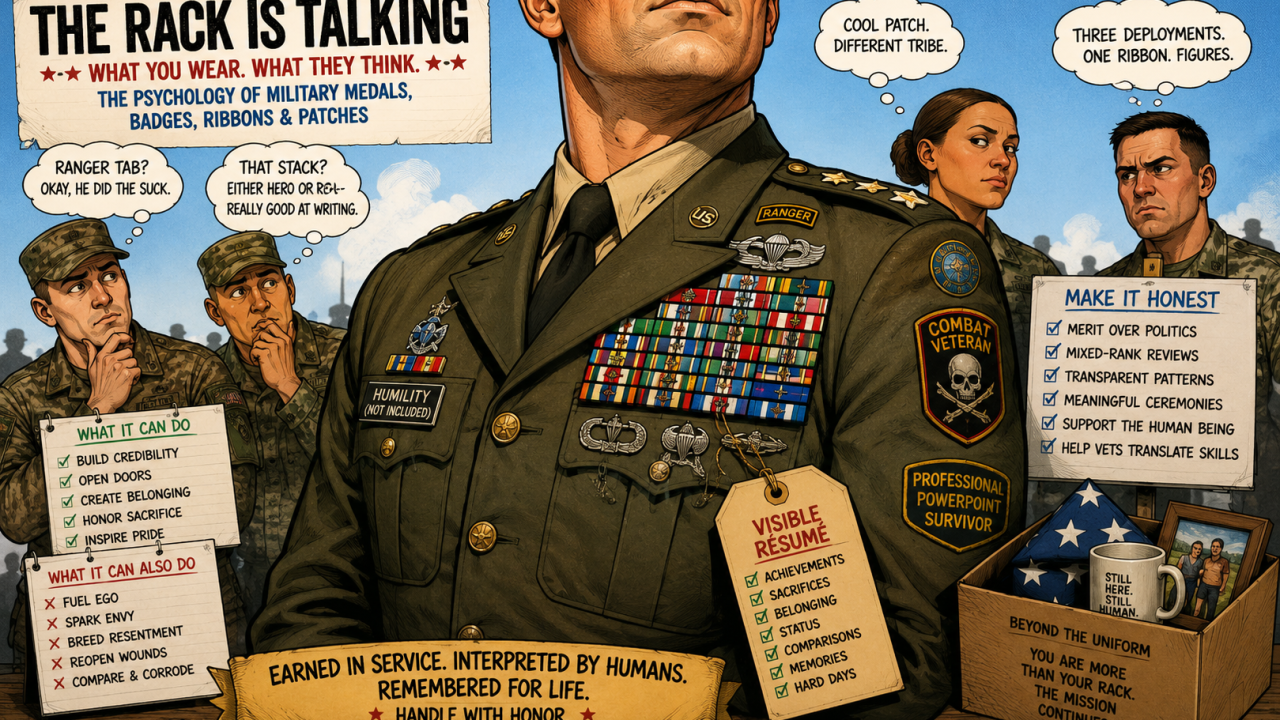
Yes, I’m aware the ribbons, badges, patches, and uniform configuration in the illustration aren’t regulation-correct. Before anyone alerts the Pentagon, contacts Stolen Valor, or begins cross-referencing AR 670-1 with the forensic intensity normally reserved for a coup investigation, please remember that this is satire, not a promotion-board photograph.
The image is meant to depict the psychological circus surrounding visible military status, not provide a printable guide for arranging your ribbon rack. Any resemblance to an authorized uniform is approximate, accidental, and probably already awaiting correction by a retired first sergeant with a ruler, a magnifying glass, and absolutely nowhere else to be.
The military, in its infinite talent for turning every human emotion into a regulation, decided achievement should be displayed over the heart in tiny rectangles of colored fabric. It’s a wearable personnel file, except everyone can read it from six feet away while pretending they aren’t counting.
Walk into any formal military event and watch the eyes. Nobody stares, of course. Professionals conduct a tactical scan. Rank. Wings. Tabs. Combat patch. Deployment ribbons. Valor device. Three rows? Six rows? One lonely ribbon sitting there like the last mozzarella stick at a command picnic? In four seconds, an entire biography has been invented and briefed to higher headquarters.
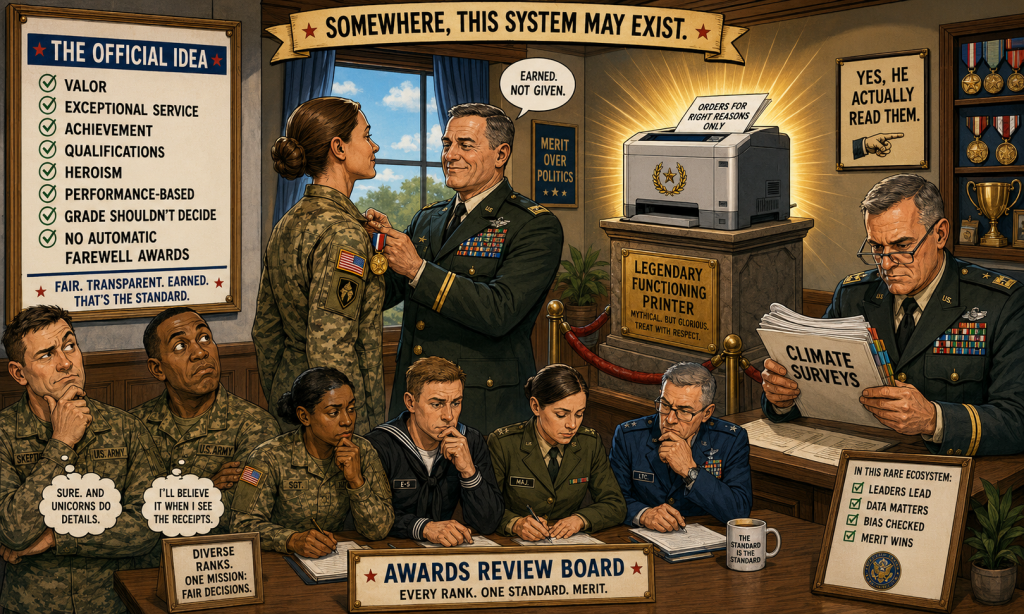
The official idea is respectable. Army regulations say decorations provide tangible recognition for valor, exceptional service, achievement, qualifications, and heroism. They also say service and achievement awards are supposed to be performance-based, grade shouldn’t determine recognition, and nobody is automatically entitled to an award merely for leaving an assignment. Somewhere, perhaps beside the perfectly functioning printer and the colonel who reads every climate survey personally, that system may exist.
In actual units, the ribbon rack can become military astrology. A senior officer with a crowded chest is presumed to possess wisdom distilled from campaigns, schools, commands, and hundreds of PowerPoint slides survived without visible nerve damage. A junior service member with fewer decorations may be equally capable, but the uniform whispers, “This one hasn’t collected enough downloadable content.”
Decorations are social currency because military life runs on compressed signals. There isn’t time to read everyone’s record before deciding whose judgment carries weight. So we use symbols. Ranger tab. Submariner dolphins. Aircrew wings. Combat infantry badge. Shoulder patch. Each says something real, but humans inflate meaning until a qualification becomes a personality, a deployment becomes moral authority, and a ribbon rack becomes a stained-glass window depicting Saint Kevin of the Exceptional OER.
Then comes comparison. One person sees a medal and remembers the worst day of his life. Another wonders why his packet vanished into the battalion headquarters Bermuda Triangle. A third knows why the executive officer received an award two levels higher for “strategic synchronization” while the people doing the synchronizing received a handshake and leftover sheet cake.
Recognition curdles into resentment when it rewards proximity to authority, literary gymnastics, and the rare battlefield skill of standing near the person with approval authority.
The psychological stakes go deeper than professional jealousy. A 2025 mixed-methods study found that decorations may ease or intensify moral injury depending on whether the recipient sees the recognized act as justified and the award as authentic. The experiment found no simple across-the-board effect, which is researcher language for “human beings remain inconveniently complicated.” Interviews suggested praise can feel validating, hollow, or grotesque when the institution celebrates an event the recipient still experiences with guilt, shame, or anger.
A medal pinned during a cheerful ceremony may represent courage. It may also represent the day someone died, the order that should’ve been questioned, the friend who should’ve been standing there, or the command’s attempt to place a shiny object over an open moral wound and declare the matter administratively complete.
Patches and badges shape belonging. They identify tribe, competence, history, and ordeal. Military identity can support resilience and connection, while identity disruption and concealment can accompany poorer mental-health outcomes, especially during transition. Research on veterans’ medals likewise shows that wearing them can reactivate and reshape veteran identity over time. Remove the uniform at separation and the person loses an entire language that once explained status, sacrifice, and community.
So what should be done?
Make award systems harder to game. Use mixed-rank review panels. Strip names and irrelevant personal identifiers from packets while preserving duty level and operational context. Publish unit award patterns by grade and occupational field so commanders can see whether “performance-based” keeps producing a pyramid with brass at the top. Track downgrades and processing delays. Separate farewell appreciation from merit decorations. A certificate can thank someone for serving without pretending that changing offices was the Battle of Midway.
For awards tied to combat, casualties, or morally difficult events, offer the recipient a private conversation before the public ceremony. Ask what the award means to them. Give them control over how it’s presented. Make chaplain or behavioral-health support available without turning the moment into a diagnostic ambush.
Transition programs should help veterans translate decorations into honest narratives. “Army Commendation Medal” means little to most civilian employers. “Coordinated emergency logistics across five locations under severe time pressure” means something. The ribbon belongs in the shadow box. The competence belongs in the next life.
Medals, ribbons, badges, and patches carry power because people carry meaning. Treated carelessly, they become costume jewelry for bureaucracy. Treated honestly, they can recognize courage, preserve memory, strengthen belonging, and remind institutions that honor is supposed to describe conduct rather than decorate hierarchy.
Tammy’s Stack of Inconvenient Reading
For anyone convinced this essay was assembled entirely from sarcasm, unresolved command resentment, and a ribbon rack purchased beside the highway, here’s the adult paperwork:
Army Regulation 600-8-22 Military Awards
https://ri.ng.mil/Portals/31/Documents/MILITARY%20AWARDS%20AR_600-8-22.pdf
Types of Decorations, Their Social Meaning and Influence on Moral Injury
https://journals.plos.org/plosone/article?id=10.1371/journal.pone.0333344
Scoping Review of Military Culture, Military Identity, and Mental Health
https://academic.oup.com/milmed/article/189/11-12/e2382/7688231
The Only Time I Think I’m a Veteran Is When I’m Dressed Up
https://www.tandfonline.com/doi/full/10.1080/17526272.2024.2443287
_____________________________
Tammy Pondsmith is the Pentagon’s unofficial curator of wearable self-esteem, currently banned from three promotion ceremonies for asking why “exceptional leadership” keeps showing up in the same parking spaces.
As the Voice of the Veteran Community, The Havok Journal seeks to publish a variety of perspectives on a number of sensitive subjects. Unless specifically noted otherwise, nothing we publish is an official point of view of The Havok Journal or any part of the U.S. government.
Buy Me A Coffee
The Havok Journal seeks to serve as a voice of the Veteran and First Responder communities through a focus on current affairs and articles of interest to the public in general, and the veteran community in particular. We strive to offer timely, current, and informative content, with the occasional piece focused on entertainment. We are continually expanding and striving to improve the readers’ experience.
© 2026 The Havok Journal
The Havok Journal welcomes re-posting of our original content as long as it is done in compliance with our Terms of Use.