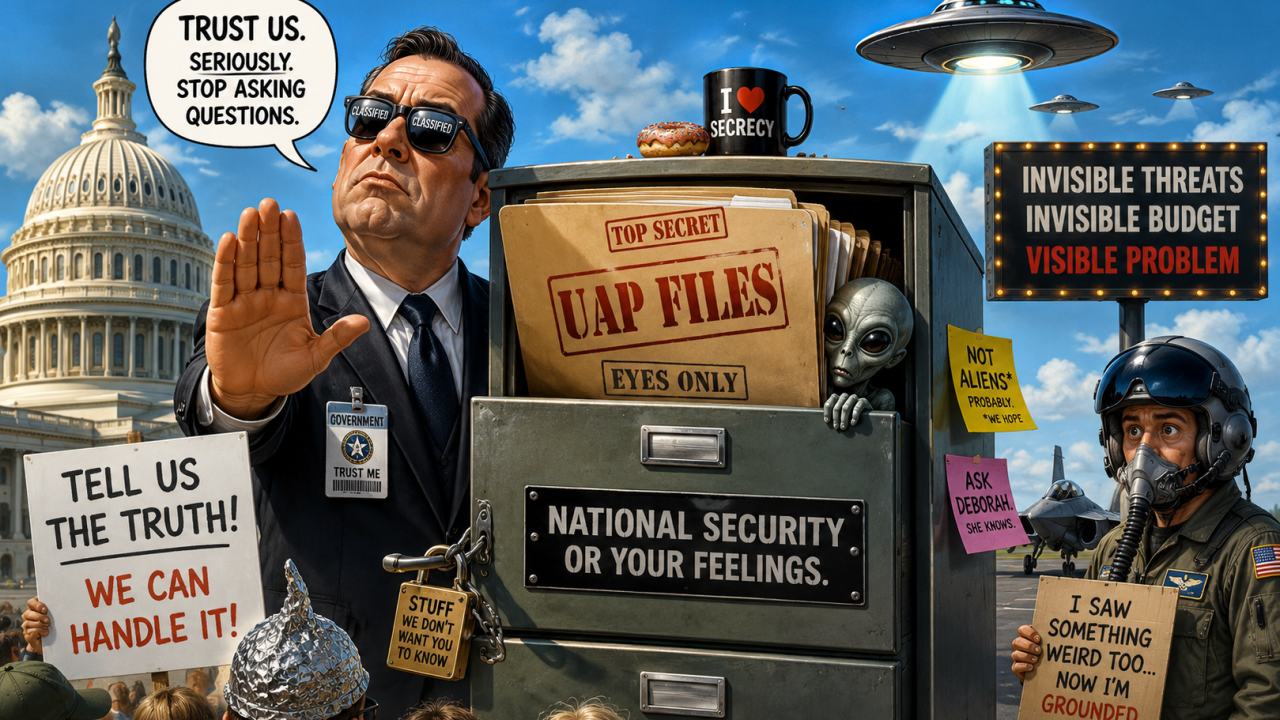
UAP disclosure is the perfect American scandal because everyone gets to be wrong in their own special outfit.
The government, naturally, behaves like a raccoon guarding a sandwich in a Pentagon air vent. Ask a simple question like, “What flew past the carrier group?” and suddenly some pale man with badge access starts sweating through a lanyard and explaining that the answer involves sources, methods, operational sensitivities, national defense, a secure facility, three acronyms, and a printer from 1997 that only Deborah knows how to use.
Then the public responds with equal restraint, by immediately deciding that every blurry dot in the sky is either a diplomatic envoy from Zeta Reticuli or the ghost of Nikola Tesla doing donuts over Fresno.

Beautiful. Everyone take a bow. Civilization has peaked and it’s wearing cargo shorts.
Here’s the part nobody wants to say because it ruins the fun of yelling “cover-up” into a podcast microphone shaped like a multivitamin. A lot of UAP secrecy is probably very practical. That doesn’t mean innocent. It means practical in the same way a casino has practical reasons for no windows. If the military releases the good version of a UAP case, it may reveal the sensor that caught it, the platform that tracked it, the altitude, the location, the resolution, the blind spots, the response time, and the delightful little fact that our billion-dollar surveillance system may occasionally mistake a balloon for a celestial TED Talk.
That’s the meat grinder. The object may be boring. The way we saw it may be priceless.
AARO has said it reviews UAP reports using classified information, including data collected by U.S. government systems. Translation, since apparently adults need one, the “thing” is sometimes less sensitive than the camera, radar, satellite, software, or classified military posture standing behind it like an overfunded bodyguard with a jazz degree.
This is how a soda can could become classified if it’s photographed by the wrong platform in the wrong place at the wrong time. The can isn’t James Bond. The lens is.
That’s the rational side. Now for the uglier side, because Tammy didn’t put on earrings to flatter a bureaucracy.
The government has also trained the public to distrust it by treating transparency like a vampire treats a beach vacation. For decades, people were mocked for reporting weird things in the sky. Pilots had to choose between speaking up and sounding like they’d taken aviation advice from a gas station wizard. Military personnel, commercial pilots, radar operators, and witnesses were all shoved into the same cultural attic as Bigfoot’s tax preparer.
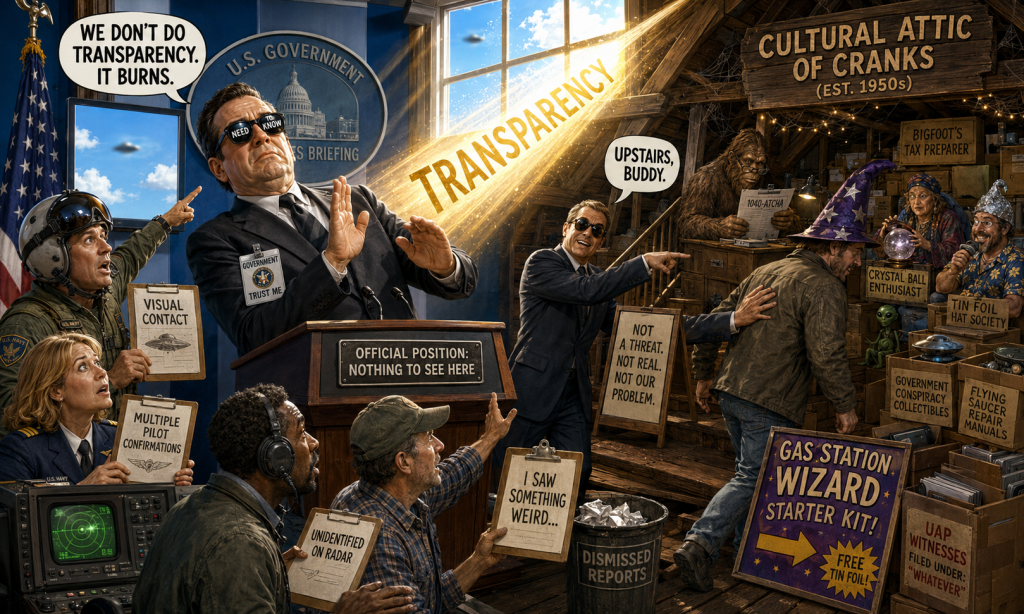
Then, suddenly, the official position became, “Actually, please report these incidents through proper channels.”
Oh, wonderful. After sixty years of giggling behind a clipboard, now they’d like everyone to use the form.
NASA said the field needs rigorous data, stronger reporting frameworks, improved analysis, and less stigma. Imagine needing a space agency to explain that humiliating witnesses is bad for collecting witness reports. Next week, a federal panel will bravely confirm that soup is difficult to eat with a rake.
The numbers aren’t trivial, either. The 2024 ODNI and AARO report covered 757 UAP reports received during the May 2023 to June 2024 period. AARO said 118 cases were resolved during that reporting period as ordinary things like balloons, birds, and unmanned aerial systems, while many other cases remained unresolved because the data was weak. As of October 24, 2024, the total was 1,652 reports. That’s enough to justify a serious system, even if half the sky is just Mylar having a midlife crisis.
And no, before the tin-foil caucus starts foaming into the comments, unresolved doesn’t mean extraterrestrial. It means unresolved. If your uncle disappears during Thanksgiving dinner, you don’t immediately conclude he was recruited by Neptune. You check the garage, the liquor cabinet, and whether he’s hiding from your aunt’s casserole.
The real scandal isn’t that every UAP is secretly alien. The real scandal is that the public is forced to choose between smug dismissal and fever-dream certainty because the institutions in charge have spent decades making “trust us” sound like a threat.
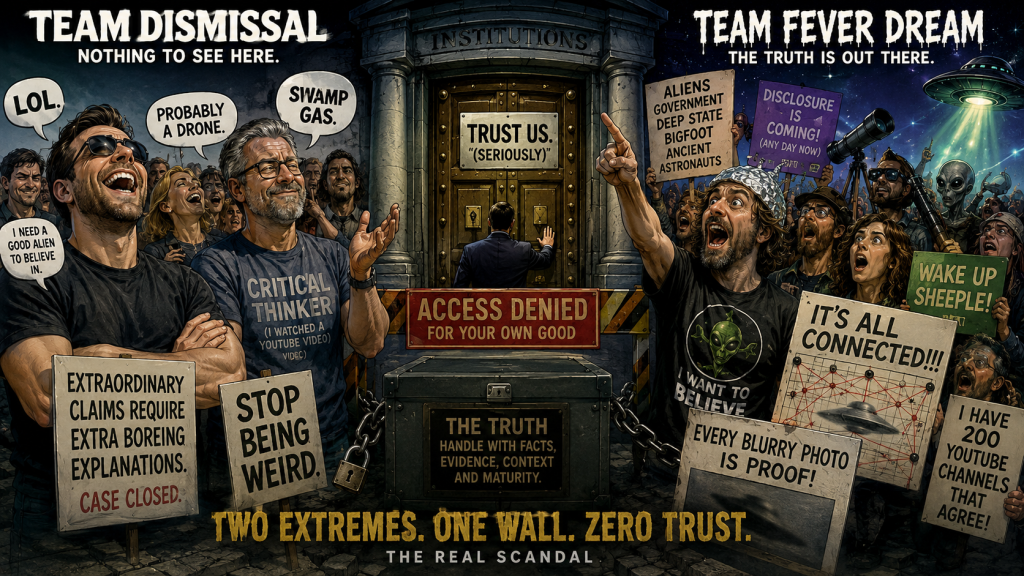
So here’s what should happen.
First, every UAP record should be presumed releasable unless an agency can name a specific harm, with a specific expiration timeline. “National security” can’t be a magic cape thrown over an entire file because someone in a windowless office feels shy.
Second, release layered versions of cases. Give the public the basic object description, date range, general location, confidence level, likely explanation, and what data was missing. Keep the sensitive sensor guts protected where needed. Adults can handle redactions when they aren’t delivered like a hostage note from a laser printer.
Third, create a standardized civilian and military reporting system with required metadata. Time, location, weather, direction, duration, sensor type, witness role, and whether somebody just launched 400 drones for a gender reveal over Albuquerque. We need structured reports, not campfire poetry with coordinates.
Fourth, protect pilots, service members, and contractors from career damage when they file good-faith reports. If we can protect whistleblowers who expose fraud, surely we can protect a Navy pilot who says, “Hey, that thing moved weird and I’d prefer not to become confetti.”
Fifth, fund independent scientific review of declassified or sanitized cases. Universities, aerospace engineers, atmospheric scientists, radar experts, image analysts, and pilots should be in the room. The current debate has too many influencers and too few people who know the difference between parallax and a portal.
Sixth, require annual public scorecards. How many reports came in? How many were resolved? How many lacked data? How many involved flight safety? How many were referred for possible foreign surveillance? How many got stuck in the swamp because some agency named after a Scrabble accident refused to answer email?
That’s transparency with a spine.

UAP disclosure matters because airspace matters, pilots matter, evidence matters, and public trust matters. If something is ours, say so when possible. If it’s foreign, take it seriously. If it’s natural, explain it. If it’s unknown, admit it without dressing uncertainty in a little tuxedo of bureaucratic nonsense.
And if it ever is aliens, I beg them to come during business hours and ask for Deborah, because she’s apparently the only person who can find the files.
For veterans specifically, this matters because the people who served inside restricted airspace, around classified systems, and under real operational risk deserve answers that don’t treat their testimony like a party trick performed by a haunted Roomba.
Tammy’s stack of irritatingly public documents for anyone allergic to taking a woman’s word for it
AARO and the Declassification Process
https://www.aaro.mil/Portals/136/PDFs/Information%20Papers/AARO_Declassification_Info_Paper_2025.pdf
2024 Consolidated Annual Report on Unidentified Anomalous Phenomena
https://www.odni.gov/files/ODNI/documents/assessments/DOD-AARO-Consolidated-Annual-Report-on-UAP-Nov2024.pdf
National Archives UAP Records Collection guidance
https://www.archives.gov/records-mgmt/uap-guidance
NASA UAP Independent Study Team Final Report
https://smd-cms.nasa.gov/wp-content/uploads/2023/09/uap-independent-study-team-final-report.pdf
AARO official website
https://www.aaro.mil/
_____________________________
Tammy Pondsmith is a former interpretive rage dancer, semi-licensed casserole interrogator, and the only woman ever banned from a congressional subcommittee for sighing in cursive.
As the Voice of the Veteran Community, The Havok Journal seeks to publish a variety of perspectives on a number of sensitive subjects. Unless specifically noted otherwise, nothing we publish is an official point of view of The Havok Journal or any part of the U.S. government.
Buy Me A Coffee
The Havok Journal seeks to serve as a voice of the Veteran and First Responder communities through a focus on current affairs and articles of interest to the public in general, and the veteran community in particular. We strive to offer timely, current, and informative content, with the occasional piece focused on entertainment. We are continually expanding and striving to improve the readers’ experience.
© 2026 The Havok Journal
The Havok Journal welcomes re-posting of our original content as long as it is done in compliance with our Terms of Use.