By Bruce D. Kowal
It is a marvelous tradition of the chiefs of our armed forces to publish a professional reading program, a reading list for officers and enlisted. Recently, the new Chief of Naval Operations, the CNO, put out his reading list, CNO Professional Reading Program, by U.S. Navy. This CNO has announced that today’s Navy can be seen as three interdependent parts: The Foundry, The Fleet and The Fight. These categories are the badge of a man who has pondered the massive establishment that is today’s Navy and sought to place it in a framework that is logical and open for discussion.
And I think it’s useful to print his intent [emphasis added]:
“Shipmates,
The United States Navy is and must remain the most formidable maritime fighting force the world has ever known. Our ability to deter, fight, and win depends not just on ships and aircraft, but on the sharpness of our minds, the strength of our character, and the resilience of our bodies.
Reading is a force multiplier. It equips us with the knowledge, perspective, and critical thinking necessary to lead, to innovate, and to prevail in the unforgiving crucible of combat. This list is not political, not trendy, and not designed to check a box. It is chosen deliberately to sharpen everyone in the Navy, from the halls of the Pentagon to the forward-deployed deckplates.
These are books I’ve found useful in my development as a Sailor and a Leader to encourage critical thinking, professional development, and discussion. The views expressed in the recommended books are those of the authors and do not reflect the official policy or position of the Department of the Navy, Department of War or the U.S. Government.
I have organized the books into categories aligned with my priorities: Foundry, Fleet, Fight, and added Total Sailor, which encompasses character, competence, decision-making, nutrition, and the whole person. Each category links to who we are, how we prepare, and how we fight.
This is a professional reading list, but it is also a call to reflection, discussion, and growth. Use these books in your wardrooms, your Chiefs’ Messes, and with your civilian teams. Ask tough questions. Challenge assumptions. Expand your thinking as a lifelong learner.
Daryl L. Caudle
Admiral, United States Navy
34th Chief of Naval Operations”
As a former E-6, I had never ventured into “doctrine,” except for an awareness of Alfred Thayer Mahan, and something about sea power and controlling the sea lanes. I stood my underway watches in heaving seas, at midnight, and thought no more of Rear Adm. Mahan.
And now I am reading The Origins of Victory, by Andrew F. Krepinevich Jr. (Yale University Press, 2023), and Deterrence, by Lawrence Freedman (Polity, 2004). And all of this is leading me to Arms and Influence, by Thomas C. Schelling (Yale University Press, 1966), and his earlier work, The Strategy of Conflict, by Thomas C. Schelling (Harvard University Press, 1960).
Although Mr. Schelling, in Arms and Influence, was writing of the Cold War, and his references are to the Korean War, the Cuban Missile Crisis and the Cold War in Europe, Berlin being the tripwire, and the beginnings of the Vietnam War, the teachings are readily transferable to the threat posed by China, as well as our recent actions against Iran: deterrence, compellence and the full working out of those terms. The real heart of his thought is in the first three chapters: “The Diplomacy of Violence,” “The Art of Commitment” and “The Manipulation of Risk.”
My framework here is to apply to recent events what I have learned from Mr. Krepinevich and from Mr. Schelling. To test both men against the moment.
Applying Mr. Krepinevich

Certainly, Russia’s experience in Ukraine demonstrates “disruptive military innovation,” the swift adaptation by Ukraine of drones to air, land and sea. Russia likely thought its February 2022 invasion of Ukraine would be its own successful version of Desert Storm. We realize now that Desert Storm, with its use of PGMs, marked both the beginning and end of a type of warfare. “Shock and awe.” Now, we wonder how any Army can seize and occupy territory faced with drone attacks.
There is already ongoing development of mobile mounted laser weapons to disable drones. Thirty Interceptions a Minute: An Israeli Startup’s Drone Solution, by Dean Shmuel Elmas (Globes). This is but one example. Is this really a full solution?
Let’s think about that for a moment. We may have tanks protected by light armor with such laser weapons. Maybe this weapon will be easy to mount on an Abrams tank. What shall we call these? Tank escorts? Because now we are into something much more costly, a land version of a carrier battle group, where combat ships are needed to protect the carrier. Is that the “logical” response? A tank battle group? Ten Abrams tanks in a column, with escort tanks on point and at the Six? And volumes of “doctrine”?
Mr. Krepinevich’s central argument is deceptively simple. The weapon does not make the revolution. Crécy was won by doctrine and concept, not by the longbow itself. The English did not merely acquire a new weapon. They reconceived the problem of battle around it. The French responded by building better armor. They lost anyway, and kept losing, because they were answering the wrong question.
Dronelight, the low-energy pulse laser system developed by Esh-Tech of Omer, is a genuinely interesting piece of engineering. Thirty interceptions per minute. Four kilowatts of output. NIS 0.10 per minute of operation against a drone that costs hundreds of dollars to manufacture in a garage. Unlike the Iron Dome’s economically absurd transaction of firing a Tamir interceptor missile at a Hamas rocket, Dronelight’s cost exchange ratio is actually favorable. Krepinevich would insist we acknowledge that honestly before proceeding. Not every directed energy response replicates the institutional pathology he documented. But acknowledging the favorable cost ratio is where the easy part of the analysis ends.
The first question Mr. Krepinevich would force me to ask is about range, and the answer is quietly devastating. Dronelight reaches one kilometer. In Ukraine, drones are routinely launched from well beyond that. An adversary who knows your intercept envelope simply launches from 1.1 kilometers. This means Dronelight is a point defense system, not an area defense system, and that distinction has enormous consequences for formation doctrine. How far apart can vehicles be and still provide overlapping laser coverage? Where are the seams? Krepinevich’s entire career has been a study in what adversaries do with seams, and they do not ignore them.
The second question is about swarm mathematics. Thirty interceptions per minute sounds formidable until you learn that coordinated drone swarms in Ukraine have involved fifty to 200 drones in a single engagement window against a single armored column. One Dronelight unit on one vehicle handles thirty per minute. The arithmetic only works if you have sufficient overlapping systems with coordinated fields of fire, which returns you immediately to formation doctrine, command and control architecture, and the escort vehicle problem that appears to have been solved, but has only been re-entered through a different door.
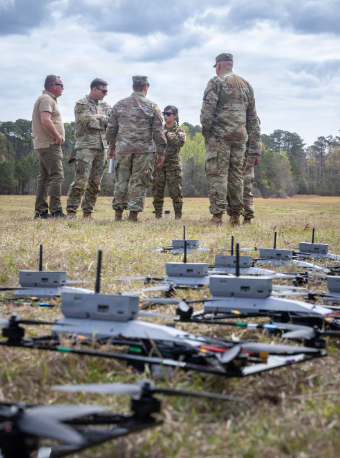
The third question is the countermeasure question: Dronelight burns through a drone’s body with focused energy. What happens when adversaries coat their airframes with reflective or ablative material? This is not speculation. It is the same adaptive logic as reactive armor against shaped charges, the same logic as the French building better plate armor after Crécy. Mr. Krepinevich documents this cycle with remorseless clarity. Hardware invites counter-hardware. The adversary adapts.
The laser system is hardware. Doctrine is not. This is precisely where Mr. Krepinevich’s argument bites hardest, not against Dronelight’s engineering, but against the institutional assumption that Dronelight closes the problem.
The fourth question is doctrinal and it concerns the crew. Dronelight’s 4kW draw is modest enough to mount on an existing Abrams without a dedicated power architecture. But a tank crew operating Dronelight now carries a dual mission. They are a direct fire ground platform and an active air defense node simultaneously. That is a doctrinal transformation of genuine consequence that nobody is yet writing the manual for. The question of how a crew manages target priority, situational awareness, and fire control across two entirely different threat spectrums in a fluid engagement has not been answered, because the institution has not yet fully asked it.
The fifth question is the one the carrier battle group analogy frames most precisely. The Abrams is the carrier. The drone is the DF-21. And the directed energy escort vehicle is the destroyer screen. The screen exists entirely because the carrier became simultaneously the dominant power projection platform and too valuable and vulnerable to operate alone. If Dronelight is mounted on the Abrams itself rather than a dedicated escort vehicle, it may appear to dissolve the analogy. But the underlying logic has not changed. The institution is still organizing its thinking around protecting the existing platform rather than reconceiving whether the platform remains viable at all. Krepinevich would say this is the most important distinction, between asking how we protect the Abrams and asking whether the era of the Abrams as the dominant land power projection platform has already passed.
The sixth question is the one that is most Krepinevich in spirit, and the quoted article itself provides the answer without recognizing what it has found. Dronelight was not developed by Rafael. It was not commissioned by a service branch through normal acquisition channels. It was built by twenty people in Omer, operating, as the article explicitly says, deliberately below the radar, funded through modest innovation grants while the institution debated doctrine elsewhere. Krepinevich documents this pattern across every military revolution he examines. The revolutionary capability emerges from outside the dominant institution while the institution is busy protecting its dominant platform. The submarine, the aircraft carrier, the precision guided munition. In each case the margin, the experimenter, the underfunded outlier, saw what the institution could not afford to see.
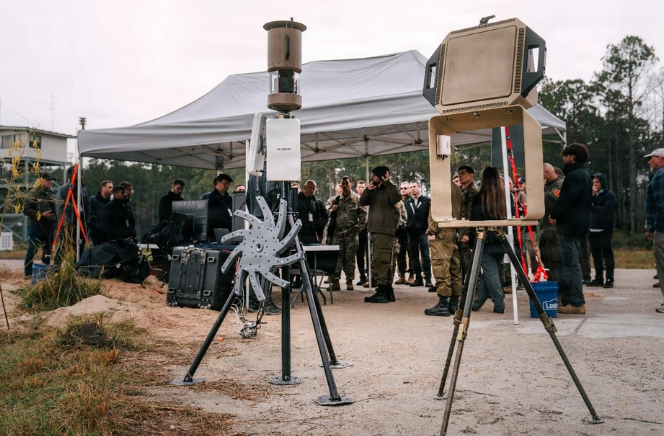
This does not mean the IDF has failed the Krepinevich test. The Israeli defense culture may be genuinely structured to hedge across both the institutional reflex and the revolutionary alternative simultaneously, funding Iron Beam at scale while nurturing Esh-Tech through the Mafat innovation program. Whether that constitutes authentic doctrinal reconception or merely sophisticated platform protection by other means is exactly the question Mr. Krepinevich would press.
Because Dronelight is promising enough, and cheap enough, and portable enough, that it might allow the armored column to survive the current generation of drone threats. And that survivability, if it comes, will feel like a solution. The institution will write the manual, build the doctrine, and design the next generation of armored vehicles around the assumption that directed energy point defense has restored the tank’s viability.
Mr. Krepinevich would call that the most dangerous outcome of all. Reassurance. Because reassurance postpones the harder reckoning, which is whether any ground force can seize and hold territory under persistent drone saturation regardless of what is mounted on the vehicle. The longbow did not merely threaten the mounted knight. It ended the social and military order that the mounted knight embodied.
Applying Mr. Schelling
My takeaways, an overused term, but we are stuck with it, from Schelling’s Arms and Influence are his frameworks for measuring commitment, as well as an exhausting parsing of the concepts of deterrence and compellence. And from his first book, The Strategy of Conflict, the concepts of brinksmanship, tacit bargaining, focal points, and most importantly credibility, and how to commit. And there is nothing in our current “kinetic” relations with Iran that has not already been limned by Tom Schelling in 1966.
Let’s start with the most fundamental distinction, the one Mr. Schelling labored over longest. Deterrence is passive. You are warning someone not to do something. Compellence is active. You are trying to make someone stop doing something they are already doing, or do something they are presently refusing to do. And compellence, Schelling said, is radically harder, because it requires the adversary to take a visible, humiliating action. They have to be seen to yield.
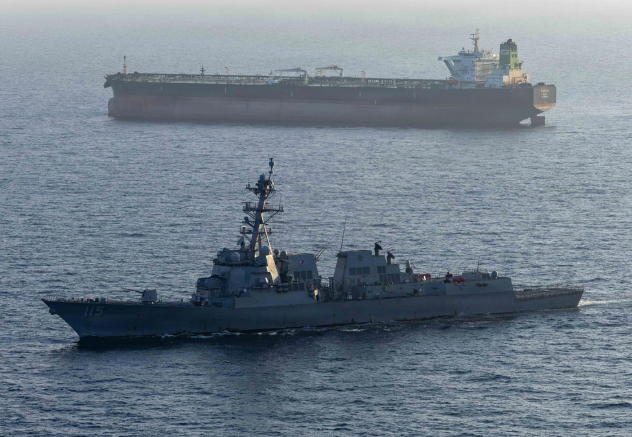
Operation Epic Fury is a compellence operation from start to finish, and the entire negotiating deadlock since April has been a textbook illustration of exactly why Schelling said compellence is so difficult.
Iran will not give up Hormuz control. Iran will not give up its enriched uranium. Iran will not be seen to have surrendered these things under military pressure. Every Iranian counterproposal preserves these positions in different language. Schelling predicted this in 1960.
The compelled party needs a face-saving exit, and no one has yet provided one.
Then look at the Strait of Hormuz itself as a Schelling focal point. It is the perfect example. It is geographically obvious. It is economically unambiguous. It is the point around which every negotiation naturally crystallizes precisely because both sides and every third party recognize it as the prize without needing to say so. Iran’s invention of the “Persian Gulf Strait Authority” on May 5 is a direct attempt to shift the focal point by bureaucratizing the Iranian claim, making it an institutional reality rather than a military one. Schelling would have recognized that move instantly.
Then look at credibility: President Trump threatens to strike power plants and bridges on June 10. Later that same day he says he will not strike Iran. A deal will be signed in Europe. This is not brinksmanship in Schelling’s sense. Brinksmanship requires that the risk be real and be perceived as real. What President Trump is doing by cycling through threats and withdrawals within hours is spending down credibility faster than the depleted missile inventory. Schelling’s entire architecture of commitment rests on the adversary believing you will do what you say. The CIA estimate that Iran still retains 70 to 75 percent of its missiles while the U.S. has expended 45 percent of its precision strike inventory is not merely a logistical problem. It is a credibility problem. The balance of remaining pain capacity has shifted, and both sides know it.
And then there is the tacit bargaining: The June 12 entry in the current timeline notes that both sides have different versions of what the ceasefire agreement says. Schelling described this exact dynamic. When adversaries cannot communicate directly, or will not, they coordinate around ambiguity. Each side reads the ambiguity in its own favor. The arrangement holds until one side acts on its reading and the other responds. Then you are back to kinetics, which is precisely what happened with Iran firing on a commercial vessel in the Strait in late June, restarting the exchange of strikes.
Schelling did not predict Operation Epic Fury, he described it. The distinction matters. Prediction requires uncertainty about whether the event will occur. Description requires only that you understand the “grammar of coercion” well enough to recognize every sentence.
The CNO reading list, the prompt for these 2,500 words, is not a professional credential. It is a civic capacity. The CNO put this list together for officers and enlisted. But the analysis it produces is available to anyone willing to do the reading. That is not a small point in a democracy that is currently watching its civilian leadership make real-time decisions about compellence and credibility in the Strait of Hormuz.
Admiral Caudle notes that: “Reading is a force multiplier. It equips us with the knowledge, perspective, and critical thinking necessary to lead, to innovate, and to prevail in the unforgiving crucible of combat.”
I hope that this essay demonstrates the soundness and accuracy of this pronouncement.

_____________________________
Bruce D. Kowal served as a Quartermaster in the U.S. Navy, completing four WESTPAC deployments during the Vietnam era. He currently serves as an AUXOP with the USCG Auxiliary. In the summer of 2025, he spent time embedded at Coast Guard Station New York.
As the Voice of the Veteran Community, The Havok Journal seeks to publish a variety of perspectives on a number of sensitive subjects. Unless specifically noted otherwise, nothing we publish is an official point of view of The Havok Journal or any part of the U.S. government.
Buy Me A Coffee
The Havok Journal seeks to serve as a voice of the Veteran and First Responder communities through a focus on current affairs and articles of interest to the public in general, and the veteran community in particular. We strive to offer timely, current, and informative content, with the occasional piece focused on entertainment. We are continually expanding and striving to improve the readers’ experience.
© 2026 The Havok Journal
The Havok Journal welcomes re-posting of our original content as long as it is done in compliance with our Terms of Use.


