curbside gift: a physical object or an act of kindness that you give, often anonymously, without expecting anything in return
I spent 27 years as an officer in the U.S. Army. Two of those years were spent in graduate school at Yale University, which ended up being one of the formative periods of my entire career. I came to Yale from a series of operational assignments in the special operations community, which involved serving as an intelligence officer in the 5th Special Forces Group, the 160th Special Operations Aviation Regiment, and, most recently, the Joint Special Operations Command. Going to Yale after seven combat deployments within SOF was definitely a change of pace.
I was reminded of that time through a recent Facebook memory. It was three photos of my youngest daughter Shannon, who is 18 now but was probably four years old during our time at Yale. We lived in the town of Hamden, a short distance away from Yale’s campus at New Haven, in a rented house in a nice middle-class neighborhood in a good school district. Nothing much happened there.
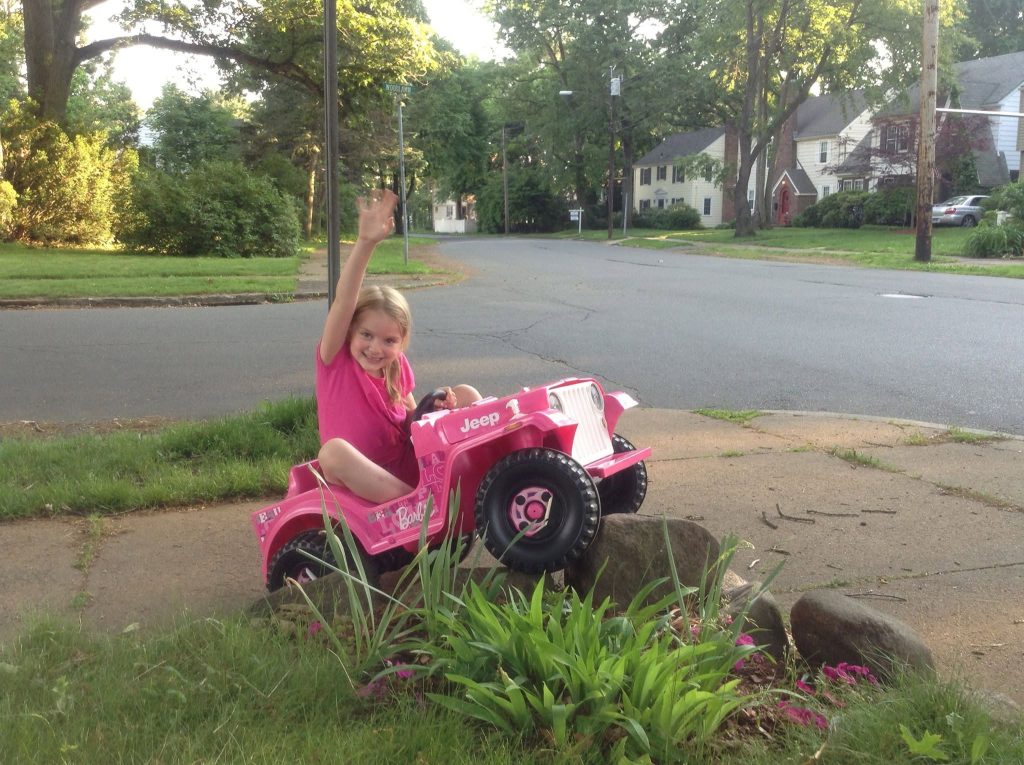
But one day on my drive home from school, there was some excitement: I spotted a pink child’s Jeep sitting at the edge of a driveway.
You know the kind. Battery-powered and Barbie-branded. Plastic wheels. Built for backyard adventures at a blistering three miles per hour… downhill. This one had clearly seen some miles. The bright pink paint was starting to fade from years in the sun, the body was scratched, and one of the wheel decals was beginning to peel away. Taped to the windshield was a simple sign:
FREE.
Somebody’s little girl had outgrown it.
To the family that put it by the curb, it was probably just one more thing taking up space in the garage. To them, it had reached the end of its useful life. To somebody else, however, it was the beginning of a new adventure. I didn’t know the neighbors who put it out. What I do know is that the people who left it there made a choice. They could have hauled it to the dump. Instead, they gave it away.
As a Jeeper, it immediately got my attention. And as the parent of two young girls, it was something I knew our family had to have. I parked my own Jeep (red, not pink) and walked down the street to claim our prize.

The Jeep was way to small for our oldest, Emily, and was almost too big for our youngest, Shannon, who was always tall for her age. It was ponderously slow, and her knees poked out when she drove. But to Shannon, it was hers, and she loved it.
Years later, when we live on West Point during one of my two instructor stints there, I put the Jeep out at our own curb. I don’t know who eventually picked it up. Maybe it became the prized possession of another child. Maybe a grandparent cleaned it up and gave it a second life. Maybe it ended up in the backyard of a family that couldn’t afford to buy one new. We paid it forward, courtesy of an anonymous neighbor’s decision to make a curbside gift.
That simple decision stuck with me. Not because of the Jeep itself, but because of what it represented. A gift from a stranger. No expectation of payment. No desire for recognition. No social media post documenting their generosity. No applause. Just a quiet act of kindness directed toward whoever happened to need it next.
The world could probably use more of that.
The veteran community certainly could.
When most people think about helping veterans, they picture large organizations, fundraising campaigns, and formal support programs. Those efforts matter, and many of them do remarkable work. But some of the most meaningful help veterans receive doesn’t come from institutions. It comes from people.
It comes from the veteran who reviews a resume. The retired NCO who makes a phone call to help someone find a job. The former platoon sergeant who checks in when a buddy goes quiet. The neighbor who notices someone struggling and offers a hand. The friend who shares information about benefits, resources, or opportunities.
Those are our community’s curbside gifts. Not because they’re now unwanted, but because they’re freely given.
Every veteran can probably point to a moment when somebody provided exactly what they needed at exactly the right time. Maybe it was a place to stay during a difficult transition. Maybe it was advice from someone who had already navigated civilian life. Maybe it was an introduction that opened a professional door. Maybe it was simply a conversation when life felt overwhelming.
Most of those gifts cost little or nothing. Yet they often have enormous impact. Just look at that smile on Shannon’s face.
I’ve had the kind of career that allowed me to do good things for good people. And I’ve been the recipient of curbside gifts throughout my Army career. Two big ones immediately come to mind. When I was in the Joint Special Operations Command, I decided to apply to teach at West Point. I commissioned through ROTC and was unfamiliar with how the West Point instructor process worked and what was necessary to land one of the highly competitive positions there. I applied (and was rejected) two or three times before one of my JSOC colleagues, without my knowledge, made some phone calls and got me the letter of recommendation that finally got my foot in the door.
That act of kindness, which I didn’t even know about until it was completed, led me to attend grad school at Yale and then go on to teach at West Point. My time at West Point was the most meaningful and fulfilling work I did as an Army officer—and that includes seven combat deployments and assignments to units like the 101st Airborne, the 5th Special Forces Group, the 160th SOAR, and JSOC. And it all came from a curbside gift.
Many years later, I was on an assignment to U.S. Army Pacific in Hawaii. It sounds like a great assignment, and it should have been. But I hated it there. I hated it for the reasons most people hate assignments: the leadership. To be clear, it was one person. But she was the person in charge, and she made life absolutely miserable. To this day I’m convinced she was, and probably still is, a sociopath. If my previous example was a curbside gift, my interactions with this other leader were more like a curb stomping. How bad was it? Bad enough that I was actively looking for a combat deployment to get me away from her. Think about that for a moment: I would rather go back to war in Iraq or Afghanistan than to be in Honolulu, Hawaii under her “leadership.” I ended up doing a couple of months in the Philippines, which was just enough time for her to fail forward into a position of even more responsibility, before she got fired from that one after an Inspector General report caught up to her.
Good riddance.
The Hawaii assignment was not all bad, however. Another leader in that organization, my immediate boss, worked to get me released from Hawaii early, and back to West Point. That was not a small thing. The person who did that didn’t have to do it. And in fact, my leaving actually made his life harder because he had one fewer good senior subordinate, and one fewer person to absorb the wrath of the sociopath. but he did it anyway, because that’s what good leaders–what good people–do.
I am grateful for those two specific curbside gifts, and the many others that I had and never even knew about.
The military teaches us that success is rarely an individual accomplishment. Nobody carries the load alone. Every achievement is built on support from others, whether we recognize it at the time or not. At our best, we understood that. Looking after one another wasn’t a program or an initiative. It was simply part of the culture. Unfortunately, that mindset can fade after we leave the service.
Life gets busy. Careers demand attention. Families require time and energy. We become focused on our own responsibilities and assume everyone else is managing theirs just fine. Meanwhile, veterans all around us are carrying burdens that could be made lighter by the smallest act of generosity.
The answer isn’t always a major intervention.
Sometimes it’s just a curbside gift.
Something useful that you’re no longer using. Knowledge you’ve already gained. A lesson learned the hard way. A professional connection. A recommendation. An opportunity. A little bit of your time.
The beauty of curbside gifts is that they create ripples.
The family who put that pink Jeep by the road will probably never know what happened to it. They’ll never see the smile on the face of the next child who climbs into the driver’s seat. They’ll never hear the laughter or watch it make endless laps around another backyard. Their role in the story ended the moment they walked back into the house.
But the gift kept moving.
The same thing happens every time we help another veteran.
Most of the time, we’ll never know the full impact. We won’t see every door that opens because of a recommendation we made. We won’t witness every success that grew from a conversation we had years ago. We won’t know how much a simple gesture mattered during somebody’s difficult season. That’s okay. The point isn’t recognition. The point is contribution.
The veteran community talks often about brotherhood, sisterhood, and taking care of our own. Those ideas matter, but they’re only meaningful when they become actions. The good news is that helping doesn’t have to be complicated. You don’t need a nonprofit. You don’t need a title. You don’t need a budget.
You just need something useful to offer.
Leave it at the curb.
Maybe it’s a job lead. Maybe it’s a piece of advice. Maybe it’s a phone call. Maybe it’s an opportunity. Maybe it’s hope.
Somebody out there needs it.
And just like that faded pink Jeep, the positive effects may continue long after you’ve forgotten where you left it.
All you have to do is put it out by the curb.
Charles served over 27 years in the U.S. Army, which included seven combat tours in Iraq and Afghanistan with various Special Operations Forces units and two stints as an instructor at the United States Military Academy at West Point. He also completed operational tours in Egypt, the Philippines, and the Republic of Korea and earned a Doctor of Business Administration from Temple University as well as a Master of Arts in International Relations from Yale University. He is the owner of The Havok Journal, and the views expressed herein are his own and do not reflect those of the US Government or any other person or entity.
As the Voice of the Veteran Community, The Havok Journal seeks to publish a variety of perspectives on a number of sensitive subjects. Unless specifically noted otherwise, nothing we publish is an official point of view of The Havok Journal or any part of the U.S. government.
Buy Me A Coffee
The Havok Journal seeks to serve as a voice of the Veteran and First Responder communities through a focus on current affairs and articles of interest to the public in general, and the veteran community in particular. We strive to offer timely, current, and informative content, with the occasional piece focused on entertainment. We are continually expanding and striving to improve the readers’ experience.
© 2026 The Havok Journal
The Havok Journal welcomes re-posting of our original content as long as it is done in compliance with our Terms of Use.