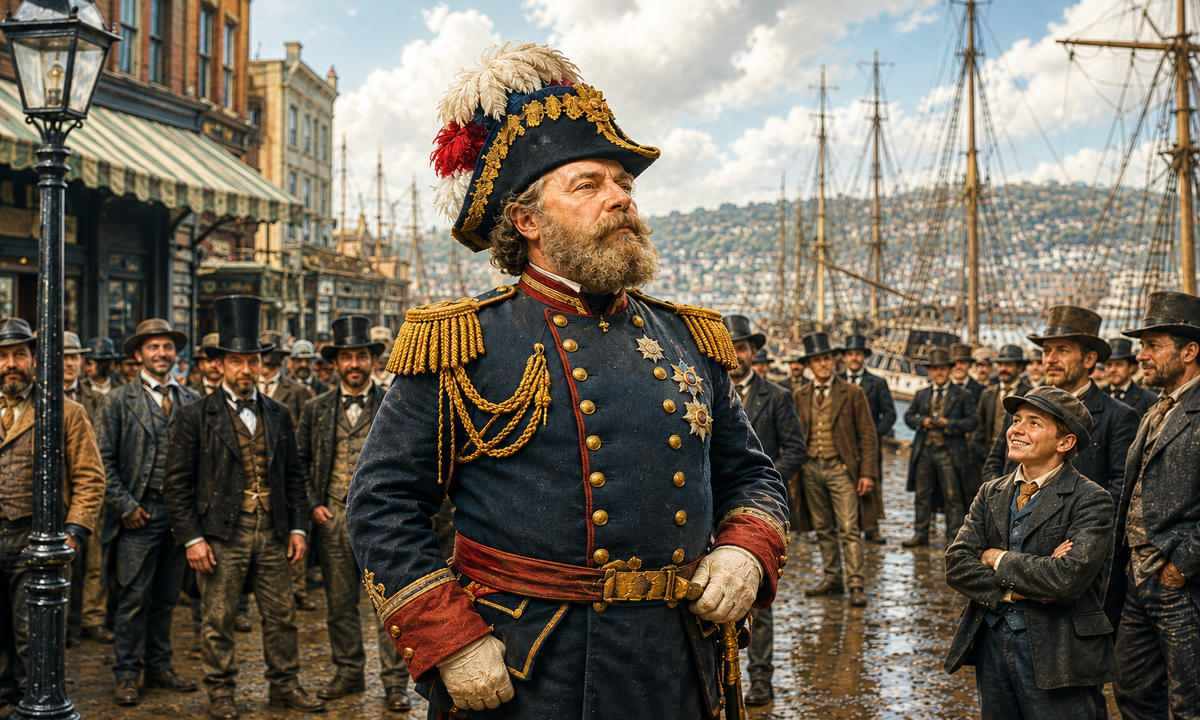
In September of 1859, a man walked into the offices of the San Francisco Bulletin and declared himself “Norton I, Emperor of the United States.” Shortly afterward, he added “Protector of Mexico” to the title for good measure. By any rational standard, Joshua Abraham Norton should have been dismissed as a harmless lunatic, another eccentric swallowed by the chaos of Gold Rush-era California.
Instead, San Francisco embraced him.
Newspapers printed his proclamations. Restaurants fed him for free. Police officers saluted him in the streets. Theaters reserved seats in his honor. Merchants accepted currency he personally issued. Upon his death in 1880, an estimated 30,000 people attended his funeral procession.
In an age obsessed with authenticity, institutions, and legitimacy, Emperor Norton remains one of the most uniquely American figures in history precisely because he exposed how fragile those concepts truly are.
Joshua Norton was not born insane. He was born into relative privilege in England in 1818 and later emigrated with his family to South Africa before eventually arriving in San Francisco during the explosive years of the California Gold Rush. By the 1850s, Norton had become a wealthy businessman and real estate investor. Contemporary accounts suggest he possessed intelligence, ambition, and a strong entrepreneurial instinct.
Then came rice.
In 1852, China experienced a famine that disrupted the global rice market. Norton attempted to corner San Francisco’s rice supply by purchasing a massive Peruvian shipment, expecting prices to skyrocket. Unfortunately for him, several additional rice ships arrived simultaneously, collapsing the market overnight. Norton lost everything in the ensuing legal and financial disaster.
Bankruptcy destroyed him socially and economically. In many respects, Norton disappeared.
When he reemerged years later proclaiming himself Emperor of the United States, observers naturally assumed madness. Yet the public reaction to Norton was strangely revealing. San Franciscans did not merely tolerate him out of pity. They participated in the fiction collectively and enthusiastically.
That distinction matters.
Norton’s “reign” unfolded during one of the most volatile periods in American history. The nation stood on the edge of civil war. Political institutions were increasingly distrusted. Corruption flourished openly. Violence and instability characterized much of public life in California. Against this backdrop, Norton’s absurd monarchy became a form of civic satire disguised as performance.
His proclamations often carried a sharper political insight than many legitimate politicians of the era.
He famously ordered the dissolution of Congress, denouncing partisan dysfunction and corruption decades before Americans would normalize contempt for their legislature. He proposed building a bridge connecting Oakland and San Francisco—an idea widely mocked at the time but eventually realized in the form of the Bay Bridge. He advocated religious tolerance and condemned sectarian violence. While many dismissed him as insane, some of his declarations demonstrated more foresight than the political establishment surrounding him.
Norton functioned less as a king and more as a mirror.
That mirror reflected something deeply American: the uneasy relationship between authority and legitimacy. Americans have historically distrusted concentrated power while simultaneously craving figures capable of transcending institutional paralysis. Norton exploited this contradiction perfectly. He possessed no legal authority whatsoever, yet ordinary people granted him cultural authority voluntarily.
In many ways, Norton understood something modern political systems still struggle to grasp—that power often depends less on legality than collective belief.
Military professionals should recognize this dynamic immediately. Armies are built on structured legitimacy. Rank insignia, uniforms, salutes, and command authority all depend upon collective acceptance of institutional rules. Strip away belief in those systems, and authority deteriorates rapidly. History repeatedly demonstrates that once legitimacy collapses, even powerful states become fragile.
Norton inverted this process. He possessed none of the formal machinery of power, yet acquired symbolic legitimacy through public consent and cultural affection.
That is both humorous and unsettling.
The military dimension of Norton’s story becomes especially interesting when considering America’s complicated historical relationship with titles, hierarchy, and leadership. The United States emerged from revolution explicitly rejecting monarchy and aristocracy. Americans traditionally pride themselves on egalitarianism while simultaneously creating elaborate systems of unofficial hierarchy and celebrity.
Norton occupied the perfect intersection of those tensions. Americans could indulge the fantasy of monarchy precisely because it lacked actual coercive power. Norton was safe because he represented authority stripped of force.
That distinction may explain why he became beloved rather than feared.
Unlike genuine tyrants, Norton demanded almost nothing from the population. He issued proclamations but commanded no armies. He wore elaborate military-style uniforms, often adorned with epaulettes and plumed hats gifted by local officers, but exercised no violence. He represented authority transformed into theater.
Yet theater itself possesses immense political significance.
Modern societies often underestimate the importance of symbolic figures and narratives. Institutions survive not merely through laws or force but through stories people collectively agree to believe. Flags, constitutions, ceremonies, and traditions all function partly as civic mythology. Norton instinctively understood this reality long before political scientists gave it academic language.
There is also something profoundly human in the public’s embrace of Norton. San Francisco in the nineteenth century was brutal, unstable, and economically ruthless. The city was filled with opportunists, drifters, criminals, immigrants, laborers, and failed dreamers. Norton himself represented personal collapse within that environment.
Yet rather than ostracize him entirely, the city created space for him.
This was not modern therapeutic compassion. Nobody attempted to “diagnose” Norton publicly or reduce him to medical terminology. Instead, society collectively transformed him into something larger than his suffering. He became a civic character, a wandering philosopher-king, a living symbol of absurdity and dignity existing simultaneously.
There is a lesson there modern America may have forgotten.
Contemporary society often oscillates between cruelty and clinical detachment when dealing with eccentricity, mental illness, or social collapse. Norton’s San Francisco responded differently. The city allowed him to preserve dignity through myth. Rather than forcing him into invisibility, it incorporated him into public life.
Perhaps that was kinder than we would like to admit.
None of this should romanticize mental illness or poverty. Norton almost certainly struggled psychologically after his financial ruin. His life was not a fairy tale. He died impoverished, collapsing on a San Francisco street in 1880 while on his way to deliver a lecture at the California Academy of Sciences.
But his legacy endures because he represented more than madness.
Emperor Norton revealed that legitimacy is often performative, that authority depends upon collective belief, and that societies occasionally choose imagination over strict rationality because human beings require symbols as much as systems.
Most importantly, Norton exposed the absurdity already embedded within politics itself.
After all, what separated Norton from many legitimate rulers throughout history? Clothing? Ceremony? Public recognition? Legal documentation? Entire monarchies have rested on foundations no more rational than collective agreement. Norton simply removed the pretense.
In doing so, he became one of the most uniquely American figures ever produced: a self-appointed emperor ruling a republic that officially rejected kings while quietly embracing one anyway.
Perhaps that contradiction explains why his story still resonates.
America has always been a nation suspended somewhere between seriousness and theater, idealism and absurdity, republican virtue and celebrity spectacle. Norton merely wore the costume openly.
The rest of the country eventually followed.
_____________________________
Charles served over 27 years in the US Army, which included seven combat tours in Iraq and Afghanistan with various Special Operations Forces units and two stints as an instructor at the United States Military Academy at West Point. He also completed operational tours in Egypt, the Philippines, and the Republic of Korea and earned a Doctor of Business Administration from Temple University as well as a Master of Arts in International Relations from Yale University. He is the owner of The Havok Journal, and the views expressed herein are his own and do not reflect those of the US Government or any other person or entity.
As the Voice of the Veteran Community, The Havok Journal seeks to publish a variety of perspectives on a number of sensitive subjects. Unless specifically noted otherwise, nothing we publish is an official point of view of The Havok Journal or any part of the U.S. government.
Buy Me A Coffee
The Havok Journal seeks to serve as a voice of the Veteran and First Responder communities through a focus on current affairs and articles of interest to the public in general, and the veteran community in particular. We strive to offer timely, current, and informative content, with the occasional piece focused on entertainment. We are continually expanding and striving to improve the readers’ experience.
© 2026 The Havok Journal
The Havok Journal welcomes re-posting of our original content as long as it is done in compliance with our Terms of Use.