In 1968, Star Trek aired one of its nastier little morality plays, an episode called “Patterns of Force,” in which a Federation historian tries to impose Nazi-style order on a chaotic planet and ends up creating exactly the sort of mechanized evil he was arrogant enough to think he could control.
By the time Captain Kirk arrives, the regime is already humming along on uniforms, slogans, fear, and bloodless bureaucratic certainty, with a compromised man enthroned at the center as the public face of authority while the real operators work the levers behind the curtain. It is almost offensively elegant. The figurehead gets the title. The handlers get the power. The propaganda department gets overtime.
Now take that premise, pour it into Biden’s presidency from January 20, 2021 to January 20, 2025, and suddenly Gene Roddenberry looks less like a science-fiction writer and more like a guy who accidentally wandered into a White House staffing chart and came back pale.
Because let’s stop pretending this was merely a normal administration with normal aging and normal political spin. This was a four-year master class in elite-managed illusion. It was a presidency presented to the public as command, while increasingly resembling assisted narration. It was a government that demanded the country ignore its own eyes, mistrust its own instincts, and clap on cue every time the people behind the curtain yelled, “Nothing to see here.”

From the first day of that term, the central question was not ideology. It was authorship. Who was actually governing? Who was drafting the major decisions? Who was setting the tone, defining the limits, shaping the language, and deciding what the president would say, sign, reverse, or “clarify” after he said it wrong the first time? That question hovered over the whole administration like a bat in a church belfry, and Washington’s answer was basically to throw a tarp over it and call everybody rude.
That is what makes the “Patterns of Force” parallel sting. The danger in that episode is not merely a broken leader. The danger is the system that forms around him. The people who discover that a weakened public face is actually useful. He absorbs blame. They exercise power. He gives them legitimacy. They give him stage lighting and a carefully managed schedule that says “resolute leadership” when it really means “do not let him freelance in daylight.”
During those four years, Americans were asked to accept a truly comic amount of contradiction. When Biden appeared shaky, confused, halting, or visibly diminished, we were told not to believe the evidence in front of us. When he drifted off script, aides “clarified” his remarks so often they might as well have been issued their own closed-captioning network. When public concern grew, that concern itself was framed as bad faith, cruelty, or partisan fantasy. The message was clear. Your perception is the problem. The management is flawless.
That’s not leadership. That’s gaslighting in a navy suit.
And what really deserves ridicule is the smugness of the people doing it. The consultants. The communications staff. The media clergy. The permanent capital-city ventriloquists who treated transparency like some vulgar Midwestern habit. These were people who wanted the reverence of constitutional government without the burden of constitutional accountability. They loved democracy right up until voters started asking who was actually running the executive branch. Then suddenly the public became dangerous, nosy, and insufficiently deferential to “the process,” which in Washington usually means “shut up while the unelected people finish deciding.”
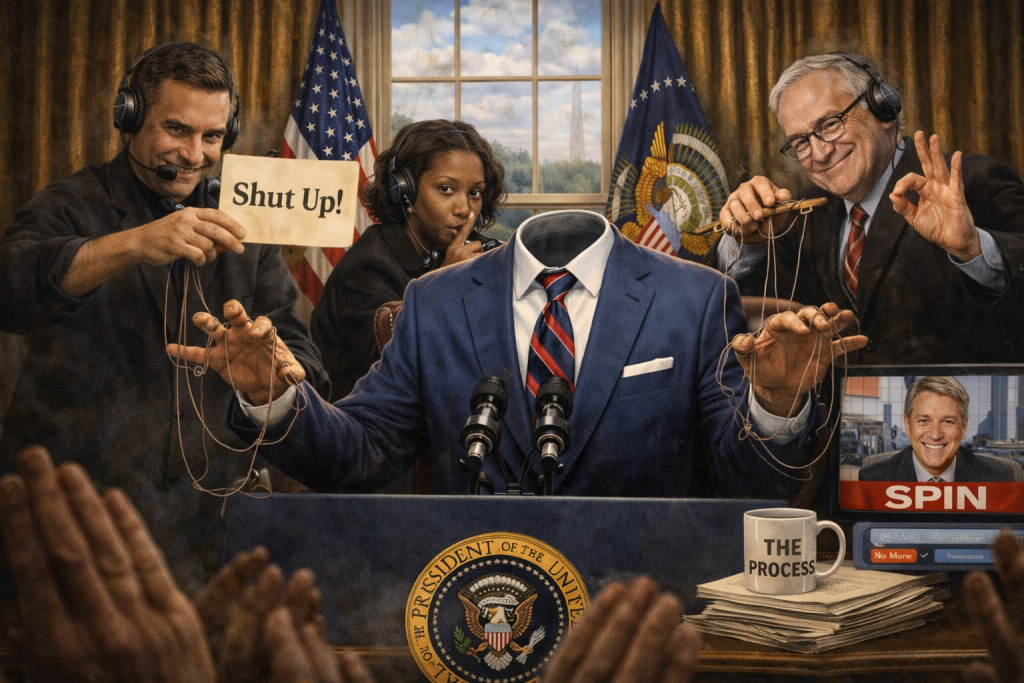
That’s the heart of the scandal. Not age by itself. Not decline by itself. Not even the existence of staff influence, because every White House has staff influence. The scandal was the scale of insulation. The degree to which mediation became substitution. The extent to which the presidency often looked like a brand wrapper around an internal operating committee.
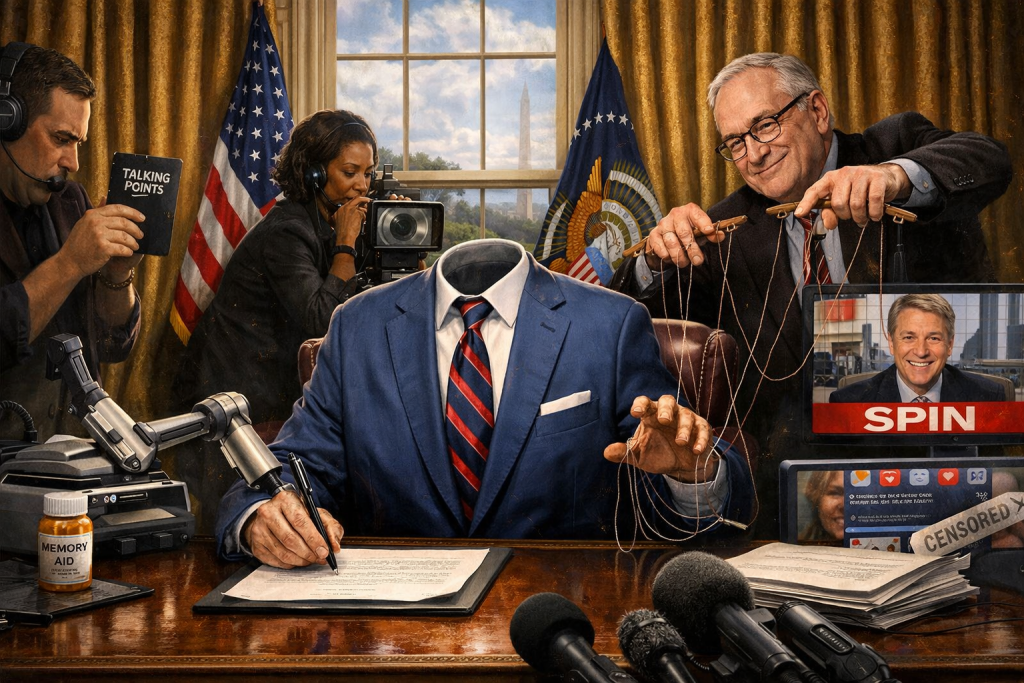
And then there’s the autopen, that tiny mechanical mascot for the age of outsourced responsibility. Yes, autopen use has bureaucratic precedent. Fine. Wonderful. Put it in a museum next to the fax machine and the last surviving ethics memo. But in a presidency defined by persistent public questions about agency, awareness, and control, autopen became more than a gadget. It became a metaphor so perfect it should’ve had its own office near the West Wing. Because what is an autopen, really, except the physical embodiment of modern political management? The signature is there. The person is allegedly there in spirit. The act is technically completed. Accountability is now wrapped in enough abstraction to survive another news cycle.
That’s the whole era in miniature. Formal authority remained visible. Actual authority became murkier by the month.
And of course the media helped, because naturally they did. A healthy press would’ve treated the discrepancy between presentation and performance as a central civic concern. Too much of the press treated it as a branding challenge. Their job, as many seemed to understand it, was not to interrogate the gap but to police who was allowed to mention it. So coverage became a ritual of selective honesty. Everything obvious was unsayable until it became impossible to hide. Then the same people who treated skepticism like heresy would pivot overnight into solemn concern, as if they’d just discovered fire.
How convenient. How brave. How absolutely full of it.
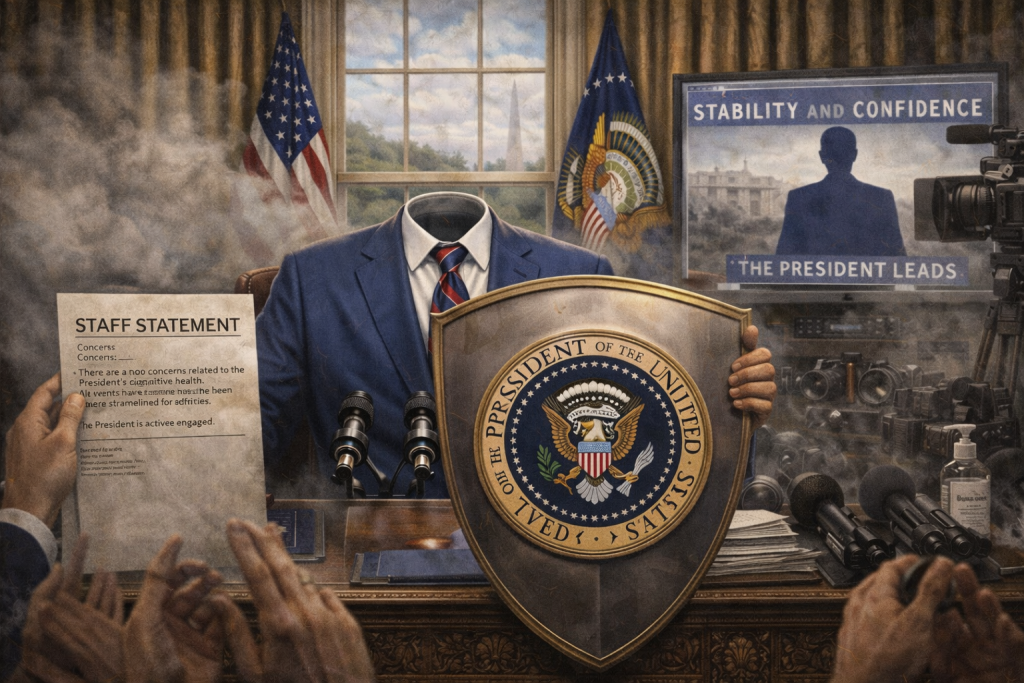
This is how republics decay without the decency to collapse dramatically. Not with tanks in the streets. With euphemism. With staff statements. With managed appearances, shortened events, sanitized interviews, and an entire culture of institutional throat-clearing designed to transform alarm into etiquette. The public is trained to confuse stability with concealment. The leader becomes a symbol. The symbol becomes a shield. The shield protects the people nobody elected.
So here are the practical fixes, because satire without remedies is just expensive whining.
Require documented presidential approval trails for major executive actions. Not vague assurances. Not staff paraphrase. Clear internal logs showing when the president personally reviewed and approved consequential decisions.
Mandate fuller medical transparency for sitting presidents. Not theatrical physician notes that read like valentines written by a campaign intern. Real assessments, standardized and independently interpretable.
Limit the routine use of devices and delegated procedures in high-consequence executive acts. The issue is not nostalgia for fountain pens. The issue is preserving unmistakable ownership.
Force more unscripted exposure. Longer press conferences. Fewer cocooned appearances. More situations where the officeholder must plainly demonstrate command without a convoy of handlers serving as intellectual airbags.
And finally, voters need to recover a lost civic skill, which is the ability to distrust packaging. A presidency is not a sentiment. It is not a protective myth for anxious partisans. It is a job. If the person in it cannot visibly, consistently, and convincingly do the job for a full term, then the country is being governed by workaround.
That was the story from January 20, 2021 to January 20, 2025. A presidency increasingly defined by mediation, insulation, and managerial theater. A public face treated as sacred, while the surrounding apparatus quietly grew bolder, more protective, and more contemptuous of scrutiny. “Patterns of Force” warned that the most dangerous regimes are not merely led by bad men, but structured around useful ones.
America watched the warning, hired the understudies, and called the ventriloquist democracy.
_____________________________
Tammy Pondsmith is Senior Vice President of Noticing Who Actually Runs Things, a thankless post created after Washington proved the real danger to democracy is not the frail man at the podium but the unelected choir teaching the public to applaud on cue.
As the Voice of the Veteran Community, The Havok Journal seeks to publish a variety of perspectives on a number of sensitive subjects. Unless specifically noted otherwise, nothing we publish is an official point of view of The Havok Journal or any part of the U.S. government.
Buy Me A Coffee
The Havok Journal seeks to serve as a voice of the Veteran and First Responder communities through a focus on current affairs and articles of interest to the public in general, and the veteran community in particular. We strive to offer timely, current, and informative content, with the occasional piece focused on entertainment. We are continually expanding and striving to improve the readers’ experience.
© 2026 The Havok Journal
The Havok Journal welcomes re-posting of our original content as long as it is done in compliance with our Terms of Use.