The modern educated class has built itself a religion for people who’d never survive a real one. It has all the thrilling features of old-time faith, guilt, ritual, excommunication, dietary fussiness, endless denunciations, and absolutely none of the useful side effects, like mercy, courage, or building a barn for a widow. What it produces instead is the Impossible Good Person, a nervous little saint of social correctness who can identify every sin except vanity, cowardice, and uselessness.
That is the central scam. We’ve replaced moral seriousness with moral accessorizing. Politics is no longer just about what you build, protect, repair, or improve. It’s become a competitive pageant in which people prove their virtue by displaying the correct anxieties in the correct order with the correct vocabulary and the correct facial expression. God forbid you solve anything. Solving things is messy. Somebody might have to pour concrete, balance a budget, talk to a disagreeable person, or admit that coalitions are made of flawed humans and not lab-grown angels.

So now public life feels less like citizenship and more like an admissions interview run by unstable prefects. You are not asked whether you are decent enough to join a cause. You are asked whether you are immaculate enough to deserve oxygen in the break room. The test never ends. There is always a new phrase to memorize, a new taboo to learn, a new moral panic to perform on command. It’s spiritual CrossFit for people whose real exercise is pointing at each other.
And notice how perfectly this flatters a certain kind of person. If your life is materially comfortable, you can afford to make identity maintenance your full-time cardio. You can turn daily life into a minefield of ethical micro-decisions and call it justice. You can feel heroic for auditing language while somebody less glamorous keeps the lights on, files the permits, drives the truck, fixes the pipes, grows the food, and does your taxes without announcing a land acknowledgment over the calculator. Nothing says modern virtue quite like outsourcing reality to people you privately consider barbaric.
That is why this whole performance has such a rotten smell of class vanity. The people most intoxicated by purity politics are often the least acquainted with the brutal dignity of necessity. If you’ve ever had to keep a business afloat, care for a relative, meet payroll, repair a roof, or coax a broken machine back to life, you develop a vulgar respect for competence. Real life beats the narcissism out of you. It teaches you that the person who gets the job done with imperfect rhetoric is infinitely more valuable than the self-certified angel who turns every meeting into a hostage negotiation with the latest approved doctrine.
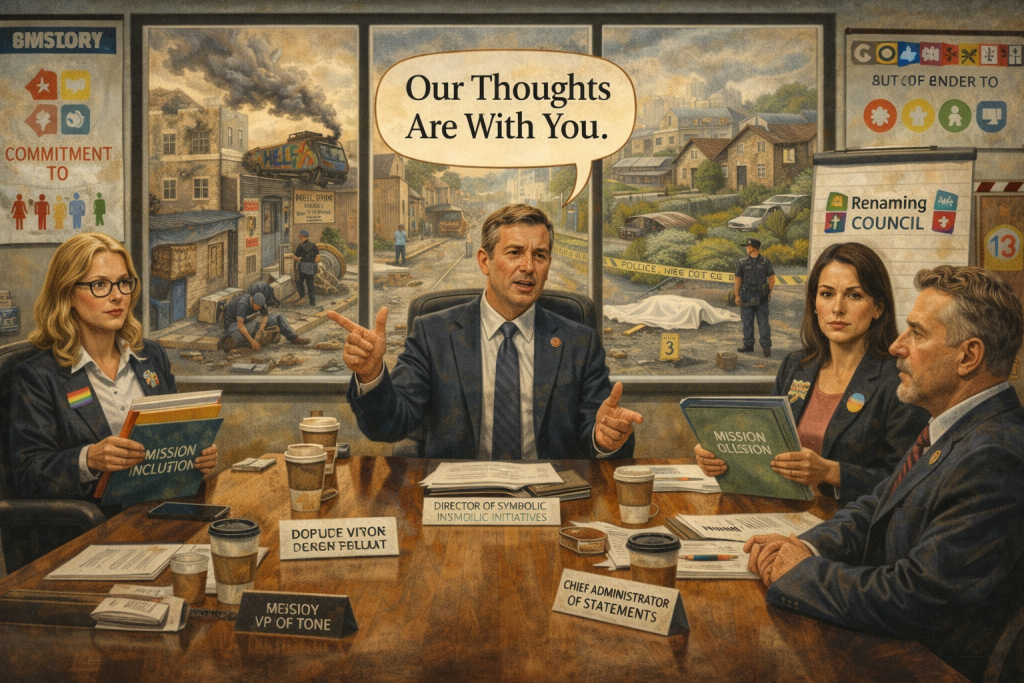
Institutions love this nonsense because it is cheaper than excellence. It costs money to run good schools, safe streets, reliable transit, workable housing, sane immigration systems, honest public health policy, and a justice system that doesn’t alternate between negligence and theater. It costs very little to issue a statement, hold a seminar, rename a committee, and appoint a deputy vice provost of Tone. Bureaucracies have discovered the miracle of symbolic management. When they cannot deliver results, they deliver atmosphere. When they cannot govern, they curate. When they cannot lead, they scold.
And to be fair, the other side has plenty of frauds, fanatics, and carnival barkers. No one with a functioning pulse should romanticize stupidity just because it wears work boots. But one reason looser, less self-interrogating tribes often look stronger is brutally simple: they understand that belonging cannot survive perfectionism. A coalition that requires total ideological purity is not a coalition. It is a luxury salon with enemies.
That is the part the purity addicts never grasp. Politics is the art of working with people who annoy you. Democracy is not speed dating for the morally exquisite. It is a grubby arrangement among imperfect citizens who need roads, order, wages, medicine, schools, and some basic permission to be human without passing a weekly heresy trial. If your movement cannot tolerate allies who are clumsy, mixed-up, uncool, religious, nonacademic, insufficiently updated, or merely ordinary, then your movement does not want power. It wants moral manicure.
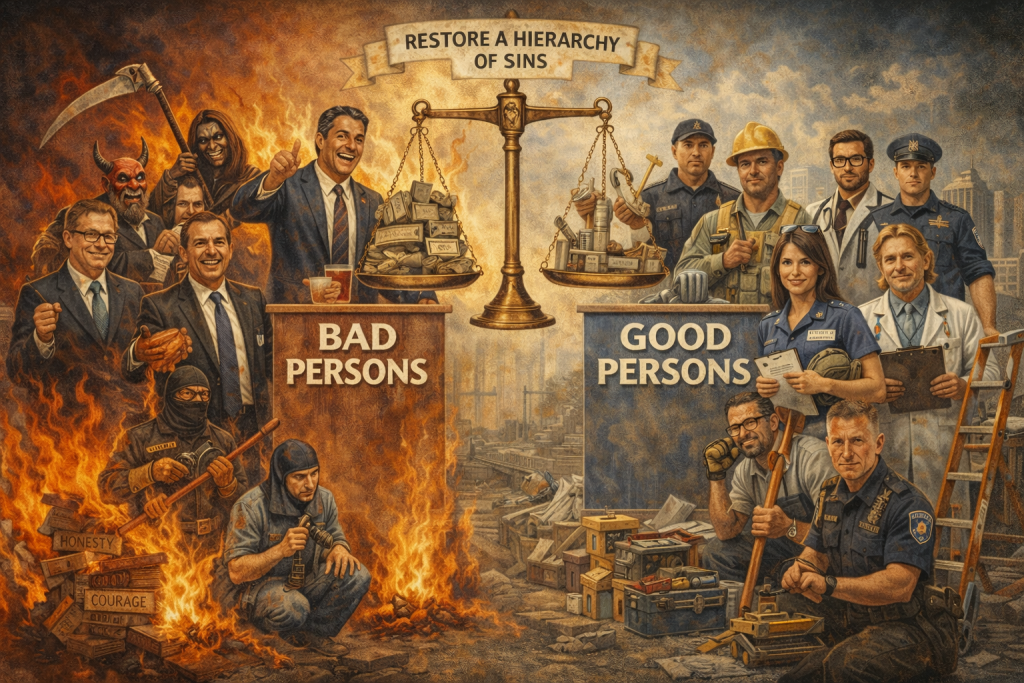
The solutions are not mysterious. First, restore a hierarchy of sins. Being corrupt, incompetent, violent, dishonest, or derelict is worse than speaking in less than postgraduate-approved phrasing. Adults know the difference. Second, reward usefulness. In politics and institutions, elevate the people who can make things function, not just the ones who can recite the latest catechism without swallowing. Third, allow disagreement without treating it as treason. Not every error is malice. Not every hesitation is hatred. Not every awkward person is a monster. Some are just awkward. Civilization used to know that.
Fourth, bring back humor. A movement that cannot survive being laughed at is not morally serious. It is emotionally brittle and probably lying. Fifth, judge politics by material outcomes. Are people safer? Is housing cheaper? Are schools better? Are families less crushed? Are public spaces more livable? If not, spare me the sanctimony. I am not paying retail for designer compassion that dissolves on contact with reality.
Above all, stop confusing permanent agitation with virtue. A decent society is not a graduate seminar with law enforcement powers. It is a place where normal people can breathe, speak, work, disagree, and occasionally enjoy themselves without some status-hungry deacon of fashionable morality auditing their soul for compliance points.
We do not need more Impossible Good People. We need resilient, fallible adults who can build a roof, tell the truth, laugh at themselves, and leave the rest of us alone until they’ve actually fixed something. Until then, the halo is just another office lanyard.

_____________________________
Tammy Pondsmith is Senior Fellow for Civic Pest Control who treats fashionable stupidity like a burst sewer main and never mistakes the smell for progress.
As the Voice of the Veteran Community, The Havok Journal seeks to publish a variety of perspectives on a number of sensitive subjects. Unless specifically noted otherwise, nothing we publish is an official point of view of The Havok Journal or any part of the U.S. government.
Buy Me A Coffee
The Havok Journal seeks to serve as a voice of the Veteran and First Responder communities through a focus on current affairs and articles of interest to the public in general, and the veteran community in particular. We strive to offer timely, current, and informative content, with the occasional piece focused on entertainment. We are continually expanding and striving to improve the readers’ experience.
© 2026 The Havok Journal
The Havok Journal welcomes re-posting of our original content as long as it is done in compliance with our Terms of Use.