If you want to understand modern politics, stop looking at policy and start looking at costumes.
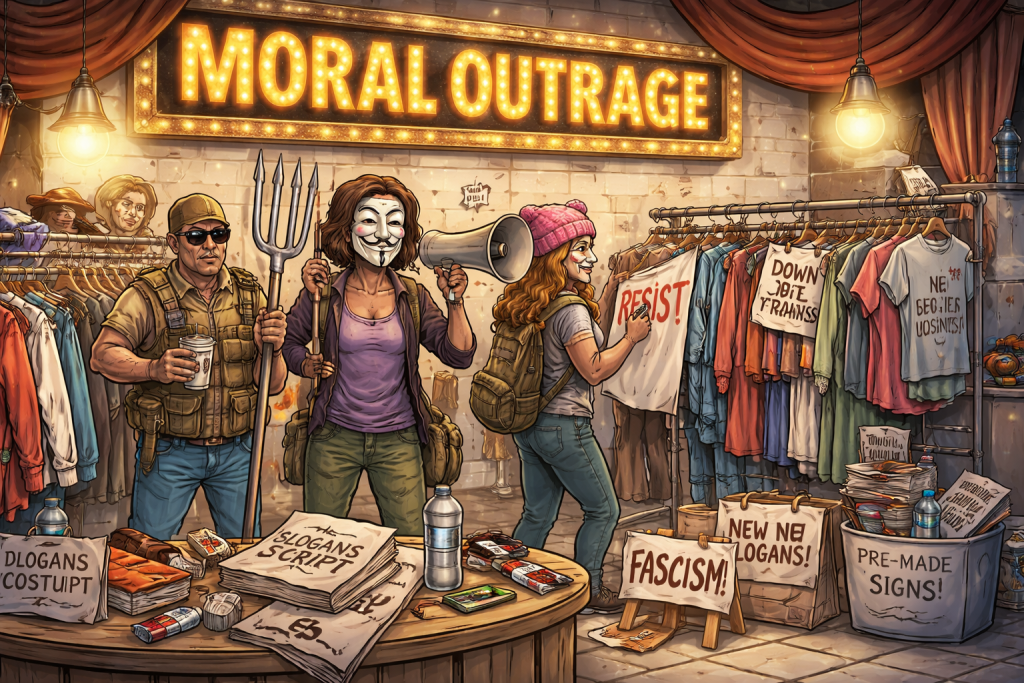
Everyone is auditioning for the role of “resistance hero” in a play that has no script, no director, and no apparent interest in reality. The props are mass-produced, the slogans are prewritten, and the villains are selected with the intellectual rigor of a horoscope. The only requirement is that you feel like you’re doing something important.
That’s the thesis. We are not arguing anymore. We are performing.
The performance works because it flatters the participant. You don’t have to grapple with how institutions actually function, or how power is distributed, or why outcomes don’t match intentions. You just pick a moral costume and step on stage. Suddenly, you are not a person with partial information and mixed motives. You are a character. Brave. Principled. On the right side of history, which is a phrase people use when they have no idea what history actually is.
Reality, unfortunately, is less theatrical. Systems are messy. Tradeoffs are real. Outcomes are often the result of boring administrative choices rather than grand ideological battles. But none of that photographs well. You can’t chant “incremental reform constrained by competing incentives.” It doesn’t fit on a sign, and more importantly, it doesn’t make you feel like a protagonist.
So the mind simplifies. It always does. It turns a complex system into a morality play. There must be a tyrant. There must be a rebellion. There must be a moment where you stand in a crowd and feel history coursing through your veins, even if what’s actually coursing through you is a vague sense of belonging and a decent amount of caffeine.
Here’s the problem. When everything is a morality play, nothing is measured against reality anymore. Claims don’t need to be precise. They need to be useful. Evidence doesn’t need to be consistent. It needs to be emotionally aligned. If a fact complicates the story, it’s ignored. If a narrative flatters the audience, it spreads like a rash.
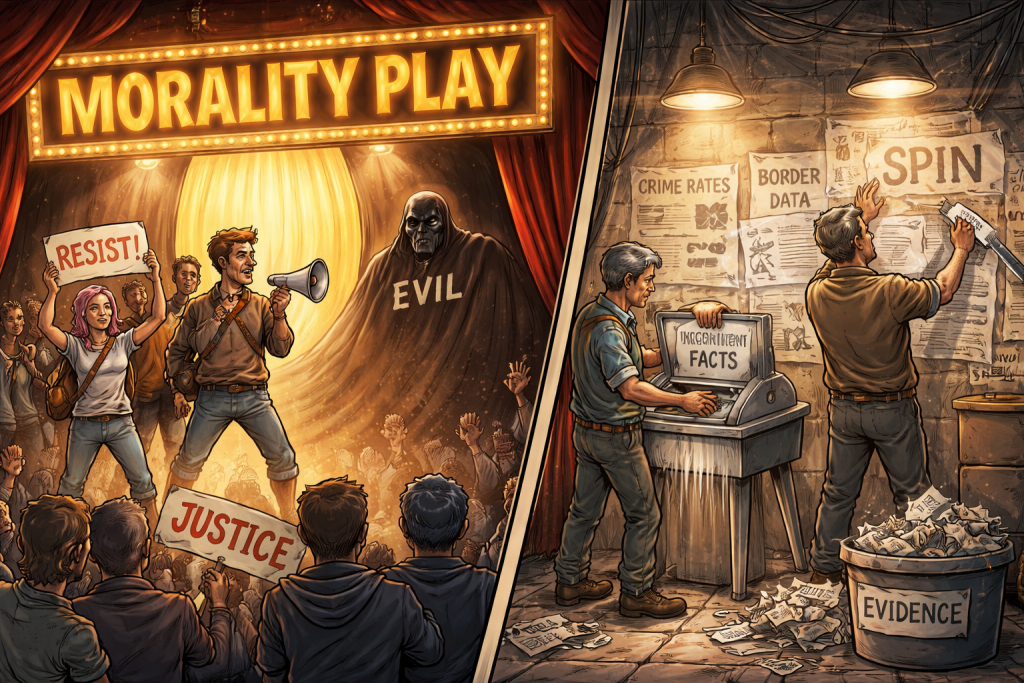
This is how you end up with people shouting about authoritarianism while living in a system that still tolerates open dissent, competitive elections, and relentless media criticism. Not because those institutions are perfect. They aren’t. But because acknowledging their existence would ruin the storyline. And the storyline is the point.
The same dynamic applies everywhere. Rules are oppressive until they’re convenient. Identification is a burden until it’s required for something you already agree with. Institutional authority is tyranny until it serves your side, at which point it becomes a necessary safeguard. None of this is hidden. It’s just unexamined. Hypocrisy isn’t a bug. It’s the operating system.
And before anyone gets comfortable, this is not a partisan diagnosis. It’s a human one. Give any group enough time, enough pressure, and enough incentive to feel morally superior, and they will start editing reality to preserve the feeling. The only difference is which details get edited out.
What’s new is the scale and the efficiency. You no longer have to construct your own understanding of the world. It arrives preassembled, complete with talking points, emotional cues, and a list of approved villains. You can join a cause the way you join a gym. Sign up, receive your orientation, repeat the phrases, and enjoy the mild glow of self-approval without the strain of independent thought.
The institutions people claim to distrust are often the same ones they rely on to validate their performance. Media amplifies it. Political actors exploit it. Advocacy groups package it. Everyone gets something out of the exchange. The participant gets identity. The institution gets engagement. The truth gets quietly escorted out the back door.
What’s missing is any serious interest in consistency. If you actually believed half the things people claim to believe, you would apply them universally. You would question your own side with the same intensity you reserve for your opponents. You would notice when your principles shift depending on who benefits. You would be, in other words, inconvenient.
But inconvenience doesn’t trend. Outrage does. Outrage is simple. It has a rhythm. It tells you who you are and who you’re not. It offers clarity without requiring understanding. It is the perfect costume for people who want to feel righteous without doing the tedious work of being right.
And so the performance continues. New slogans, same structure. New villains, same script. The crowd gathers, the lines are delivered, and everyone goes home convinced they’ve participated in something meaningful.
Maybe they have, in the narrow sense that shared illusions are still a kind of social glue. But if you’re looking for truth, or coherence, or even basic intellectual honesty, you’re in the wrong theater.
This isn’t a revolution. It’s community theater for people who think costumes are convictions.
_____________________________
Tammy Pondsmith is a Senior Fellow in Institutional Nonsense Studies who has spent a career watching serious adults cosplay their own press releases.
As the Voice of the Veteran Community, The Havok Journal seeks to publish a variety of perspectives on a number of sensitive subjects. Unless specifically noted otherwise, nothing we publish is an official point of view of The Havok Journal or any part of the U.S. government.
Buy Me A Coffee
The Havok Journal seeks to serve as a voice of the Veteran and First Responder communities through a focus on current affairs and articles of interest to the public in general, and the veteran community in particular. We strive to offer timely, current, and informative content, with the occasional piece focused on entertainment. We are continually expanding and striving to improve the readers’ experience.
© 2026 The Havok Journal
The Havok Journal welcomes re-posting of our original content as long as it is done in compliance with our Terms of Use.