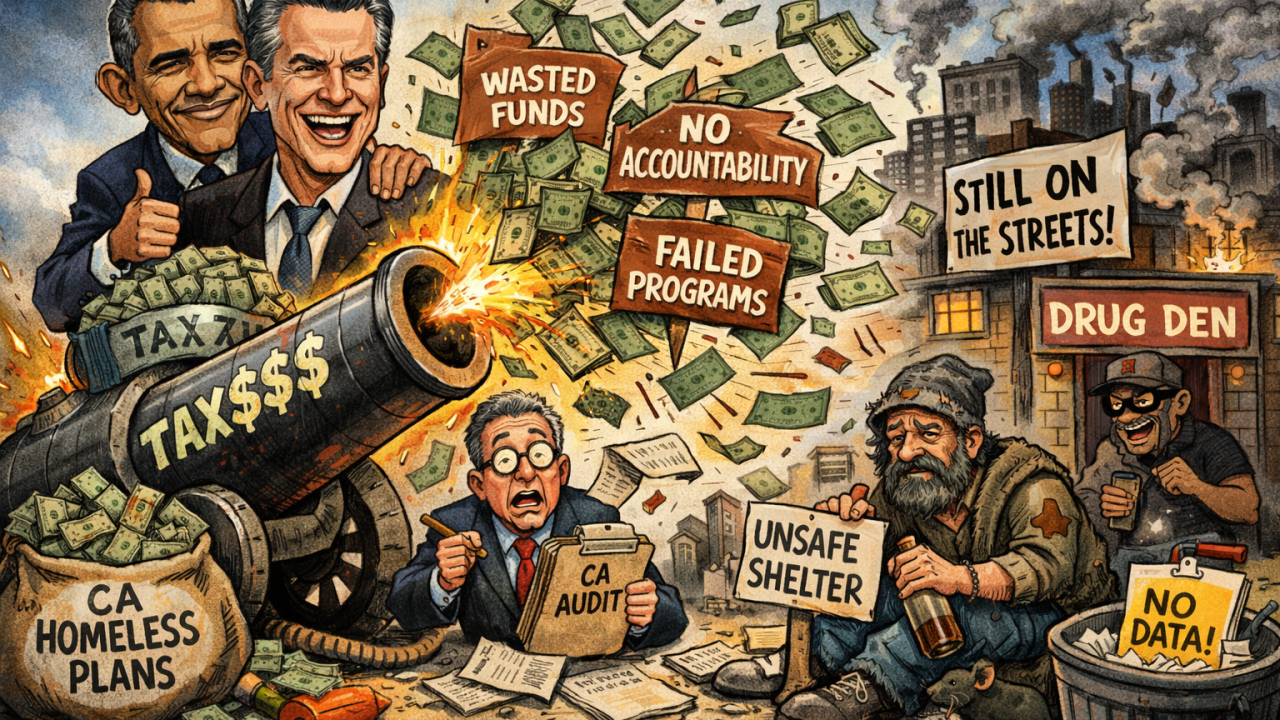
California has a special talent. Not Silicon Valley “invent a future” talent. Not Hollywood “manufacture a reality” talent. I mean the rarer gift: the ability to spend obscene amounts of money and still look you dead in the face like, “What money?”
Over roughly five years, California shoveled about $24 billion into homelessness programs—yes, billion, with a “B”—and the state auditor still couldn’t confidently tell you what worked, what didn’t, and where the outcomes went to die. That’s not policy. That’s a Vegas magic act where the magician also runs the cashier’s cage.
And before anyone starts sobbing into their reusable water bottle: yes, the moral premise is fine. The idea that people shouldn’t rot on sidewalks is not controversial unless you’ve replaced your soul with a parking validation stamp. The Obama-era “Opening Doors” framework—Housing First, safe and stable housing as the foundation—is explicitly rooted in the belief that nobody should be without a safe place to live. Great. Human. Civilized.
But California took that premise and performed the most California move imaginable: it turned compassion into a procurement process.

Because here’s the part that makes your molars hurt: the audit didn’t just say “needs improvement.” It said California lacks reliable, current, statewide information on the costs and results of key homelessness programs, and that the agency responsible for gathering the data hadn’t analyzed spending past 2021. Which is incredible. Imagine running a restaurant where you stop checking receipts in 2021 but keep announcing you’re “feeding the community” based on vibes and a dream.
Meanwhile, the street-level reality is not a spreadsheet problem. It’s a safety problem, a health problem, and yes, often a substance-use and mental-health problem—sometimes all at once. Major reporting and federal counts routinely show California has the nation’s largest unhoused population; HUD’s point-in-time count recorded about 181,399 people experiencing homelessness in California in 2023. Those aren’t “lifestyle choices.” That’s a full-blown systems failure with a human face.
And here comes the political two-step.
Governor Gavin Newsom touts a 9% drop in unsheltered homelessness based on preliminary community-reported 2025 numbers, calling it the biggest drop in years. Could that be true? Sure. Could it also be fragile, uneven, and influenced by counting methods, timing, local enforcement shifts, and the general chaos of tracking people who are—by definition—hard to track? Also yes.
Here’s the uncomfortable truth nobody likes to say out loud at the ribbon cutting: “unsheltered down” is not the same as “problem solved.” It might mean more people are inside. It might mean people moved. It might mean some communities counted differently. It might mean enforcement got tighter. Or it might mean the crisis is being rearranged like furniture before guests arrive—same mess, different corner.
And the other uncomfortable truth? Housing that exists on paper is not the same thing as housing that feels safe enough to enter.
If a person’s choices are “sleep outside with your eyes open” or “sleep inside where you might get robbed, threatened, or recruited into somebody else’s chaos,” a shocking number of humans will pick the option they can control: the sidewalk. That isn’t “refusing help.” That’s risk management. You can call that tragic, infuriating, or both, but you can’t call it irrational.
This is where the slogans start eating themselves.
Housing First is not “Housing Only.” It’s housing plus stability plus support. When the environment inside is violent or predatory, when staffing is thin, when rules are incoherent, when accountability is basically a suggestion—congratulations, you didn’t build housing. You built an indoor version of the street with worse lighting.
And the state’s data problems aren’t a nerd issue; they’re the beating heart of the scandal. Because when you can’t track spending and outcomes consistently, you don’t have an anti-homelessness strategy. You have a money distribution ecosystem.
That ecosystem has natural predators:
- Consultants who “coordinate stakeholders” (translation: schedule meetings about meetings).
- Vendors who bill like surgeons for services delivered like fast food.
- Agencies that measure success by dollars deployed instead of humans stabilized.
- Politicians who treat homelessness like a campaign backdrop: grim enough to sound urgent, vague enough to avoid consequences.
And taxpayers? Taxpayers are told to shut up, because asking “Where did it go?” is portrayed as cruelty. That’s the emotional blackmail at the center of the whole thing. If you demand accountability, you must hate the unhoused. If you don’t demand accountability, you’re “compassionate,” even if the outcome is… more suffering.
Here’s a radical idea: real compassion keeps receipts.
So sure, scream into the night about homelessness. Write the speeches. Declare the emergency. Announce the billions. But until California can answer basic questions—What did we fund? What did it do? Who got housed and stayed housed? Which programs failed? Which ones worked?—this will remain the state’s most consistent public service:
Turning moral urgency into a budget line item that evaporates on contact, like hand sanitizer in a fentanyl windstorm.
_____________________________
Tammy Pondsmith is a civic romantically-involved arsonist who lights policy on fire just to see which “community partners” try to invoice the smoke.
As the Voice of the Veteran Community, The Havok Journal seeks to publish a variety of perspectives on a number of sensitive subjects. Unless specifically noted otherwise, nothing we publish is an official point of view of The Havok Journal or any part of the U.S. government.
Buy Me A Coffee
The Havok Journal seeks to serve as a voice of the Veteran and First Responder communities through a focus on current affairs and articles of interest to the public in general, and the veteran community in particular. We strive to offer timely, current, and informative content, with the occasional piece focused on entertainment. We are continually expanding and striving to improve the readers’ experience.
© 2026 The Havok Journal
The Havok Journal welcomes re-posting of our original content as long as it is done in compliance with our Terms of Use.