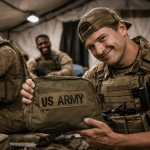
My son, Hans, called me. Hans is an Iraq War vet (2011 deployment). He likes to talk to me about his work (he pumps concrete for a living down in Texas). When we chat on the phone, the conversation always drifts toward military topics. Both Hans and I are veterans, and we have a mutual understanding of how the Army works. We share some common experiences.
Hans was lamenting how he sometimes loses his temper at home. Hans attributed his fits of anger to his time in the Army. He described it to me this way:
“Dad, I watched this video with a psychiatrist talking about how we get trained in the Army. This stuff isn’t just about guys with PTSD. Anybody who has spent a minute in the military is taught to deal with a problem right away. Now, some civilian, he might gradually react to different levels of stress. He might go from first gear to second to third to fourth and then to fifth gear. We go right from first to fifth! You and I are trained to deal with bad shit. We don’t know how to handle small stuff anymore.”

There is some truth to that. If you have been a soldier, then you are taught to have a “sense of urgency.” You deal with problems as if they were matters of life and death, because sometimes they really are. I remember when I was in flight school learning how to operate a helicopter. I got drilled over and over again about how to deal with emergencies in flight. What do you do if the engine quits? How do you handle a tail rotor failure? What if a hydraulic line breaks? When these things happen, there isn’t time to ponder your options. You do something and you do it right fucking now.
Hans noted that in a crisis situation we tend to act quickly, and somehow, we usually do it calmly. I can remember, back in 2009, when I got run over by a forklift at work. The 8,000-pound lift crushed my right foot and ankle. I screamed “fuck” when I got rolled, but after that I felt no emotions at all. I was aware that my leg was trashed, but I just stayed put and waited for the EMTs to come and throw me into the back of an ambulance. I can think of other traumatic situations where I just did whatever needed to be done, without really thinking or feeling. Afterward, I was a mess, but not during the crisis. It was almost like I was more of an observer than an active participant when things went sideways.
It’s the smaller issues that trigger us. I used to freak out when our kids would spill a glass of milk at dinner time. For years, I was a rage-aholic. I would go off the deep end over petty incidents. I could deal with the stuff that needed me in fifth gear, but I continually overreacted to the little things.
I told Hans that it gets better as you get older. It’s not that I am any more patient than I was years ago. It’s just that I no longer have the stamina to be constantly outraged by life. I still lose my temper, but I don’t have the energy to maintain that emotional state for more than a couple minutes. Often, after I blow up about some piddly thing, I feel sick and exhausted, sometimes for up to an hour.
I have found that meditation helps with the anger. It allows me to slow down while I deal with stress. I still can’t always shift through the gears in the correct order. But I can do better than I used to do.

_____________________________
Frank Pauc is a former Army aviator, a longtime trucking-company supervisor, and a contributor to The Havok Journal. A West Point graduate from the Class of 1980, he completed the Military Intelligence Basic Course and flight school, served with the 3rd Armored Division in West Germany and the 7th Infantry Division at Fort Ord, and left the Army in 1986. He later taught citizenship classes through Voces de la Frontera in Milwaukee, took part in peace and protest work, and writes largely about veterans, family, grief, and the long aftermath of military service.
As the Voice of the Veteran Community, The Havok Journal seeks to publish a variety of perspectives on a number of sensitive subjects. Unless specifically noted otherwise, nothing we publish is an official point of view of The Havok Journal or any part of the U.S. government.
Buy Me A Coffee
The Havok Journal seeks to serve as a voice of the Veteran and First Responder communities through a focus on current affairs and articles of interest to the public in general, and the veteran community in particular. We strive to offer timely, current, and informative content, with the occasional piece focused on entertainment. We are continually expanding and striving to improve the readers’ experience.
© 2026 The Havok Journal
The Havok Journal welcomes re-posting of our original content as long as it is done in compliance with our Terms of Use.