
It was Friday, Nov. 11, 2016.
Standing on the fantail, I watched the patchy, silvered overcast roll down out of the snow-frosted mountains. Their peaks looked especially foreboding and hostile that morning. At least they did when I could see them. Half the time, they were shrouded in mist that clung like a ground fog, which, when you think about it, describes mountain clouds, doesn’t it? Admittedly, my meteorology vocabulary was weak when it came to shoreside weather. I let my thoughts wander and just watched the day. The clouds broke for a moment and the sun, silver-white and cold, shone down with a diffuse light that was almost too harsh to look at. The wind was damp and cold as it rolled down from those peaks.
I zipped my parka all the way up and hunched into its stiff, high collar. That pale sunlight gave no warmth. The shroud over the mountain peeled away and the northern edge of the Olympic Range was revealed in a moment that should’ve been accompanied by a full orchestra playing the kind of music you associate with grand epic movies. Instead, all I heard was the steady drone of the aft-steering ventilation stacks. That and a lone set of bagpipes.
I clearly remember thinking, “Wait, bagpipes? What?”
The high-pitched sound was difficult to pinpoint, especially over water, and for a moment I thought I was hearing things. Trying to find a musical pattern in a squeaky fan belt or blown bearing. Finally, I spotted the crosshatched pattern of a traditional kilt. It stood out starkly on the vibrant green of the yard in front of the command building.
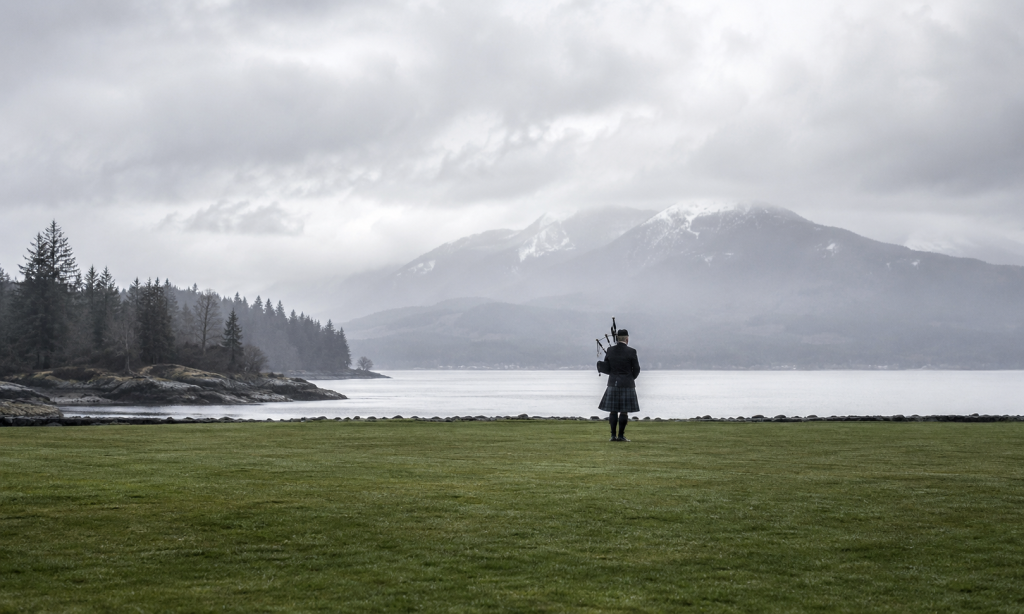
The figure was alone, with no audience to watch. At a distance of about 500 yards, he was little more than a human shape standing still as the wind ruffled the dark-colored cloth of his kilt and the tassels on his pipes. I recognized the tune from the half-dozen memorial and fallen soldier services I’ve attended, though I couldn’t put a name to it. The sound was soul-wrenching, mournful, lonely. There was an abnormally large amount of vehicle traffic on base that day. Further on, I saw a few dress uniforms moving around; some of them were a few decades out of date. The holiday ensign, an oversized American flag, flapped lazily on the flagstaff in the cold mountain breeze.
Bagpipes, old men in dress uniforms, holiday ensign … it was Veterans Day.
Duh.
The pipes continued to play. He shifted to “Amazing Grace,” and for some reason, I was overcome with grief, as though every child, spouse and lover who left for war in the last 200 years and never came home were somehow a personal loss to me. Thank God I was alone out there on deck. My throat closed and breathing was difficult. There was a visceral pain in my chest. I fumbled at my coffee mug and hid my face behind a long pull on the nearly scalding black liquid.
Enough was enough. I clamped down on the emotions. It was not the time or the place. I had never carried a casket draped in our flag, never taken a wound for my country, or lost a friend or family member to enemy action. I had no right to those emotions. The pain didn’t go away, it just stopped being important for a little while. The cold silver day suddenly seemed appropriate.
I had been thanked for my service, and even after six years of active duty, I was never certain how to respond. “You’re welcome, and it’s a privilege,” was my usual answer. I hardly believed that what I did in that short time earned any thanks. I hadn’t exactly closed with and engaged the enemy, or hunted them down in their places of strength at the ragged edge of the world so far from my home. Hell, I was more of a first responder than I was a warfighter.
I thought about all those things as I listened in the cold.
“Amazing Grace” finally ended. It sounded more like a lament than a hymn. Maybe it was. The sun disappeared behind a heavy blanket of bruised blue cloud and the wind grew colder. The peaks were completely covered again and the day was noticeably dimmer.
Maybe it was just my mood.
Those same people who thanked me for my service told me that I was a veteran. I certainly didn’t feel like one at the time. Though, maybe my view of veterans was a bit skewed. When I was very young, my mother’s side of the family still told stories of the Civil War. Granddaddy talked about his grandparents hiding chickens under the porch to keep Union soldiers from stealing them when Gen. Sherman burned his way to Savannah.
I sat across the dinner table from men who served in the European and Pacific campaigns of World War II, and shared an afternoon with those who served in Korea. I had two great-uncles enlist in that war. My father and many others I know were drafted for Vietnam. I remembered seeing Desert Storm on TV and talking to soldiers who came back from there. I went to college and boot camp during the early Iraq and Afghanistan campaigns in the early 2000s. I had shipmates who served and returned from Bahrain. Those men and women were the veterans. They were the ones who deserved thanks.
I was just trying to do the right thing and pay the bills along the way.
_____________________________
K.C. Aud is a U.S. Coast Guard reservist and Navy civilian contractor in the Puget Sound region. He enlisted in the Coast Guard in 2010 as an Operations Specialist, later served aboard USCGC Active, left active duty after several years, and reenlisted in 2020 as a Maritime Law Enforcement Specialist. Before returning to the service, he worked a range of civilian jobs, including brewing, farm work, machining, and Navy contract support. For The Havok Journal, he writes from Coast Guard and veteran experience, with a focus on military life and maritime service.
As the Voice of the Veteran Community, The Havok Journal seeks to publish a variety of perspectives on a number of sensitive subjects. Unless specifically noted otherwise, nothing we publish is an official point of view of The Havok Journal or any part of the U.S. government.
Buy Me A Coffee
The Havok Journal seeks to serve as a voice of the Veteran and First Responder communities through a focus on current affairs and articles of interest to the public in general, and the veteran community in particular. We strive to offer timely, current, and informative content, with the occasional piece focused on entertainment. We are continually expanding and striving to improve the readers’ experience.
© 2026 The Havok Journal
The Havok Journal welcomes re-posting of our original content as long as it is done in compliance with our Terms of Use.


