By Anna Redmond
Every veteran has the drawer.
Maybe it’s an actual drawer, the top one in the dresser, under the socks that never get worn. Maybe it’s a shoebox in the garage, an ammo can in the closet, a shadow box on the wall that guests glance at politely and never ask about. Whatever form it takes, it holds the same thing: a pile of heavy metal discs that mean absolutely nothing to anyone who wasn’t there, and almost everything to the one person who was.
Challenge coins are strange objects when you stop and look at them. They have no official standing. They confer no benefits. The VA does not care how many you have. You cannot wear them, spend them or list them on a resume. By every practical measure, they are paperweights, yet nobody throws them away. Ask a veteran to sell his coins and watch his face. Ask him where each one came from, and if you have a few hours, he might actually tell you.
That’s the thing about a challenge coin. The metal is not the point. The metal is just the part you can hold.
The Handshake
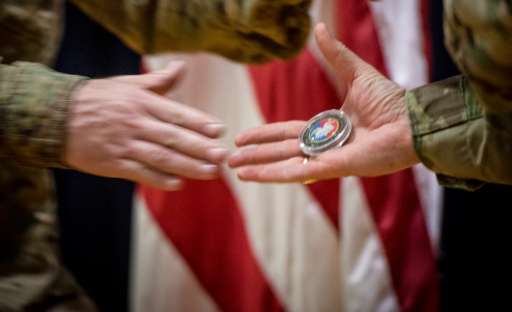
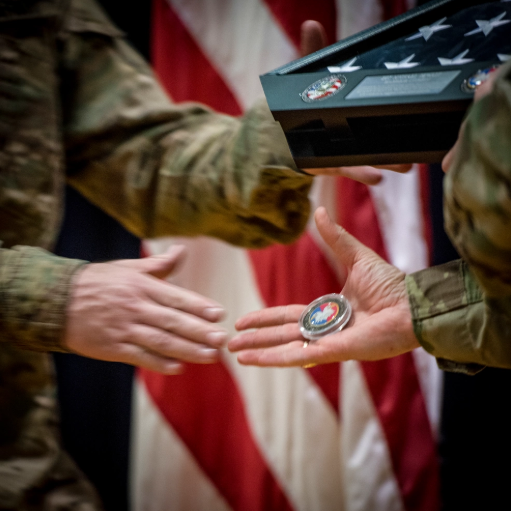
If you served, you know how most coins actually arrive: pressed into your palm in a handshake that lasts a half-second longer than it should, usually from someone whose time was worth more than yours. There’s no ceremony. Often there are no words at all, or just a quiet “good work” that you’ll replay more times than you’d admit. You don’t look at the coin until later. That’s part of the etiquette nobody wrote down but everybody knows.
The origin story most often told (and it is a legend, so take it as one) goes back to World War I: a young American pilot carrying a bronze squadron medallion is captured, escapes and is nearly executed as a spy until the coin in his pouch proves who he is. Whether or not it happened exactly that way, the legend survives because it captures what a coin actually is: proof of belonging. Proof that you were one of us, in that unit, at that time, and somebody thought you should have something to show for it.
And then there are the rules: the coin check, the bar games, the arguments about whether a coin on a belt buckle counts (it doesn’t) and whether the guy who fumbles his coin buys the round (he does). All of that is real culture, the kind that doesn’t get written into any manual and is passed hand to hand, literally.
But the coins that matter most are usually not the ones from the games. They’re the quiet ones. The one from a command sergeant major who never gave them out. The one from the hospital. The one from the unit that came home smaller than it left. Every collection has one or two coins that the owner will pick up differently than the rest, a little slower, with a half-beat of silence. Those coins are carrying weight the brass was never rated for.

What the Coin Knows
Here is an uncomfortable exercise. Pick up one of your coins, one of the ones that matters, and ask yourself: If I weren’t here to explain this, what would anyone know about it?
The answer is whatever is stamped on it. A unit crest. A motto in Latin nobody in the family can translate. Maybe a date. That’s it. Everything else (who put it in your hand, where you were standing, what you had just come through and why you kept this one when you lost track of a dozen others) exists in exactly one place, and that place is your memory.
Coins outlive memory. That is the whole problem.
Anyone who has helped clear out a parent’s or a buddy’s house after a funeral knows what it looks like when the stories go and the objects stay. The coins end up in a sandwich bag. The family keeps them, of course they keep them, but they keep them the way you keep a stranger’s photographs: reverently and blindly. Twenty years later, somebody finds the bag, can’t attach a single coin to a single event, and the collection becomes an eBay lot described as “vintage military coins, mixed.” Sold by weight, more or less. Every coin in that lot was a handshake once.
Nobody plans for this. That’s exactly why it keeps happening. The stories don’t disappear in a fire; they leak out slowly, one unasked question at a time, until the day there’s no one left to ask.
Preservation is a Mission, Not a Mood
The military is actually good at preservation when it decides to be. Units keep lineage books. Ships have historians. Museums archive the big things: the flags, the aircraft and the medals with citations attached. But challenge coins live below that altitude. They’re personal, not accountable property. No historian is coming for your drawer. If the stories in it are going to survive, that’s on you, and the standard for success is embarrassingly low: the story has to exist somewhere outside your head. That’s it. That’s the whole mission.
Some practical ways to run it:
Write it down; badly is fine. For each coin that matters, record who gave it to you, when, where and why you kept it. Three sentences beat a blank page. Nobody is grading the prose. Your kids will not care that you wrote “so we didn’t die” instead of something eloquent. They will care that it’s in your handwriting.
Say it out loud. If writing isn’t your thing, talk. Hand your phone to your kid at Thanksgiving, have them hit record and go through five coins. Twenty minutes. You will never regret owning that recording, and neither will they.
Photograph both sides. Coins scatter. They get borrowed, displayed or lost in moves. A good photo of the front and back, kept with the story, means the record survives even if the object walks off.
Tell someone which ones matter. Every collection has a hierarchy only the owner can see. Make it visible. “If you only keep one, keep this one, and here’s why” is one of the more valuable sentences a veteran can say to his family.
Do it at the unit level, too. Reunions are the natural place for this. Your association’s coins are scattered across the whole country in individual collections; a reunion is the one weekend a year they’re all in the same room. Some ship and unit associations have started running exactly this play: a table, a camera and an afternoon of “okay, tell me about this one.” Every reunion has a guy who knows all the stories. He will not be at every reunion forever.
Where the Digital Part Comes In
Full disclosure: this is the part where I tell you what we build, and I’ll keep it short.
AllCoin is a free platform we built at Braav for exactly the problem this article describes. A veteran (or a family member or a unit association) photographs a coin, writes or records the story behind it, and it lives in a searchable digital Coin Library: image and story together in one place. Families use it to preserve a father’s or grandmother’s collection with the meaning still attached. Unit and reunion associations use it to build shared archives of their coins from every era of the unit’s history. There’s an In Memoriam use, too, preserving the coins of members who have passed as a tribute their shipmates and families can actually visit.
That’s the pitch, and it’s the whole pitch. The platform is free because the mission is the point: we think every one of these stories deserves to outlast the drawer it’s sitting in. Whether you use AllCoin, a notebook or a voice memo app, the mission is the same, and any of them beats doing nothing.
The Challenge
So here’s a coin check of a different kind.
This weekend, open the drawer. Pick one coin, not the whole pile, just one: the one that goes quiet in your hand. Write down its story or record yourself telling it. Send it to your kid, your sister, your old team guys. Then put the coin back.
Total time: 15 minutes. Total cost: nothing. And when that coin eventually ends up in someone else’s hands (because someday every coin does), it will arrive the way it was given to you: with the story attached, in something like a handshake.
The metal was never the point. Pass down the part that was.
_____________________________
Anna Redmond is the Founder & CEO of Braav/AllCoin.This piece was collaboratively written by the team at AllCoin by Braav (allcoin.braav.co), a free platform for digitizing and preserving challenge coins and the stories behind them.
As the Voice of the Veteran Community, The Havok Journal seeks to publish a variety of perspectives on a number of sensitive subjects. Unless specifically noted otherwise, nothing we publish is an official point of view of The Havok Journal or any part of the U.S. government.
Buy Me A Coffee
The Havok Journal seeks to serve as a voice of the Veteran and First Responder communities through a focus on current affairs and articles of interest to the public in general, and the veteran community in particular. We strive to offer timely, current, and informative content, with the occasional piece focused on entertainment. We are continually expanding and striving to improve the readers’ experience.
© 2026 The Havok Journal
The Havok Journal welcomes re-posting of our original content as long as it is done in compliance with our Terms of Use.


