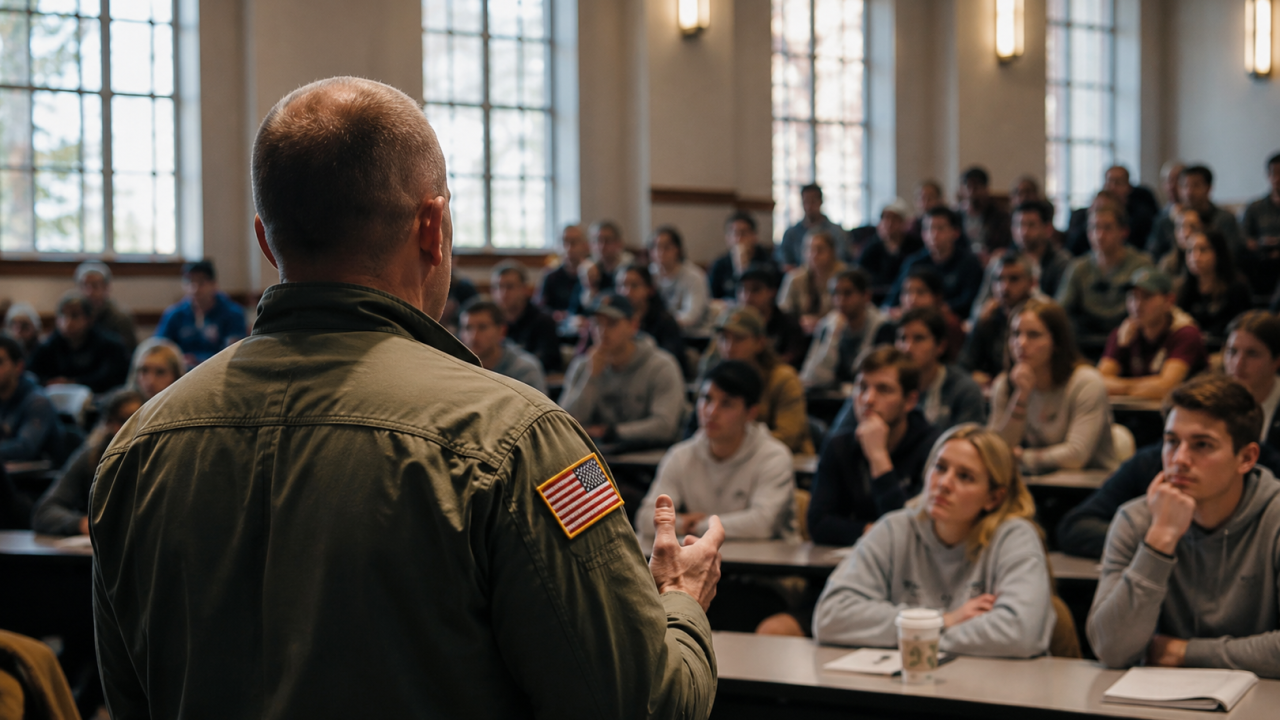
As I looked across the room of first-year college students, I wondered which parts of my story would be relevant to share. I was asked to come and speak to a small class at Wake Forest University about the veteran experience. I’m always humbled to be able to share and hope that, through my awkwardness and nervous laughter, people hear whatever they need to hear to validate the invitation in the first place.
It struck me after I left the classroom that none of these kids were alive on 9/11. These young coeds only understood the Global War on Terror from their textbooks and maybe TikTok videos. Nothing has ever made me feel older. I’ve been home from my vacation in the land of sand and blood for 20 years now. Most of these students weren’t even alive when I deployed. Dang!
Still, I have said it before, and I’ll say it again: our stories matter. There’s a big push for closing the veteran-civilian divide. It’s a buzzword or hot topic that gets pushed by well-meaning folks, and although there’s some truth to it, there’s really no way to bridge the expanse completely.
The chasm between those who have served and those who haven’t is vast, but it’s by design. There are just some things you can’t put words to. You have to have lived it. Storytelling helps elucidate some of the nuances of a deployment or training evolution, but it can’t fully bridge the gap in understanding.
How can I explain that, no, I wasn’t some sort of Rambo while deployed, but I lived in a pressure cooker of violence that I don’t have the words to explain. Is there a way to share the very palpable presence of death that clouded many of our experiences while driving in hostile territory? On paper, it’s all very neat, orderly, and sterile. We hauled shit no one needed to places no one cared about, and sometimes people got blown up.
The world went on while we were gone. There’s a quote attributed to an unnamed lieutenant colonel that I think about a lot from the early days of the Global War on Terror: “We’re at war, America is at the mall.” The sentiment still seems to stand, although malls are now vestiges of a bygone era, just like me.
I asked the students if they knew a veteran, and many hands were raised. I explained that I was their age when I deployed and even younger when I enlisted originally. With the current and never-ending conflicts in the Middle East, it’s not inconceivable that at least some of those students could end up in some dusty guard shack or on some bomb-blasted highway one day. I hope not, for their sake.
Sharing our stories shows others that veterans aren’t monolithic creatures; we’re your neighbors, uncles, brothers, and friends. Veterans are just normal people called to do sometimes extraordinary things. Or all too often, pawns in some political chess game that none of us know the rules to. Perhaps we exist as carriers of history, living examples of what can happen when America needs defending or thirsts for blood. Most of us aren’t heroes; we just did jobs, came home, and tried to put the war away.
Aside from the one student who fell asleep, an ROTC cadet, no less, I think my presentation went well. I was honored to be asked to share, and I hope I helped to bridge the divide in their understanding of the veteran experience. As much as possible, anyway. The only way to change the broken veteran narrative and other negative stereotypes is to get off our islands of isolation and share our stories.
We all did what we were called to do. Regardless of your role in the military machine, don’t dismiss your contribution as unworthy by playing the toxic game of comparison. So many chose not to serve. A good many almost did, but would have punched a drill sergeant. Veterans actually did the dang thing, so be proud and tell your story.
_____________________________
Stan Lake is a writer, photographer, and filmmaker based in Bethania, North Carolina. His work has appeared in Dead Reckoning Collective, The Havok Journal, Reptiles Magazine, Lethal Minds Journal, and other outlets, and he directed Hammer Down, a documentary about his 2005 deployment in support of Operation Iraqi Freedom with Alpha Battery 5-113th of the North Carolina Army National Guard. For The Havok Journal, he often writes essays and reflections about war memory, veteran life, the outdoors, and everyday experience. You can find his books, collected works, and social media at www.stanlakecreates.com.
As the Voice of the Veteran Community, The Havok Journal seeks to publish a variety of perspectives on a number of sensitive subjects. Unless specifically noted otherwise, nothing we publish is an official point of view of The Havok Journal or any part of the U.S. government.
Buy Me A Coffee
The Havok Journal seeks to serve as a voice of the Veteran and First Responder communities through a focus on current affairs and articles of interest to the public in general, and the veteran community in particular. We strive to offer timely, current, and informative content, with the occasional piece focused on entertainment. We are continually expanding and striving to improve the readers’ experience.
© 2026 The Havok Journal
The Havok Journal welcomes re-posting of our original content as long as it is done in compliance with our Terms of Use.


