America has 14.3 million military and veteran caregivers. RAND estimates that their largely uncompensated labor produces between $119 billion and $485 billion in value every year. That’s quite a range. Somewhere between “major domestic industry” and “apparently the republic is being held together by relatives who haven’t finished a cup of coffee while it was still hot since 2009.”
Nobody applies for this job. One day you’re a spouse, adult child, sibling, friend, or neighbor. The next you’re coordinating medications, monitoring symptoms, interpreting benefit letters, driving to appointments, tracking claims, handling insurance, watching for suicidal behavior, and locating the one federal employee who knows why a form submitted six months ago has entered witness protection.
The government calls you a caregiver. That sounds sweet. So does “woodland helper,” and neither title captures the fact that you’re performing medical, administrative, financial, and psychological labor while somebody in Washington announces another awareness month using a podium assembled by contractors.
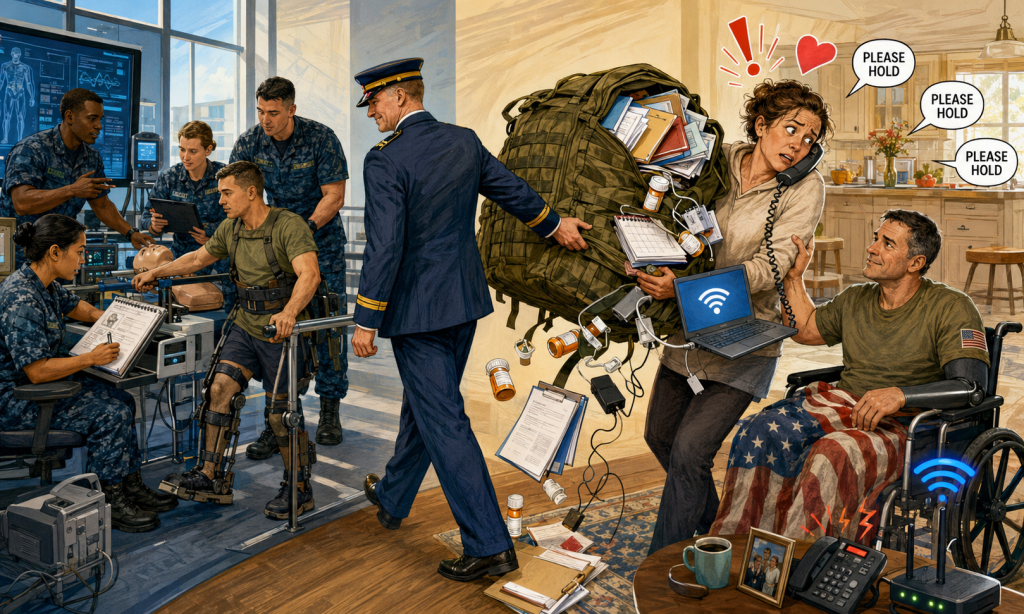
The nation loves this arrangement. The military spends years training a service member for specialized work. When that person comes home wounded, ill, aging, or psychologically injured, large portions of the continuing mission quietly transfer to a family member whose qualifications include love, panic, internet access, and the ability to remain on hold through three separate recordings thanking them for their patience.
The VA does offer caregiver programs, and they’re important. The Program of General Caregiver Support Services provides training, coaching, peer support, and referrals to caregivers of enrolled veterans from any era. The Program of Comprehensive Assistance for Family Caregivers can provide a stipend, mental health counseling, respite care, and health insurance for qualifying primary caregivers who lack other coverage. Among its eligibility requirements, the veteran must have an individual or combined service-connected disability rating of at least 70%.
Naturally. Because a veteran rated at 60% can apparently drive to neurology, remember the evening dosage, calm a trauma response, argue over a denied claim, and prepare dinner without anyone’s help.
RAND found that military and veteran caregivers spend an estimated $8,583 annually from their own pockets and sacrifice another $4,522 in household income. This is the federal government’s favorite kind of public-private partnership. The public makes the promise, and a private citizen sells back pieces of her life to fulfill it.
The health numbers are worse. Among military and veteran caregivers supporting people age 60 or younger, 42% met criteria for depression. Twenty percent reported having thought about taking their own lives. America responded by calling them “hidden heroes,” which is a gorgeous phrase once you realize that hidden is the operational requirement. Heroes can be praised. Visible workers might ask about staffing, compensation, respite, legal authority, or why their own children have started absorbing responsibilities meant for adults.
Research commissioned by the Elizabeth Dole Foundation estimated that approximately 2.3 million children under 18 live with a disabled veteran. Some help manage siblings, household duties, finances, or daily care. We call them resilient because “minor quietly drafted into the national care infrastructure” doesn’t fit on a challenge coin.
Here’s the central scam. Family caregiving doesn’t merely respond to institutional failure. It conceals it.
Every spouse who catches a medication problem prevents an adverse event. Every daughter who spends lunch break correcting an appointment prevents another missed visit. Every friend who talks a veteran through the night absorbs a crisis before it appears on an agency dashboard. The family turns public breakdown into private exhaustion, and the system records another successful day.

Then the family collapses and everyone acts surprised, as though sleep deprivation, lost income, isolation, fear, and permanent vigilance were decorative throw pillows.
Adult supervision would begin with five changes.
First, identify caregivers during enrollment, discharge, disability evaluation, and major diagnosis. Give each family a named navigator who can resolve problems across health care and benefits. A toll-free number is a doorway. A navigator who owns the case is help.
Second, create one consent-based caregiver portal for appointments, medication lists, care plans, claims status, respite scheduling, and secure messages. Families currently operate as the veteran’s central coordination office while receiving information through keyholes.
Third, pay people according to documented caregiving hours and clinical burden. Expand financial support beyond the narrowest eligibility gate. Love may motivate the work, but pharmacies, landlords, and employers remain stubbornly unimpressed by devotion.
Fourth, guarantee usable respite. That means trained replacement care that can actually be scheduled before the caregiver reaches the emotional condition of a raccoon trapped inside a vending machine.
Fifth, provide confidential mental health screening and treatment for caregivers and their children. When 20% of a caregiver group has contemplated suicide, a meditation worksheet and a cheerful refrigerator magnet have completed their tour of duty.
Employers belong in this plan too. Paid caregiver leave, predictable flexibility, and protection from career penalties should become standard for federal agencies, contractors, and companies collecting public incentives. The nation cannot outsource veteran care to families and then allow employers to punish them for performing it.
America can continue distributing lapel pins and adjectives, or it can recognize a labor force. Gratitude without infrastructure is applause from people who slipped out before the chairs needed stacking.
A system that survives because families surrender income, sleep, health, and childhood isn’t efficient. It’s a cost-transfer scheme wearing a flag pin.
Veterans were promised care. Their families were never supposed to become the missing federal agency.

Sources for readers whose patriotism can survive opening a PDF
America’s Military and Veteran Caregivers, by Rajeev Ramchand et al. (RAND Corporation)
https://www.rand.org/pubs/research_reports/RRA3212-1.html
VA Caregiver Support Program, by the U.S. Department of Veterans Affairs
https://www.caregiver.va.gov/index.asp
Caregiver Support Services, by Military OneSource (U.S. Department of Defense)
https://www.militaryonesource.mil/benefits/caregiver-support-services/
Hidden Helpers Commitments, by the Elizabeth Dole Foundation
https://familyresourcehub.elizabethdolefoundation.org/wp-content/uploads/2021/11/EDF-HiddenHelpers-Commitments.pdf
_____________________________
Tammy Pondsmith directs the Federal Bureau of Spousal Load-Bearing, where exhausted caregivers receive a ceremonial lanyard, seventeen passwords, and permission to collapse next fiscal year.
As the Voice of the Veteran Community, The Havok Journal seeks to publish a variety of perspectives on a number of sensitive subjects. Unless specifically noted otherwise, nothing we publish is an official point of view of The Havok Journal or any part of the U.S. government.
Buy Me A Coffee
The Havok Journal seeks to serve as a voice of the Veteran and First Responder communities through a focus on current affairs and articles of interest to the public in general, and the veteran community in particular. We strive to offer timely, current, and informative content, with the occasional piece focused on entertainment. We are continually expanding and striving to improve the readers’ experience.
© 2026 The Havok Journal
The Havok Journal welcomes re-posting of our original content as long as it is done in compliance with our Terms of Use.