
Hatred is a contagion, but let’s not insult viruses. Viruses at least have the decency to mutate quietly in a Petri dish. American hatred straps on a lapel mic, opens a podcast, sells hoodies, lands a mattress sponsor, and calls itself “public discourse.” It’s not politics anymore. It’s emotional meth with lower production values.
We’ve become a nation of people standing in the grocery store checkout line, reading headlines designed by feral interns who clearly majored in cortisol. “Person You Hate Said Thing You Already Assumed They’d Say.” Fantastic. Ring the bell. Democracy is saved because Brenda in Ohio just commented “This!!!” under a video of a man screaming in front of books he hasn’t read.
The modern outrage economy is a buffet where every dish is flaming garbage, and somehow everyone leaves feeling morally nourished. On the left, the right is always one poorly tailored suit away from goose-stepping through a farmers market. On the right, the left is always one community theater drag brunch away from turning your town into a compostable gulag. Everyone’s Hitler. Everyone’s Stalin. Everyone’s a fascist. Everyone’s a communist. Meanwhile, actual historians are in the corner trying to drink themselves into a quieter century.
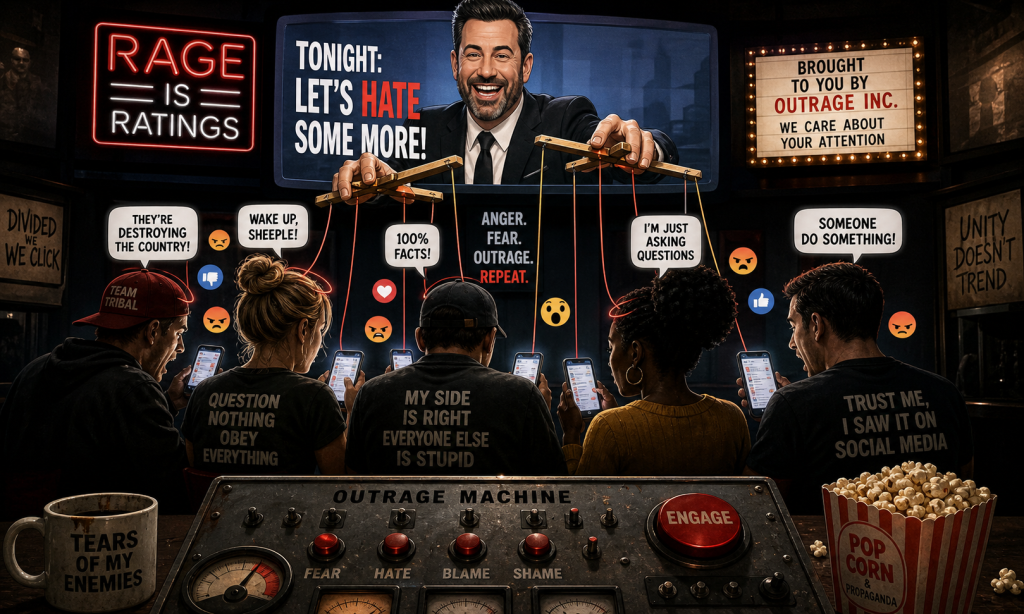
And the best part? Nobody thinks they’re participating. Oh no. Everyone else is radicalized. Everyone else is brainwashed. Everyone else is “in a bubble.” You, however, are a lone truth-seeker with seven browser tabs open and the media literacy of a raccoon trapped in a Verizon store.
The people who profit from this mess know exactly what they’re doing. Cable news doesn’t want you informed. It wants you neurologically tenderized. Social media doesn’t want you connected. It wants you addicted, inflamed, and too emotionally swollen to notice you’ve spent three hours arguing with an avatar named LibertyBadger1776 who may be a bot, a retiree, or a raccoon with a burner phone. Late-night comedy, political commentary, influencer activism, partisan panels, and moral panic merchants have all discovered the same golden rule: hate scales beautifully.
Love is complicated. Nuance takes time. Forgiveness has terrible engagement metrics. But rage? Rage is plug-and-play. Rage is cheap. Rage is the Costco rotisserie chicken of human emotion. Hot, available, and suspiciously underpriced.
The ugliest truth is that hatred makes dumb people feel brilliant and cowardly people feel brave. It lets a woman who can’t assemble an IKEA nightstand believe she understands geopolitics because she watched an eight-minute video titled “THEY Don’t Want You To Know This.” It lets celebrities, pundits, and politicians cosplay as revolutionaries from climate-controlled studios. It lets every smug little sermonizer confuse contempt with courage.
And yes, words matter. No, that doesn’t mean every joke causes violence, so unclutch your heirloom pearls, Mildred. But when public life becomes a nonstop dehumanization carnival, don’t act shocked when unstable people start treating politics like permission. You can’t spend years calling your opponents vermin, traitors, Nazis, groomers, terrorists, demons, and existential threats, then gasp like a Victorian aunt when some basement prophet decides your daily outrage sermon requires live ammunition.

Free speech protects your right to say vile, reckless, stupid things. It does not protect you from being recognized as vile, reckless, or stupid. The First Amendment is not a spa robe you wear while taking a hot tub soak in moral sewage. It protects expression from government censorship. It does not require advertisers, audiences, employers, or sentient adults to pretend you’re a brave truth-teller when you’re really just rage-bait with cheekbones.
But cancellation culture is not a solution either. Half the country discovered boycotts five minutes after calling them tyranny, and the other half discovered free speech five minutes after trying to get someone fired for misusing a pronoun. Congratulations, everyone. You’ve all become what you claimed to hate, just with different hashtags and the same sanctified appetite for punishment.
So what do we do?
First, stop rewarding emotional arsonists. Don’t share the clip. Don’t quote-tweet the idiot. Don’t feed the algorithmic raccoon. If a commentator, comedian, influencer, or politician depends on making you hate strangers for a living, treat them like expired seafood.
Second, make advertisers own their choices. Companies love “brand safety” until the outrage machine prints money. Fine. Ask them directly why they fund content that turns citizens into enemy combatants. Be specific. Be polite. Be relentless. Corporations understand only three languages: profit, liability, and public embarrassment.

Third, platforms should add friction to viral political content. Not censorship. Friction. Slow down resharing during breaking news. Label manipulated clips. Penalize accounts that repeatedly spread falsehoods. Make people read an article before reposting it. Yes, some users will object because reading is apparently oppression now.
Fourth, schools should teach rhetoric, propaganda, civics, and emotional regulation like the republic depends on it, because it does. A teenager should graduate knowing the difference between argument and manipulation, evidence and vibes, satire and slander, disagreement and dehumanization. Right now we’re handing kids smartphones and hoping their frontal lobes can outwit Silicon Valley. That’s not parenting. That’s releasing raccoons into a fireworks warehouse.
Fifth, punish reckless public language where it actually hurts. Don’t demand jail time. Don’t beg for censorship. Pull donations. Cancel speaking invitations. Pressure sponsors by name. Vote against officials who traffic in dehumanizing rhetoric. Ask party leaders, boards, stations, publishers, and event organizers one direct question: why are you rewarding someone who turns political opponents into targets? Free speech protects the match. It doesn’t guarantee the book deal, the donor check, the prime-time slot, or the microphone after you keep aiming it at the gas can.
Finally, ordinary people need to get a grip. Talk to someone who disagrees with you without reaching for your rhetorical flamethrower. Touch grass. Read a book older than your favorite grievance. Admit when your side lies. Admit when the other side has a point. The republic does not require you to like your opponents. It requires you to remember they’re human.
Hatred is contagious, yes. But so is restraint. So is courage. So is decency. Unfortunately, decency doesn’t come with a promo code, a chyron, or a merch table, which is why it’s going to need better marketing.

_____________________________
Tammy Pondsmith is a freelance moral disinfectant, chaos sommelier, and unpaid exterminator of manufactured contempt.
As the Voice of the Veteran Community, The Havok Journal seeks to publish a variety of perspectives on a number of sensitive subjects. Unless specifically noted otherwise, nothing we publish is an official point of view of The Havok Journal or any part of the U.S. government.
Buy Me A Coffee
The Havok Journal seeks to serve as a voice of the Veteran and First Responder communities through a focus on current affairs and articles of interest to the public in general, and the veteran community in particular. We strive to offer timely, current, and informative content, with the occasional piece focused on entertainment. We are continually expanding and striving to improve the readers’ experience.
© 2026 The Havok Journal
The Havok Journal welcomes re-posting of our original content as long as it is done in compliance with our Terms of Use.


