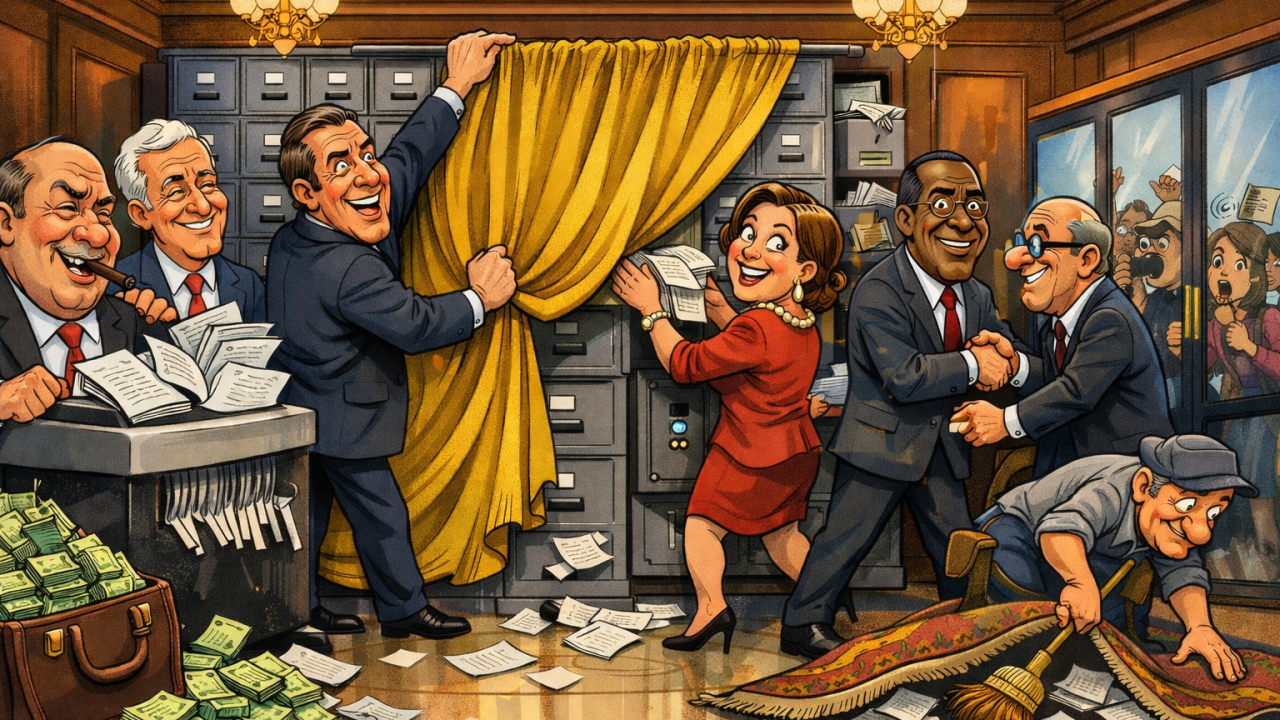
There is nothing, and I mean nothing, more spiritually moving than watching 357 members of Congress sprint together to bury sexual misconduct transparency like lab rats trying to hide a missing bag of cocaine before the lab tech gets back.
That vote was not a procedural maneuver. It was a group project in institutional deodorant. It was the legislative version of a restaurant kitchen dimming the lights because the roaches have started developing names and voting rights. Washington looked at the idea of sunlight and said, “Absolutely not, sweetheart, this place is held together with NDAs, taxpayer cash, and the kind of mutual blackmail that makes middle school lunch tables look like Quaker meetings.”
And please spare me the pious press release language about “process,” “committee review,” and “protecting the integrity of the institution.” When politicians start talking about protecting the integrity of the institution, lock your wallet and count the silverware. That phrase has all the moral sincerity of a casino carpet. It means the same thing it always means: the building matters more than the people damaged inside it.
If taxpayer money has ever been used to settle sexual harassment claims involving members of Congress, then the taxpayer is not some nosy outsider peeking through the blinds. The taxpayer is the unwilling sugar daddy. You paid for the room, the minibar, and the cleanup crew. You do not get to be told, after the fact, that the details are a “private personnel matter.” Private? Darling, the second public money shows up, privacy clocks out and accountability clocks in.
That is what makes this whole spectacle so gorgeously obscene. These are the same people who speak in reverent TED Talk tones about “believing survivors,” “defending democracy,” and “restoring trust.” Yet the moment transparency threatens to leave fingerprints on a donor blazer, both parties suddenly become emotional support animals for each other’s scandals. The left protects its creeps. The right protects its creeps. Then they gather under the Capitol dome and call it statesmanship, like two raccoons dividing stolen cough syrup and congratulating themselves on bipartisanship.
George Carlin was right. It is a big club, and you are not in it. You are the ATM outside the club, blinking in the rain while the bouncer tells you there is a dress code.
And that is the part Americans understand in their bones. Not everybody can explain the appropriations process, but everybody can smell a protection racket. This is why trust in government is circling the drain with the determination of a goldfish funeral. Normal people already suspect the system is a gated community for the shameless. Then Congress shows up with a vote like this and essentially says, “We appreciate your cynicism, and we are prepared to exceed it.”
The most insulting part is that they expect us to keep pretending this is all a matter of a few bad apples. Please. Washington is not a barrel with a few bad apples. It is a cider mill run by lobbyists where rotten fruit gets promoted to senior leadership. Power does not magically corrupt saints. Mostly, it removes the social muzzle from people who were already morally unsupervised. Give a disciplined person power, and you get a serious public servant. Give a narcissistic degenerate power, and you get a walking HR seminar with donor access.
And now we hit the really nauseating part of the American pageant, the obsession with Epstein, the single famous monster because he is convenient. People love a marquee villain. One dead monster with a memorable name, one island, one scandal, one symbol everyone can chant at like it is a campfire exorcism. Fine. He was real. The victims were real. The evil was real. But the national fixation on one depraved celebrity pipeline can also become a narcotic, because it tricks people into thinking the rot is exotic, rare, and imported from some decadent lair instead of embedded in the wallpaper of ordinary power.
That is the real horror show. The headline monster is not the whole disease. He is a logo. The deeper sickness is a society packed with smaller predators, quieter enablers, and institutions that would rather maintain brand confidence than confront the human wreckage. Congress shielding misconduct records while the country drowns in exploitation, abuse backlogs, and bureaucratic cowardice is not irony. It is the business model.
This is what the ruling class does best. It treats public outrage like seasonal weather. Wait it out, issue statements, name a task force, bury the paper trail, and pray the audience gets distracted by the next shiny apocalypse. Maybe a celebrity trial. Maybe an influencer divorce. Maybe another hearing where a lawmaker with the moral profile of a damp towel scolds America about values.
Meanwhile, the people writing the rules keep arranging a legal and political universe where consequences are for civilians. You miss a tax form, they find you with satellites. They misuse power, public money, or public trust, and suddenly everyone becomes a constitutional scholar of due process and confidentiality. How touching. Accountability, apparently, is a value so sacred it can never actually be practiced.
So here is the uncomfortable truth: when Congress moves with this much speed and unity to hide who benefited from secrecy around sexual misconduct complaints or settlements, it is not because the facts are harmless. It is because the facts are radioactive. Innocent people do not usually form a human shield around a filing cabinet.
What they protected in that vote was not dignity. It was leverage. Not justice, but club membership. Not the public, but the arrangement.
And if that sounds cynical, good. Cynicism is what happens when reality keeps showing up overdressed as satire.
_____________________________
Tammy Pondsmith is a self-appointed forensic coroner of public morality who can smell hypocrisy through three layers of marble, two security clearances, and one very nervous communications director.
As the Voice of the Veteran Community, The Havok Journal seeks to publish a variety of perspectives on a number of sensitive subjects. Unless specifically noted otherwise, nothing we publish is an official point of view of The Havok Journal or any part of the U.S. government.
Buy Me A Coffee
The Havok Journal seeks to serve as a voice of the Veteran and First Responder communities through a focus on current affairs and articles of interest to the public in general, and the veteran community in particular. We strive to offer timely, current, and informative content, with the occasional piece focused on entertainment. We are continually expanding and striving to improve the readers’ experience.
© 2026 The Havok Journal
The Havok Journal welcomes re-posting of our original content as long as it is done in compliance with our Terms of Use.


