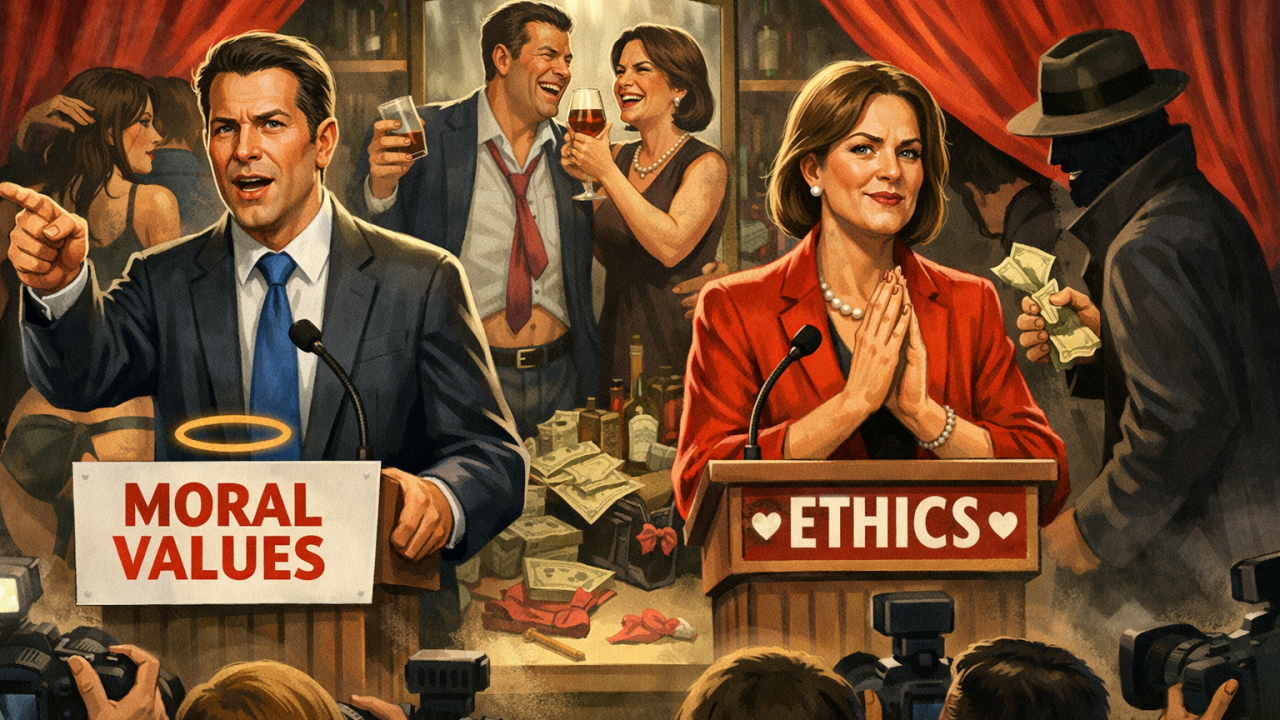
Our public life is now run by the exact species of person who used to get shoved off the student council for being too obviously fake. Not too ideological. Not too passionate. Too fake. The type who speaks in the plush, upholstered language of moral concern while privately behaving like a raccoon in a pharmacy. And every time one of these peacocks of virtue detonates in scandal, the same pious village drama begins. There is shock. There is sorrow. There is a statement about accountability. There is a request for privacy from people who have made a career out of invading everyone else’s moral privacy with a floodlight and a lectern. Then comes the real obscenity, which is not the scandal itself but the revelation that none of this is surprising anymore.
That is the disease. The scandal is just the fever. The disease is a system that rewards theatrical moralism over actual character, then acts stunned when the actors turn out to be actors.
We have built a culture that confuses public righteousness with private integrity. Those are not cousins. They aren’t even in the same zip code. Public righteousness is a costume. Private integrity is what happens when there is no applause, no camera, no donor dinner, no panel discussion, no staff memo about values. One is branding. The other is discipline. And because branding scales better than discipline, branding won.
So now every institution is lousy with people who think ethics is mainly a communications challenge. They don’t ask, “Am I decent?” They ask, “What is the statement if this gets out?” They don’t cultivate restraint. They cultivate language. They don’t build a moral life. They assemble a crisis kit. They are less interested in behaving well than in sounding devastated by the suggestion that they might not have behaved well. It is therapy-speak in a necktie. It is repentance as public relations. It is the conversion of sin into talking points.
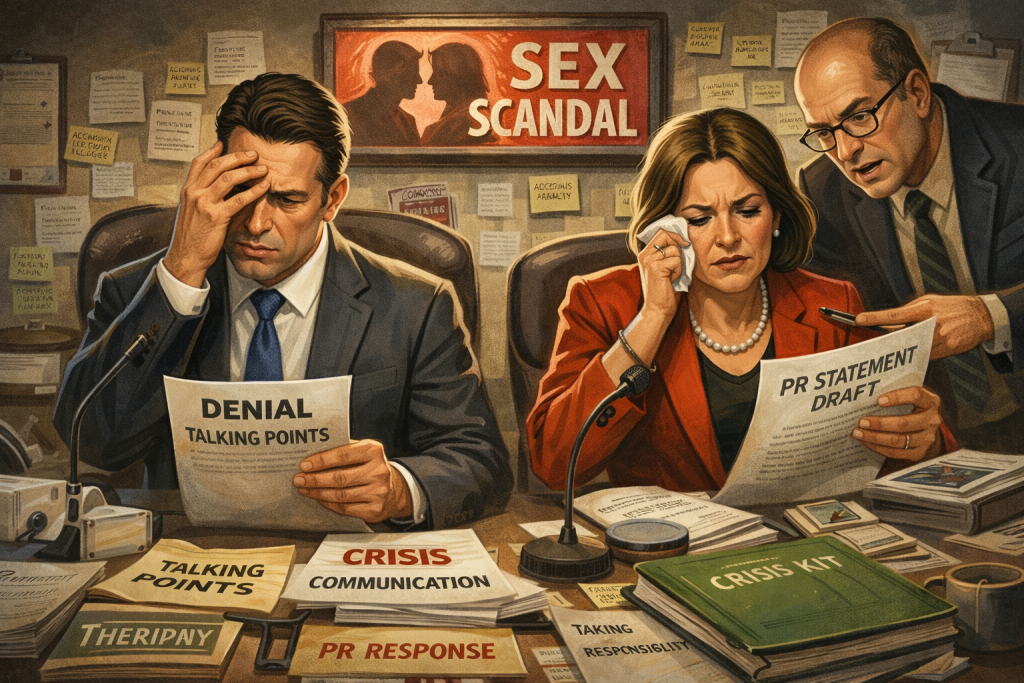
And before the tribal idiots start clapping like trained seals, this is not confined to one party, one ideology, one movement, or one fashionable moral vocabulary. Please. Hypocrisy is the only truly bipartisan infrastructure project this country still completes on time. Every faction now produces its own line of preening scolds who demand severe consequences for the little people and endless nuance for themselves. Rules are absolute until they become inconvenient. Then suddenly we’re all amateur philosophers of ambiguity. Amazing how many people discover the complexity of human frailty only when it’s their own name in the headline.
The reason this keeps happening is not merely that ambitious people are flawed. Of course they are. So is everyone. The reason it keeps happening is that our institutions actively select for a particularly dangerous kind of flaw. They reward shamelessness, performative certainty, and a bizarre hunger to dominate the moral weather of the room. They elevate people who enjoy accusation more than introspection, who treat public life as a stage on which to display virtue rather than a job requiring sobriety, competence, and a functioning sense of embarrassment. Normal adults find this atmosphere nauseating and leave. Narcissists smell opportunity and apply for office.
Then we pretend to be baffled that the talent pool looks like the waiting room outside a very expensive rehab center.
Here is the part nobody likes because it is much less fun than the scandal. The problem is structural. We turned politics, media, activism, and large parts of professional life into celebrity ecosystems. Celebrity ecosystems do not reward wisdom. They reward visibility, aggression, emotional exhibitionism, and the ability to survive without a shame gland. Once a system starts promoting people for their skill at appearing morally electric, it will be overrun by exhibitionists, phonies, and thrill-seeking lunatics with excellent hair and terrible souls.
The fix is not to demand a more inspiring batch of performers. The fix is to make performance less valuable.

First, shrink the moral grandstanding. Public officials should do less sermonizing and more paperwork. Stop rewarding people for delivering national TED Talks on the human condition when their actual job is to manage a committee, read a bill, and refrain from acting like a drunken emperor at a hotel bar. The more somebody seems to enjoy broadcasting their virtue, the more aggressively we should assign them a stack of zoning documents and a budget spreadsheet.
Second, enforce rules plainly and universally. No mystical exceptions for the eloquent, the connected, or the politically useful. A society cannot survive if punishments are determined by factional convenience and media mood. Clear rules, real investigations, predictable consequences. Not because human beings are perfect, but because institutions shouldn’t be run like improv theater for the morally overcaffeinated.
Third, lower the glamour of power. Pay civil servants decently, cap the circus around them, and stop treating every middling apparatchik like a prophet-warrior with a podcast deal. Public life should attract conscientious adults, not fame addicts with a martyr complex and a documentarian following them to lunch.
Fourth, recover the nearly extinct idea that private conduct matters because it reveals judgment. Not because we need saints. Good luck with that. But because people entrusted with power should not be obvious hostages to appetite, vanity, or chaos. Self-government requires some self.
Until then, enjoy the pageant. The same people who can’t return a phone call without a branding strategy will continue issuing moral decrees like tablets from the mountain, right up until security escorts them out carrying a banker’s box full of inspirational books and unopened ethics training manuals.
_____________________________
Tammy Pondsmith is Senior Auditor of Public Virtue, clocking the nation’s halo salesmen just before the ring lights short out.
As the Voice of the Veteran Community, The Havok Journal seeks to publish a variety of perspectives on a number of sensitive subjects. Unless specifically noted otherwise, nothing we publish is an official point of view of The Havok Journal or any part of the U.S. government.
Buy Me A Coffee
The Havok Journal seeks to serve as a voice of the Veteran and First Responder communities through a focus on current affairs and articles of interest to the public in general, and the veteran community in particular. We strive to offer timely, current, and informative content, with the occasional piece focused on entertainment. We are continually expanding and striving to improve the readers’ experience.
© 2026 The Havok Journal
The Havok Journal welcomes re-posting of our original content as long as it is done in compliance with our Terms of Use.