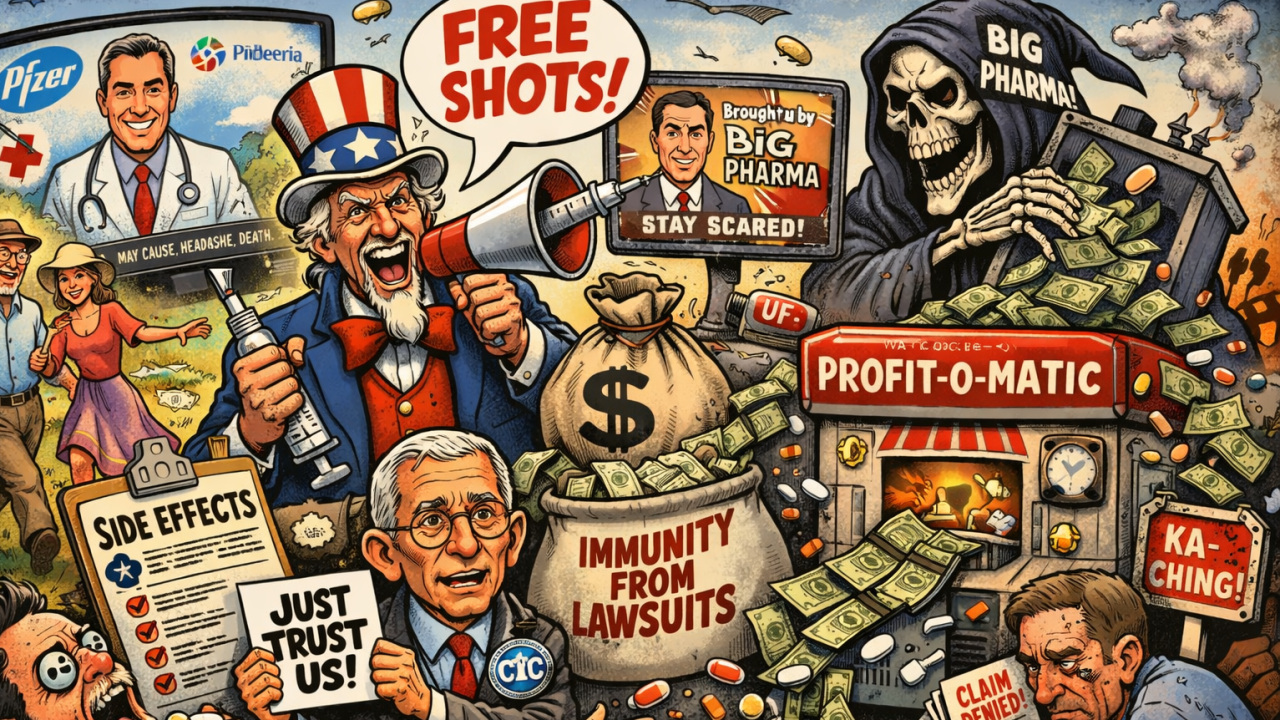
Oh, darling readers, gather ’round the glowing idiot box that is your television, because Tammy Pondsmith is here to dissect the grotesque carnival of drug company commercials with the precision of a surgeon wielding a chainsaw. You know the ones: glossy little fever dreams where a silver-haired couple frolics through a meadow, somebody regains the will to pickle vegetables or kayak after an emotionally devastating toenail fungus diagnosis, and a velvet-voiced narrator whispers promises of relief right before machine-gunning a side-effect list that sounds like the Book of Revelation with better lighting.
It is a masterpiece of modern absurdity, and yes, the broad point is real: the United States and New Zealand are the two big outliers that still allow direct-to-consumer advertising of prescription drugs while much of the rest of the developed world treats the idea like an open manhole full of industrial waste. In most sane places, prescription drugs are marketed primarily to clinicians. In America, they’re marketed to Steve in cargo shorts during the weather break and Brenda halfway through “Wheel of Fortune.” Because naturally the best way to handle complex medical decision-making is to shove it between a truck ad and a chicken-sandwich spot.
Why? Because in the United States there was never some clean, glorious moment when the grown-ups slammed the brakes and said, “Maybe corporations with a fiduciary duty to maximize revenue should not be allowed to diagnose the public through interpretive dance.” No. We just sort of drifted into this swamp. The legal structure already permitted prescription-drug promotion under regulation, and then in 1997 the FDA issued guidance explaining how broadcast ads could satisfy disclosure requirements without reading the entire warning label aloud like an auctioneer possessed by Beelzebub. That was the hinge. Not a sudden act of legalization, but something almost more American: a bureaucratic refinement that let industry take a mile after being handed an inch.
So the floodgates did what floodgates do. Drugmakers took the hint, television took the money, and the public got drafted into a national pageant of symptom suggestion. We now live in a country where people routinely ask their doctors about medications they first encountered while buttering toast, not because they studied comparative evidence, but because a commercial showed an attractive couple reclaiming intimacy beside a suspiciously well-maintained lake. Medicine, apparently, is no longer merely a branch of science. It is also a mood board.
Over in New Zealand, the explanation is less constitutional opera and more long-running policy shrug. They never put in a hard preemptive ban, and the practice stuck around long enough to become one of those miserable inherited problems governments study, frown at, hold panels about, and somehow never bury. So yes, America and New Zealand remain the odd little duopoly of prescription-drug marketing to the masses: one superpower with a freedom fetish, one island nation still trying to decide whether this particular imported habit is worth the smell.
Then the pandemic arrived, and the pharmaceutical-sales machine found a glorious new cathedral. In 2020 and 2021, vaccine promotion was not one neat ad campaign so much as a full-spectrum national sermon: White House podiums, public-health briefings, corporate branding, celebrity endorsements, urgent headlines, social pressure, neighborly scolding, and a moral vocabulary that made every question sound faintly heretical. Later, in August 2024, HHS put a sleek federal logo on the broader respiratory-virus push with “Risk Less. Do More.,” a campaign aimed at boosting uptake of flu, COVID, and RSV vaccines. Same emotional grammar, cleaner packaging. The state brought the clipboard, industry brought the product, and television did what television does best: turned anxiety into a repeated purchase opportunity.
And the money, bless its greasy little heart, was spectacular. Pfizer’s COVID vaccine, Comirnaty, brought in roughly $36.8 billion in 2021, $37.8 billion in 2022, and about $11.2 billion in 2023. That is revenue, not profit, and words matter unless you work in corporate communications, where words are mostly used to Febreze bloodless greed into “stakeholder value.” Add Paxlovid and the COVID haul gets fatter still. So no, let’s not be imprecise and say they “pocketed” over $100 billion from vaccines alone. Let’s be more exact and therefore more irritating: the revenue from these products was enormous, public-health urgency accelerated demand, and the companies involved were not exactly passing around the hat at a church picnic.
And then comes the legal part, where the script shifts from sales pitch to velvet rope. The PREP Act, passed in 2005 and invoked for COVID countermeasures in 2020, provides broad liability immunity for covered manufacturers, distributors, and administrators, with a narrow exception for willful misconduct. Translation: if something goes wrong, you are not strolling into a courtroom to let a jury sort it out in broad daylight. You are entering a legal maze built by people who believe the phrase “administrative process” has the same soothing quality as chamomile tea. The Countermeasures Injury Compensation Program exists, yes, but it is a constrained remedy, a payer of last resort, and its compensation history has been modest compared with what ordinary people imagine when they hear the word justice. That is not “zero liability,” and accuracy matters here. It is something arguably more infuriating: broad shield first, narrow remedy later, and good luck navigating the fluorescent labyrinth if you think you drew the short straw.
Now zoom out and admire the mural of institutional compromise. Healthcare in America is not purely a healing profession anymore; it is a hybrid creature, stitched together from science, finance, law, branding, lobbying, and enough strategic ambiguity to tranquilize an elephant. Patients are expected to be informed consumers in a marketplace they did not design, doctors are expected to practice medicine while fending off marketing pressure from every direction, regulators are forever balancing public safety against political convenience, and the media somehow never tires of cashing checks from the very industry it occasionally pretends to scrutinize. In 2025 alone, pharma TV ad spending topped $7 billion through the first 11 months. At that point the question is not whether television is financially dependent on pill money. The question is whether anyone still remembers what an unconflicted ad break looks like.
And that is the part polite people hate most, because it ruins the bedtime story. We are told this is all about empowerment, awareness, access, innovation, trust, and the majestic dignity of informed choice. What it often looks like from down here is something less angelic: a system where fear can be monetized, reassurance can be branded, urgency can be subsidized, and accountability can be narrowed when the stakes get too high for the right people. That does not make every drug evil, every vaccine corrupt, or every public-health campaign a scam. It does mean that once profit, policy, and media revenue start sharing a waterbed, the public has every reason to ask who exactly is being comforted, and who is merely being managed.
So here we are, flipping channels through the great American pill parade, watching disease get merchandised and immunity get sloganized, while every institution involved swears it is acting solely out of noble concern for our tender little well-being. Maybe some of them even believe it. But when the same culture that sells you a condition also sells you the cure, and the same apparatus that urges speed also narrows recourse, skepticism is not pathology. It is what reason looks like after being lied to enough times.
Public money. Private windfalls. Broad legal shields.

Sources (Because Even in This Circus, the Clowns Have Receipts)
Darlings, if you’re the type who likes to peek behind the curtain while the rest of the audience is still applauding the dancing pill bottles, here’s the paperwork I dragged out of the dumpster fire so you don’t have to. Read it, weep, or weaponize it—your choice.
- Wisconsin Watch fact-check (2025) confirming these pharma infomercials are only legal in the US and New Zealand: https://wisconsinwatch.org/2025/05/prescription-drug-direct-advertising-us-new-zealand-pharmacy
- The Conversation explaining why New Zealand still lets the snake oil salesmen on air when everyone else banned them decades ago: https://theconversation.com/most-high-income-countries-ban-direct-advertising-of-prescription-drugs-why-does-nz-still-allow-it-231688
- NIH/PMC deep dive into the sordid US-New Zealand duopoly history: https://pmc.ncbi.nlm.nih.gov/articles/PMC2001072
- HHS/FDA’s own fact sheet on how they loosened the leash in 1997 so drug companies could start yelling at you during dinner: https://www.hhs.gov/press-room/hhs-fda-drug-ad-transparency-fact-sheet.html
- Another PMC autopsy of drug advertising’s long, ugly evolution: https://pmc.ncbi.nlm.nih.gov/articles/PMC2690298
- The actual 1997 Federal Register notice where the FDA politely handed Big Pharma the microphone: https://www.govinfo.gov/content/pkg/FR-1997-08-12/html/97-21291.htm
- HHS/ASPR’s official PREP Act page—the get-out-of-jail-free card they dusted off for COVID shots: https://aspr.hhs.gov/legal/PREPact/pages/default.aspx
- Congressional Research Service summary (2025) spelling out the near-total immunity party: https://www.congress.gov/crs-product/LSB10730
- Federal Register’s parade of amendments keeping the liability shield shiny: https://www.federalregister.gov/documents/2024/12/11/2024-29108/12th-amendment-to-declaration-under-the-public-readiness-and-emergency-preparedness-act-for-medical
- Pfizer’s own 2023 Annual Report bragging about the mountain of cash Comirnaty and Paxlovid shoveled in: https://www.pfizer.com/sites/default/files/investors/financial_reports/annual_reports/2023
- Their 2022 earnings release for the victory lap numbers: https://s206.q4cdn.com/795948973/files/doc_financials/2022/q4/Q4-2022-PFE-Earnings-Release.pdf
- 2021 performance report so you can watch the profits snowball in real time: https://www.pfizer.com/sites/default/files/investors/financial_reports/annual_reports/2021/performance
- The actual “Risk Less. Do More.” propaganda campaign straight from HHS’s mouth: https://www.hhs.gov/risk-less-do-more/index.html
- Their newsroom archive of vaccine cheerleading ads: https://www.hhs.gov/risk-less-do-more/newsroom/index.html
- Ad Age on the 2025 pharma TV ad bonanza and what it means when networks start sweating: https://adage.com/brand-marketing/health-care/aa-pharma-ad-crackdown-implications
- MM+M Online reporting pharma blew past $7 billion on TV spots in 2025 alone: https://www.mmm-online.com/news/pharma-tv-ad-spend-topped-7b-in-2025
- The Wrap breaking down how linear TV (your grandparents’ cable package) still lives off these pill dollars: https://www.thewrap.com/prescription-drug-ad-crackdown-linear-tv-impact-analysis
- eMarketer tracking the near-$5.4 billion spent just through November 2025: https://www.emarketer.com/content/pharma-marketers-tally-nearly–5-4-billion-tv-ad-spending-through-november
- Statista on actual R&D numbers (spoiler: it’s higher than marketing these days, but the old myth dies hard): https://www.statista.com/statistics/265085/research-and-development-expenditure-us-pharmaceutical-industry
- Deloitte’s 2024 return-on-innovation report for the grown-up version of the spending debate: https://www.deloitte.com/us/en/Industries/life-sciences-health-care/articles/measuring-return-from-pharmaceutical-innovation.html
There. Now you’ve got the receipts, the dates, and the URLs. Go forth and annoy your relatives at Thanksgiving.
Tammy Pondsmith
_____________________________
Tammy Pondsmith is the love child of a rogue pharmacist and a stand-up comic who overdosed on truth serum, now dispensing verbal venom from her bunker in Pharma Hell, where she moonlights as a consultant for side-effect support groups.
As the Voice of the Veteran Community, The Havok Journal seeks to publish a variety of perspectives on a number of sensitive subjects. Unless specifically noted otherwise, nothing we publish is an official point of view of The Havok Journal or any part of the U.S. government.
Buy Me A Coffee
The Havok Journal seeks to serve as a voice of the Veteran and First Responder communities through a focus on current affairs and articles of interest to the public in general, and the veteran community in particular. We strive to offer timely, current, and informative content, with the occasional piece focused on entertainment. We are continually expanding and striving to improve the readers’ experience.
© 2026 The Havok Journal
The Havok Journal welcomes re-posting of our original content as long as it is done in compliance with our Terms of Use.

