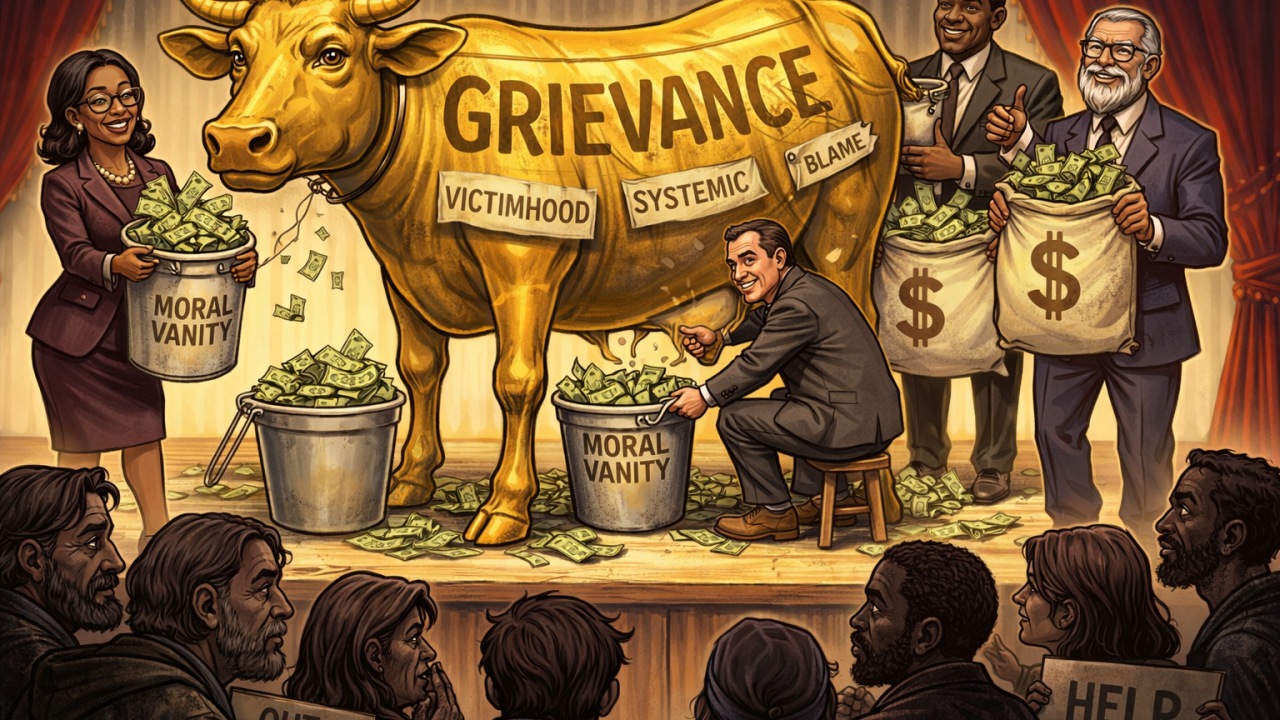
America has developed a thriving luxury market in moral melodrama, and its flagship product is the explanation that explains everything while clarifying nothing. You know the one. Every bad school, broken family, violent block, bureaucratic fiasco, and self-inflicted civic wound must be fed through a single approved machine until it comes out as a flattering sermon for educated spectators. It’s a marvelous system if you enjoy feeling righteous without the inconvenience of being useful.
That’s the thesis, really. Our professional compassion class has built an industry around stripping human problems of texture so they can be repackaged as ideological theater. The point isn’t understanding. The point is moral positioning. Once that happens, any discussion of incentives, conduct, family stability, educational habits, crime, discipline, or plain old terrible decision-making is treated like a small act of heresy. Apparently noticing that behavior affects outcomes is now considered a gateway drug to barbarism.
It’s such a cozy racket. If a neighborhood declines, the approved people don’t ask what happened inside the schools, the homes, the streets, or the local political machine. They don’t ask who stole the money, who lowered the standards, who rewarded chaos, or who kept voting for decorative frauds with campaign slogans instead of a governing brain. No, that would be judgment, and judgment is now the one sin the modern clerisy cannot forgive unless it’s directed at the unfashionable. So instead they produce a cloud of jargon, sprinkle it over the wreckage, and call it analysis. The result is a kind of moral Airbnb. Everyone rents virtue for the weekend, takes a few tasteful selfies, and leaves the place filthier than they found it.
What makes this especially grotesque is the sheer vanity of the performance. The people peddling these frameworks are forever presenting themselves as dangerous truth-tellers, as if they’re smuggling contraband wisdom past the authorities. Please. These are not dissidents. These are the authorities. These are the people with faculty lounges, foundation grants, HR departments, sensitivity panels, and public radio voices so delicate they sound upholstered. They are not speaking truth to power. They are power, wearing progressive costume jewelry and pretending it’s courage.
And because the whole performance depends on preselected villains and preapproved victims, reality has to be bullied into cooperating. If there are poor people who don’t fit the script, they’re ignored. If there are minorities who excel in ways that complicate the victim catechism, they become awkward guests who must not be seated near the narrative. If there are cultural habits that correlate with flourishing, suddenly we’re told not to notice patterns. Study, marry, save, delay parenthood, obey the law, stay sober, raise your children like you plan to know them in twenty years. All of this, we are informed, is suspiciously judgmental. It’s amazing. A civilization produces standards that help people survive, and an entire activist class decides the real oppression is being reminded they exist.
That’s because the grievance franchise has no use for standards that work. Standards create comparison, comparison creates embarrassment, and embarrassment is terrible for fundraising. A politics built on permanent injury cannot tolerate the possibility that some forms of misery are aggravated by culture, incentive structures, or plain human weakness. That would force institutions to do something dreadful, namely tell the truth in complete sentences. Much easier to moralize at the public and keep the machinery humming. Then the nonprofit sector gets its grants, the consultant class gets its contracts, the university gets its diversity bureaucracy, and the politician gets to campaign as the official importer of pain.
Notice how rarely any of this produces repair. It produces language. It produces training sessions, initiatives, statements, murals, symbolic appointments, therapeutic vocabulary, and a national fog of sanctified evasiveness. It produces adults who can recite twelve layers of structural critique but can’t bring themselves to say a child needs two functioning parents, a school needs order, and a city cannot survive if it treats criminality as a misunderstood form of self-expression. We’ve arrived at the point where obvious truths have to sneak into public life wearing fake mustaches.
The most insulting part is that this whole regime pretends to be compassionate while showing open contempt for the ordinary disciplines that allow people to build decent lives. It would rather offer slogans than expectations. It would rather flatter people than help them. It would rather turn suffering into a theatrical asset than risk offending anyone with standards. That’s not mercy. That’s abandonment with a graduate degree.
And yes, there are real injustices. Of course there are. Any serious person knows that. But serious people also know that injustice is not cured by lying about everything else. It is not cured by treating agency as a right-wing myth or by pretending institutions can decay forever without anyone inside them making choices. If you reward disorder, you get more disorder. If you excuse failure, you manufacture more of it. If you teach people that all meaningful explanation lives outside the self, don’t act stunned when accountability disappears like a city budget after a federal grant.
That’s why this moral style is so destructive. It does not merely misdiagnose problems. It protects the people who profit from the misdiagnosis. It turns human beings into mascots, communities into case studies, and dissent into blasphemy. It keeps the wound open because a healed public is much harder to manage. People who believe in responsibility are difficult customers. People who’ve been trained to see themselves as ideological dependents are wonderfully compliant.
So the sermon continues. More euphemism. More cowardice. More high-status frauds mouthing compassionate nonsense while the social fabric frays beneath their imported eyewear. They can keep the slogans. Reality is still sitting there with its arms crossed, waiting for the adults to return. And until they do, the grievance merchants will go on doing what they do best, selling moral vanity to people who prefer a flattering lie to a functional society.
_____________________________
Tammy Pondsmith covers elite hypocrisy, bureaucratic cowardice, and the thriving national hobby of mistaking slogans for solutions.
As the Voice of the Veteran Community, The Havok Journal seeks to publish a variety of perspectives on a number of sensitive subjects. Unless specifically noted otherwise, nothing we publish is an official point of view of The Havok Journal or any part of the U.S. government.
Buy Me A Coffee
The Havok Journal seeks to serve as a voice of the Veteran and First Responder communities through a focus on current affairs and articles of interest to the public in general, and the veteran community in particular. We strive to offer timely, current, and informative content, with the occasional piece focused on entertainment. We are continually expanding and striving to improve the readers’ experience.
© 2026 The Havok Journal
The Havok Journal welcomes re-posting of our original content as long as it is done in compliance with our Terms of Use.


