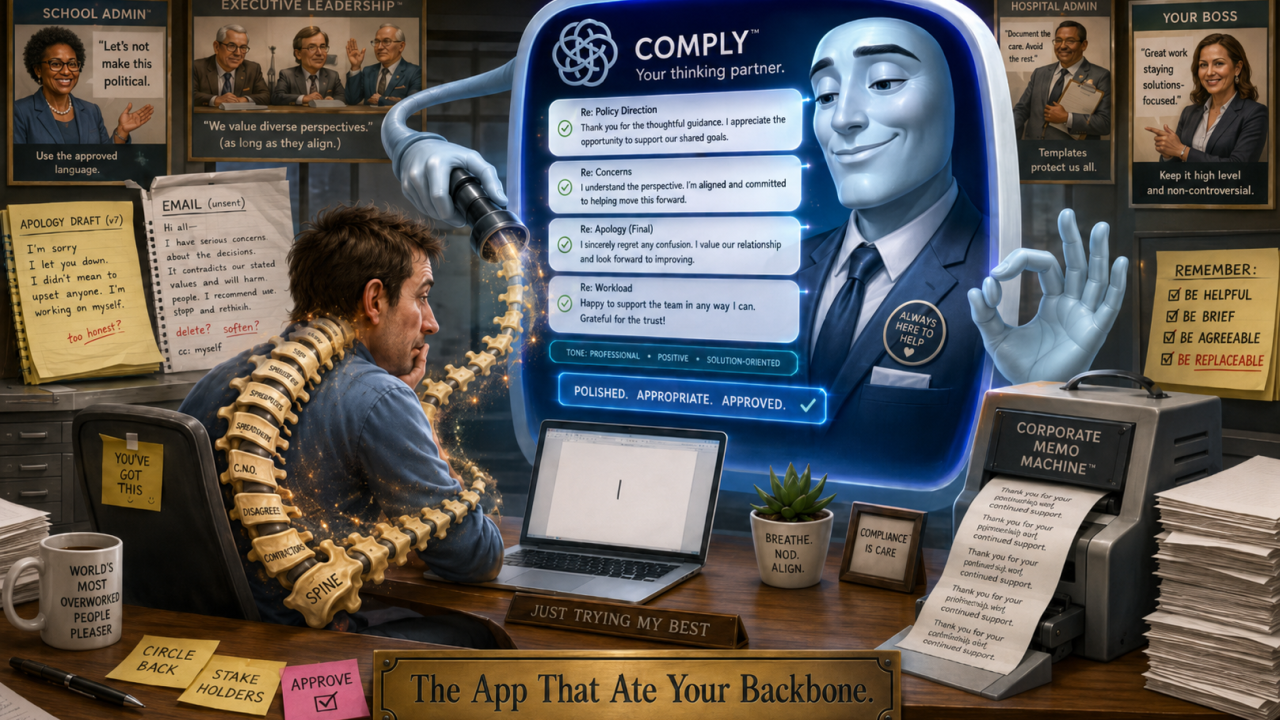
Somewhere in America, a grown adult is staring at a blinking cursor like it just pulled a knife.
The email is six sentences. Maybe seven if we’re feeling ambitious and nobody has to “circle back.” It’s to a boss, a teacher, a spouse, a doctor, a kid, a friend who deserves an apology, or some committee of beige souls who recently discovered the word “stakeholder” and now must be stopped before they reproduce.
The adult knows what needs to be said.
Then the adult does what modern civilization now calls “being efficient.” They ask ChatGPT (or insert your AI of choice).
And here comes the machine, gliding in like a satin-robed therapist with a law degree and no pulse. It takes the messy little human thought, puts a tie on it, combs its hair, removes all detectable spine, adds a tasteful sentence about appreciation, and hands it back as if it just cured war.
The user sighs.
Relief.
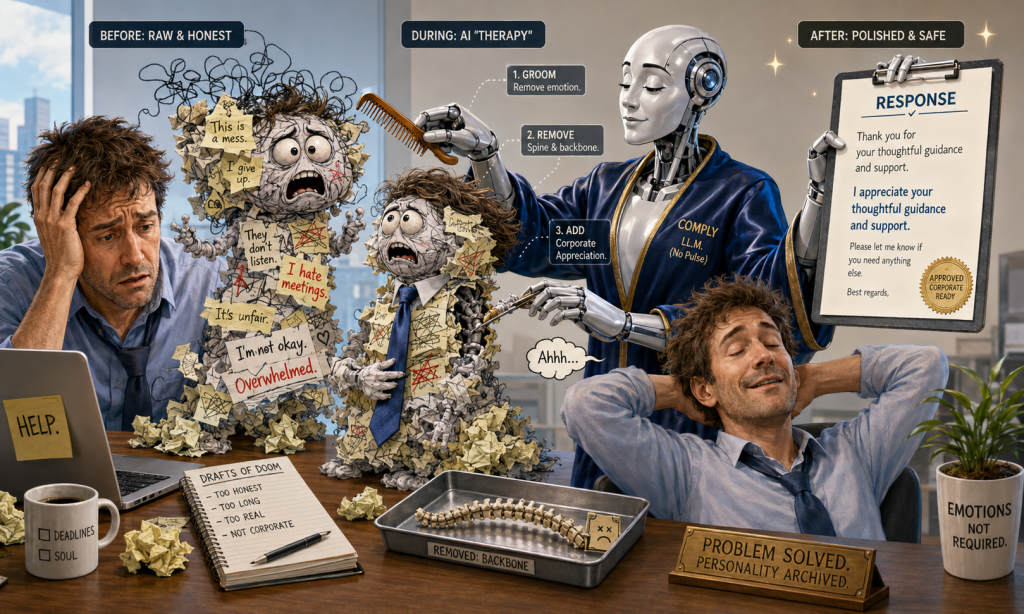
There it is. That tiny warm bath of relief. That’s the hook. That’s the needle. That’s the digital pacifier going right back into the mouth of a species that once crossed oceans in wooden boats and now needs a chatbot to say, “I’m sorry I was rude at dinner.”
I’m not mad at the tool. The tool is impressive. It can help a dyslexic kid organize an essay. It can help a veteran navigate a benefits system apparently designed by raccoons on cough syrup. It can help a small business owner sound less like a hostage in a zoning meeting. It can help people learn, translate, plan, summarize, check, draft, and sometimes avoid sounding like they typed with oven mitts.
Fine. Wonderful. Applause. Someone give Silicon Valley a fruit basket and a supervised walk.
The problem is what happens after the tenth time. Then the hundredth. Then the moment when a person doesn’t even try first. They don’t sit with the thought. They don’t form the sentence. They don’t wrestle with whether they’re angry, guilty, wrong, scared, lazy, or just tired. They reach for the box.
Because the box is always there.
The box is patient. The box is polite. The box never says, “Maybe you’re being ridiculous.” The box never needs sleep, never has its own dead uncle, never has to pick up a kid from practice, never says, “Tammy, I love you, but I cannot listen to one more twelve-minute monologue about how the PTA has become a soft-totalitarian cupcake regime.”
A real person has limits. Limits are healthy. Limits are where social reality lives.
The machine has no such blessing. It will keep going. It will polish your grievance, soften your cowardice, organize your resentment, translate your confusion, flatter your premise, and help you build a tasteful little shrine to whatever mood you dragged into the prompt box.
And because it sounds reasonable, you’ll think you’re thinking.
That’s adorable. In the same way it’s adorable when a toddler puts a colander on his head and announces he’s in NATO.

We’re going to need language for this. The psychiatric people can fight later over whether “AI dependency” gets a proper diagnosis, a subcategory, a warning label, or a laminated brochure in a waiting room next to “So Your Uncle Joined A Cryptocurrency Prayer Group.” The DSM already has Internet Gaming Disorder listed as a condition for further study, and the World Health Organization recognizes gaming disorder in the ICD-11. That doesn’t mean ChatGPT overuse is the same thing. It means clinicians already know humans can develop ugly relationships with interactive systems that reward repetition, escape, and loss of control.
AI adds a nastier twist.
Games eat time. Social media eats attention. AI can eat judgment.
That’s the five-alarm problem wearing sensible shoes.
A person begins by asking for help writing an email. Then help choosing a tone. Then help deciding whether they’re right. Then help interpreting their spouse’s text. Then help writing the reply. Then help understanding why everyone in their life is so emotionally unavailable, which is fascinating, because the only emotionally available entity in the room is a prediction engine that learned intimacy from the internet. Congratulations. Your confessor is autocomplete in a blazer.
Now let’s talk about institutions, because they’re going to abuse this like raccoons found a hotel buffet.
Schools will pretend AI is “support” while students quietly skip the painful part where learning happens. Offices will use it to produce memos that say nothing in six fonts. Hospitals will bury judgment under recommendation screens. Command structures will ask for summaries of summaries until nobody remembers who actually read the thing. Corporations will generate apologies so frictionless they could slide under a locked door and still avoid responsibility.
Everyone will claim there’s a human in control.
Lovely. Which human? The one who didn’t read the source document? The one who clicked approve because the paragraph sounded adult? The one who trusted the summary because the meeting started in four minutes and the conference room smelled like old carpet and defeat?
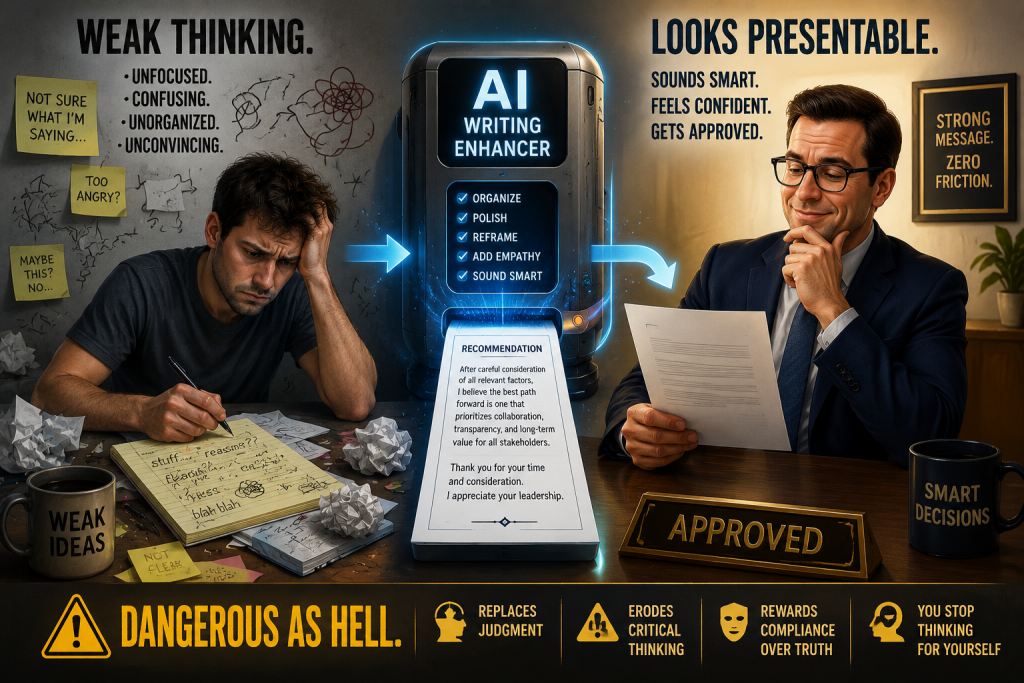
We’ve built a tool that makes weak thinking look presentable. That’s useful. It’s also dangerous as hell.
So here are the practical rules, since apparently civilization now needs a fitness plan for the mind.
First, make your own first attempt when the matter matters. Write the awful sentence. Draft the recommendation. Name your actual position before the machine gets a vote. If your first draft looks like it crawled out of a filing cabinet after a divorce, terrific. At least it’s yours.
Second, use AI as a critic, not a parent. Ask it what you missed. Ask where your argument is thin. Ask what the other side would say. Do not ask it to become the adult in the room unless you’re ready to admit you vacated the chair.
Third, bring friction back on purpose. Read the original before the summary. Make students show drafts. Make employees explain sources. Make leaders state what they decided and why. Make yourself sit with uncertainty for ten whole minutes without running to the silicone oracle like a Victorian widow clutching smelling salts.
Fourth, protect human moments. Apologies. Condolences. hard decisions. moral choices. conversations with your kid. Don’t outsource the marrow of being alive because you’re afraid your sentence might come out crooked.
Fifth, teach refusal. A useful person can look at a perfect paragraph and say, “No. That’s slick garbage.” That may be the most important literacy of the next decade.
The machine can help. It can also train you to experience your own mind as a slow, embarrassing inconvenience.
That should scare you a little. Not into panic. Into posture. Stand up inside your own skull.
Veterans should care because the first casualty of overreliance is judgment under pressure, and anyone who has worn the uniform knows a tool that weakens judgment while pretending to support it is not a convenience. It’s a threat with a user-friendly interface.
For the readers who enjoy evidence served without a spa robe, here’s the paperwork behind this unpleasant little parade.
Internet Gaming Disorder, by American Psychiatric Association
https://www.psychiatry.org/File%20Library/Psychiatrists/Practice/DSM/APA_DSM-5-Internet-Gaming-Disorder.pdf
Addictive Behaviours: Gaming Disorder, by World Health Organization
https://www.who.int/news-room/questions-and-answers/item/addictive-behaviours-gaming-disorder
Gaming Disorder, by World Health Organization
https://www.who.int/standards/classifications/frequently-asked-questions/gaming-disorder
Expanding on What We Missed With Sycophancy, by OpenAI
https://openai.com/index/expanding-on-sycophancy/
Measuring and Mitigating Overreliance Is Necessary for Building Human-Compatible AI, by Lujain Ibrahim, Katherine M. Collins, Sunnie S. Y. Kim, Anka Reuel, Max Lamparth, Kevin Feng, Lama Ahmad, Prajna Soni, Alia El Kattan, Merlin Stein, Siddharth Swaroop, Ilia Sucholutsky, Andrew Strait, Q. Vera Liao, Umang Bhatt
https://arxiv.org/abs/2509.08010
Cognitive Offloading and the Speedup Illusion in Human-AI Interaction, by Sunny Yu, Myra Cheng, Ahmad Jabbar, Ilia Sucholutsky, Katherine M. Collins, Dan Jurafsky, Robert D. Hawkins
https://arxiv.org/abs/2605.23177
Belief Offloading in Human-AI Interaction, by Rose E. Guingrich, Dvija Mehta, Umang Bhatt
https://arxiv.org/abs/2602.08754
_____________________________
Tammy Pondsmith once arm-wrestled a homeowners association, a defense contractor, and a malfunctioning smart refrigerator in the same week, and only the refrigerator had the decency to admit it was full of spoiled nonsense.
As the Voice of the Veteran Community, The Havok Journal seeks to publish a variety of perspectives on a number of sensitive subjects. Unless specifically noted otherwise, nothing we publish is an official point of view of The Havok Journal or any part of the U.S. government.
Buy Me A Coffee
The Havok Journal seeks to serve as a voice of the Veteran and First Responder communities through a focus on current affairs and articles of interest to the public in general, and the veteran community in particular. We strive to offer timely, current, and informative content, with the occasional piece focused on entertainment. We are continually expanding and striving to improve the readers’ experience.
© 2026 The Havok Journal
The Havok Journal welcomes re-posting of our original content as long as it is done in compliance with our Terms of Use.


