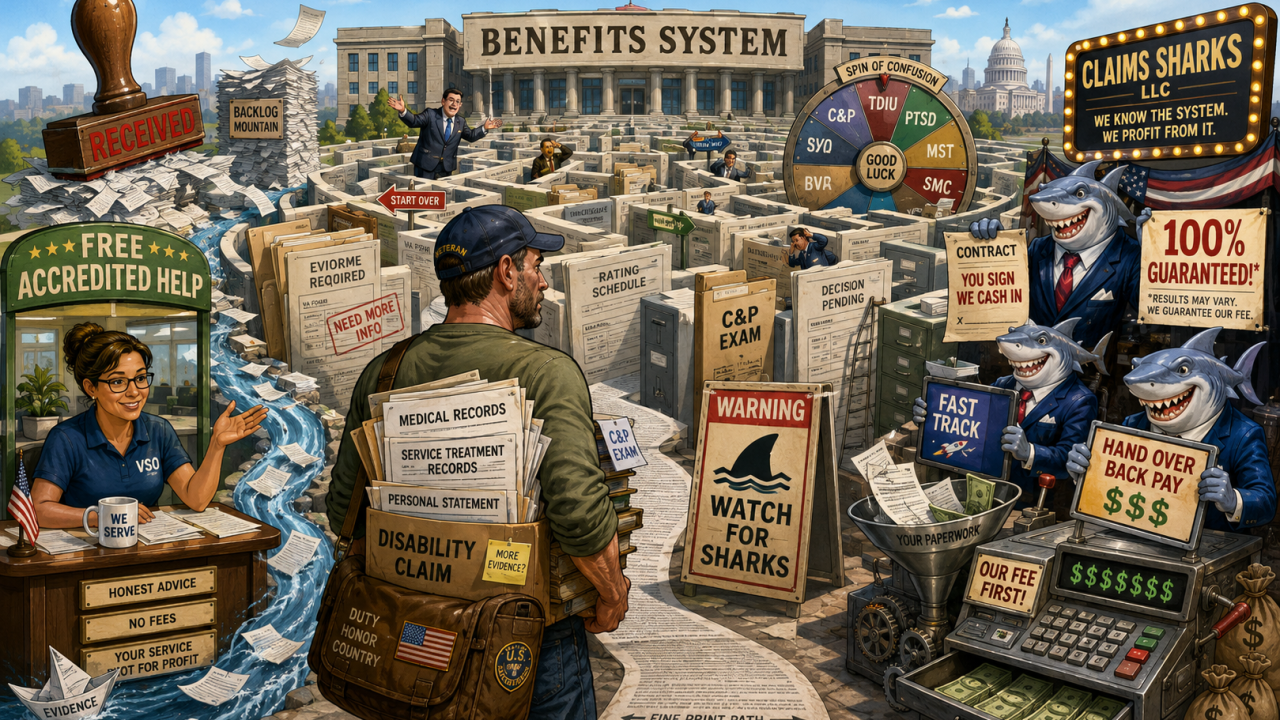
America loves veterans the way casinos love high rollers. There are lights, applause, complimentary coffee, and a powerful institutional interest in making sure the money ultimately travels in the preferred direction.
You served your country, wrecked a knee jumping out of government aircraft, developed tinnitus from machinery designed to rearrange geography, and came home with a spine that now predicts rain more accurately than the Weather Channel. Congratulations. Your reward is access to a federal benefits system so intuitive that an entire private economy has evolved around explaining it to you.
Nature truly is magnificent.
On July 27, the Federal Trade Commission warned veterans about scammers who call, text, email, or slide into social media claiming they can secure missing VA benefits, guarantee a 100 percent disability rating, or speed up a claim for a fee. The FTC’s guidance is wonderfully straightforward. Applying for VA benefits is free. Nobody can guarantee a rating. Nobody has a secret velvet rope into the Department of Veterans Affairs.
Which raises a tiny question, roughly the size of the Pentagon.
Why does this market exist?
Predators don’t establish thriving businesses around processes everybody understands. Nobody is operating a multimillion-dollar underground consultancy teaching Americans how to use a toaster. The opportunity appears when something important, confusing, slow, emotionally loaded, and financially consequential meets a population desperate for competent help.

Enter the VA claims ecosystem, where acronyms reproduce faster than rabbits near a protein supplement warehouse.
To be clear, legitimate representation matters. VA-recognized Veterans Service Organizations provide claims help free of charge. VA-accredited attorneys and claims agents can charge under specific rules after VA has issued an initial decision, when appeals and additional review may require genuine expertise. VA currently reports $410.8 million in attorney and agent fees paid over the preceding 12 months. That figure isn’t evidence that accredited lawyers and agents are villains. It’s evidence that navigating adverse decisions is a serious enough undertaking to support a very large professional market.
The scandal is the shadow market standing beside it wearing Oakleys indoors and promising, “Bro, I can get you to 100.”
GAO reported in 2025 that VA’s Accreditation, Discipline, and Fees program has limited options when dealing with unaccredited operators. Against accredited representatives, VA has an oversight system. Against unaccredited people, officials told GAO they may investigate, send a cease-and-desist letter, or refer possible crimes to law enforcement.
A cease-and-desist letter.
Fantastic. Somewhere a predatory benefits consultant just felt a disturbance in the Force and moved the letter underneath a Papa John’s menu.
Congress has noticed the problem too. The SAFEGUARD Veterans Act, introduced in June 2026, would restore criminal penalties for unauthorized paid claims assistance, tighten accreditation rules, target loopholes, improve reporting, and increase warnings to veterans.
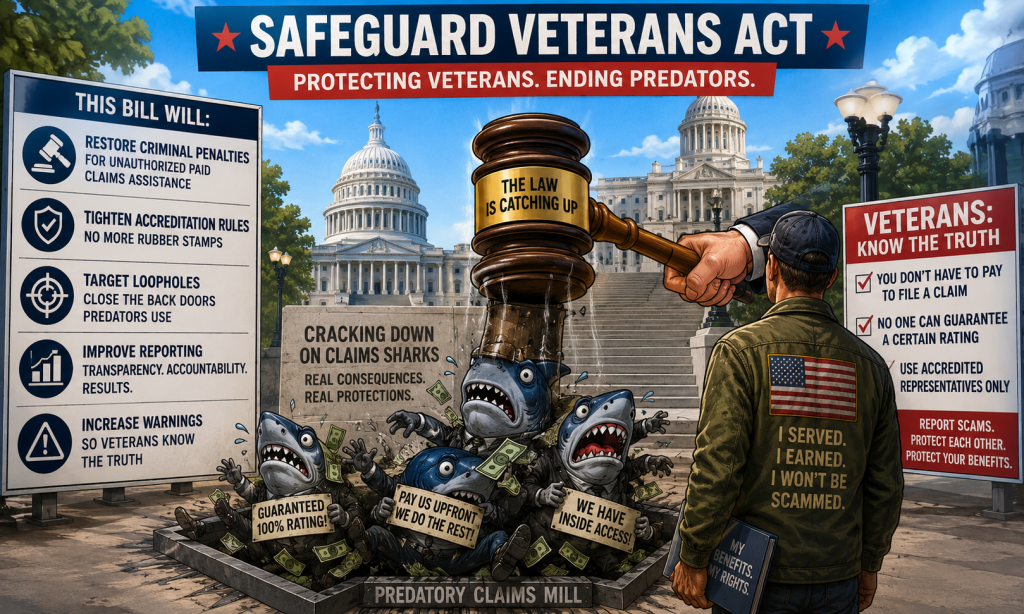
Warnings are useful. So are smoke detectors. But if the federal kitchen keeps filling with smoke every Tuesday, maybe eventually somebody should stop congratulating the detector.
Here’s what should happen.
First, VA should make the initial disability process aggressively understandable. One guided digital path. Plain-English evidence requirements. Service and medical records preloaded whenever legally and technically possible. A claim-status page that explains what is missing, who has the ball, and what happens next. Denial letters should tell a normal human being why the evidence failed and exactly what would materially change the decision.
Second, Congress should give enforcement actual teeth. If an unaccredited company charges veterans for work federal law reserves to accredited representatives, regulators need swift civil penalties, restitution authority, fee disgorgement, and meaningful criminal consequences for knowing violations. A business model based on “maybe nobody prosecutes us” is not innovation. It’s a dare.
Third, every paid advertisement offering VA claims assistance should identify the provider’s VA accreditation status and accreditation number prominently. Platforms selling those ads should be required to verify it. If DoorDash can tell me where a burrito is every six seconds, surely the republic can determine whether the guy promising a disabled Marine $4,200 a month is authorized to touch his claim.
Fourth, give separating service members an accredited benefits navigator before discharge, rather than six months afterward when Facebook has already introduced them to Patriot Mega Claim Freedom Eagle LLC. Build the defense upstream.
Finally, VA should publish useful complaint, discipline, processing-time, reversal, and fee data in one place. Sunlight doesn’t eliminate opportunists, but it ruins the mood.
Veterans absolutely bear some responsibility for checking who they’re dealing with. Adults should read contracts. They should verify accreditation. They should run from anyone guaranteeing a disability percentage or promising special access.
But government doesn’t get to construct a maze, scatter wounded people inside it, post a pamphlet titled WATCH FOR SHARKS, and declare the customer-education campaign a triumph.
A veteran’s disability compensation is payment for damage connected to service. It shouldn’t become raw material for a secondary industry built on confusion.
Thank you for your service.
Now please take a number, memorize Title 38, create twelve passwords, locate a scanner, learn administrative law, and remember that anyone offering to make this easier may be the next problem you have to solve.
References
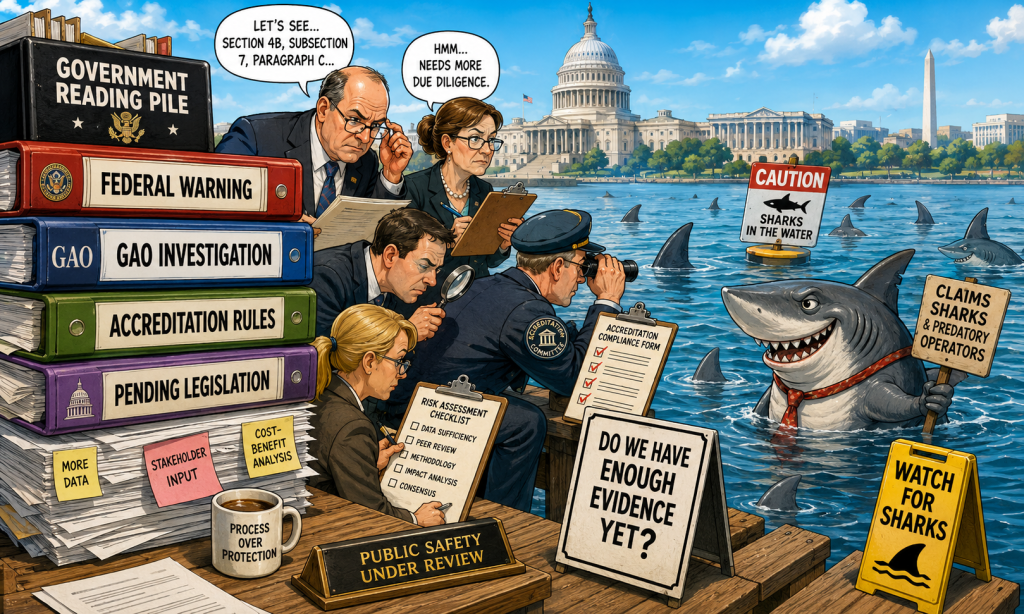
Because apparently a federal warning, a GAO investigation, an accreditation bureaucracy, and pending legislation are required before we may officially acknowledge that the water contains sharks, here’s the government reading pile:
- Federal Trade Commission, Veterans Don’t Pay to Apply for VA Benefits
https://consumer.ftc.gov/consumer-alerts/2026/07/veterans-dont-pay-apply-va-benefits - Department of Veterans Affairs, Accredited Representatives
https://www.benefits.va.gov/vso/ - Department of Veterans Affairs, Attorney and Agent Fees Paid by VA
https://benefits.va.gov/REPORTS/attorney-fee-report/index.asp - U.S. Government Accountability Office, Veterans Benefits More Thorough Planning Needed to Help Better Protect Veterans Assisted by Representatives
https://www.gao.gov/products/gao-25-107211 - U.S. Senate Committee on Veterans’ Affairs, SAFEGUARD Veterans Act Announcement
https://www.veterans.senate.gov/2026/6/blumenthal-pappas-introduce-bill-to-crack-down-on-claims-sharks-scamming-veterans
_____________________________
Tammy Pondsmith studies military bureaucracy, veteran policy, and the mating habits of federal acronyms, then reports the offspring before Congress can name another subcommittee.
As the Voice of the Veteran Community, The Havok Journal seeks to publish a variety of perspectives on a number of sensitive subjects. Unless specifically noted otherwise, nothing we publish is an official point of view of The Havok Journal or any part of the U.S. government.
Buy Me A Coffee
The Havok Journal seeks to serve as a voice of the Veteran and First Responder communities through a focus on current affairs and articles of interest to the public in general, and the veteran community in particular. We strive to offer timely, current, and informative content, with the occasional piece focused on entertainment. We are continually expanding and striving to improve the readers’ experience.
© 2026 The Havok Journal
The Havok Journal welcomes re-posting of our original content as long as it is done in compliance with our Terms of Use.


