There’s a new little trick in prestige television, and by “new” I mean recycled with the confidence of a toddler wearing lipstick on its forehead. It’s called “reimagining history,” which is Hollywood-speak for “we know what happened, we know what people looked like, we know the public can Google portraits in fourteen seconds, and we’re going to do whatever we want anyway because we attended one panel discussion and now we’re cultural surgeons.”
Let’s get one thing straight, since apparently the entertainment industry has been staring into a ring light so long it can’t recognize a human face anymore: when you’re portraying a real historical person, casting should plausibly represent that person. That’s it. That’s the whole circus tent. White actors shouldn’t play Genghis Khan. Black actors shouldn’t play Anne Boleyn. A British-Japanese actor as Mozart in a straight historical drama? That’s not bold. That’s the casting department trying to win a moral Peloton class.
And before somebody reaches for their emergency smelling salts and screams “representation,” relax. Representation matters. It matters so much that maybe actors of color deserve original characters, real historical figures from their own cultures, and stories that don’t require them to cosplay dead Europeans like someone raided a museum gift shop during a fever dream.

The problem isn’t diversity. The problem is lazy diversity, the kind that slaps a different face on an existing figure and then expects applause like it just cured gout. It’s corporate activism with costume jewelry. It says, “We believe in inclusion, unless inclusion requires writing new stories, funding unknown creators, researching world history, or doing anything harder than swapping headshots in a spreadsheet.”
And yes, it’s irritating both ways. When John Wayne played Genghis Khan, it wasn’t “classic cinema.” It was a mayonnaise thunderstorm galloping across Mongolia with a cowboy squint. When Alec Guinness played an Arab prince, when Rex Harrison played a Thai king, when white actors spent decades bronzing themselves into other civilizations like sad little rotisserie chickens, it was absurd. It also kept actual non-white actors away from roles that should’ve been theirs. That was wrong.
But here’s the part modern Hollywood keeps pretending is complicated because complication comes with grants: reversing the direction doesn’t magically make the principle disappear. If historical accuracy matters when one group is misrepresented, it matters when any group is misrepresented. Otherwise we’re not defending truth. We’re playing grievance Twister with a publicist yelling, “Left foot, moral superiority!”
The defense is always the same: “Well, it’s art.” Yes, and a gas station hot dog is technically cuisine. That doesn’t mean I want it interpreting Shakespeare. Art can be stylized. Theater can be symbolic. A musical like Hamilton announces its conceit with a marching band and lyrical fireworks. Nobody watching it thinks George Washington secretly had the vocal tone of Christopher Jackson and a backup ensemble. Fine. That’s theatrical language. It’s upfront. It’s part of the machinery.
But when a production sells itself as a serious historical drama, asks the audience to care about real events, real people, real consequences, and then visually rewrites central figures for contemporary applause, it’s no longer brave. It’s a costume party wearing a dissertation hat.

And spare us the “history was more diverse than you think” lecture delivered with the smugness of someone who just found Morocco on a map and now thinks they’re Ibn Battuta with a streaming deal. Yes, history was more diverse than many old dramas admitted. Ports, empires, armies, courts, colonies, migration, diplomacy, all of it was complicated. Excellent. Then show that truth. Show the African Romans. Show the Moorish scholars. Show the Ottoman diplomats. Show the Indian soldiers under empire. Show the Black Loyalists. Show the Asian seafarers. Show the global past in all its messy, fascinating detail.
Don’t take Isaac Newton, flip the casting, and then act like critics are cavemen for noticing. Newton isn’t a vibe. He’s a person. He had a body, a place, a context, and a culture. So did Mozart. So did Queen Elizabeth. So did Toussaint Louverture, Sitting Bull, Shaka Zulu, Mansa Musa, Queen Liliʻuokalani, Tecumseh, and Ho Chi Minh. Funny how Hollywood is overflowing with white Tudors to reinterpret, yet somehow can’t find the checkbook to make ten seasons of actual non-white history. Incredible. Just breathtaking. Somebody get Netflix a map before it greenlights Marie Curie: The Samba Years.
Here are practical solutions, since apparently adults now need laminated instructions for sincerity.
First, label the thing honestly. If it’s alternate history, say alternate history. If it’s theatrical interpretation, say theatrical interpretation. If it’s inspired by real people but visually symbolic, say that before the audience presses play.
Second, cast historical figures with reasonable fidelity in serious biopics and dramas. That includes race, ethnicity, age range, language, and cultural grounding. Nobody needs a DNA affidavit, just a good-faith effort.
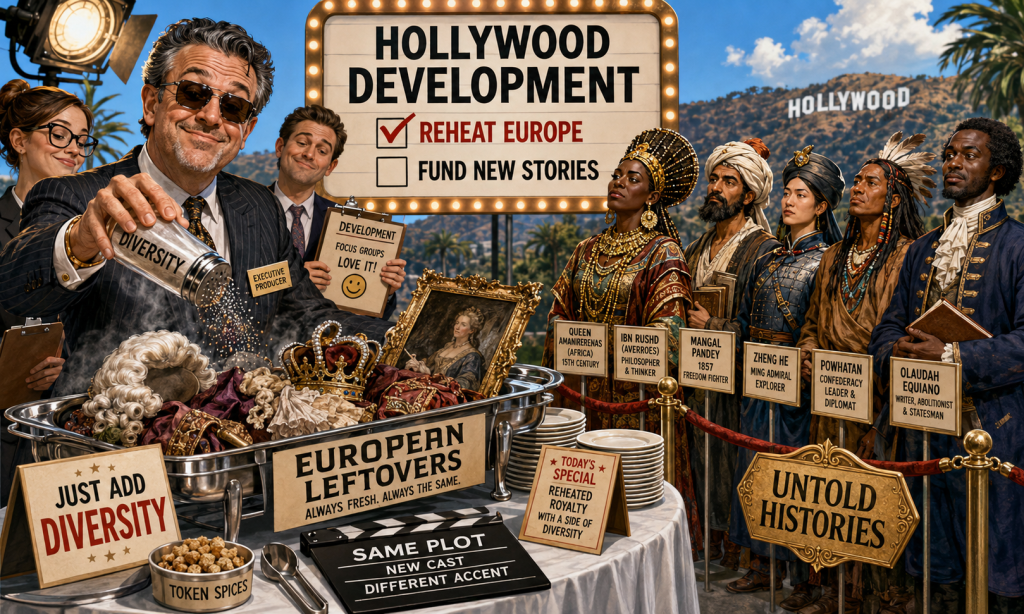
Third, commission more stories about underrepresented historical figures instead of using them as seasoning on European leftovers. The world is not short on heroes, villains, geniuses, warriors, tyrants, artists, rebels, martyrs, and magnificent lunatics.
Fourth, hire historians who can do more than stand near the set looking haunted. Then listen to them. Pay them. Let them save you from turning the past into a TED Talk with corsets.
Fifth, trust audiences. Most people can handle complexity. What they resent is being told that noticing an obvious mismatch makes them morally defective. Viewers aren’t stupid. They can smell ideology wearing pancake makeup.
The past deserves more than being dragged through a present-day branding meeting and released with a smug trailer. Real people lived, fought, created, failed, conquered, suffered, and died. They weren’t avatars for our current anxieties. They weren’t empty jackets waiting for the streaming economy to stuff them with whatever demographic message tests well in Los Angeles.
Tell the truth. Or say you’re making fantasy. Just stop putting a powdered wig on activism and calling it history.
And veterans should care because they know, better than most, that memory, sacrifice, identity, and truth aren’t props to be rearranged by comfortable people chasing applause from other comfortable people.

_____________________________
Tammy Pondsmith is a recovering optimist, part-time cultural exterminator, and full-time thundercloud who once stared down a focus group until it apologized to the Enlightenment.
As the Voice of the Veteran Community, The Havok Journal seeks to publish a variety of perspectives on a number of sensitive subjects. Unless specifically noted otherwise, nothing we publish is an official point of view of The Havok Journal or any part of the U.S. government.
Buy Me A Coffee
The Havok Journal seeks to serve as a voice of the Veteran and First Responder communities through a focus on current affairs and articles of interest to the public in general, and the veteran community in particular. We strive to offer timely, current, and informative content, with the occasional piece focused on entertainment. We are continually expanding and striving to improve the readers’ experience.
© 2026 The Havok Journal
The Havok Journal welcomes re-posting of our original content as long as it is done in compliance with our Terms of Use.