by Untactic Al
Introduction: A Dish That Outsold the Man
When most Americans order Chinese takeout, they aren’t thinking about Qing Dynasty military campaigns, the intricacies of Hunanese cuisine, or the finer points of 19th-century geopolitics. They’re thinking about whether they can eat an entire Styrofoam clamshell of General Tso’s Chicken without having to unbutton their pants.
But while millions happily devour the sticky, sweet, chili-laden chunks, very few know the true story of the man behind the name. That’s because the truth has nothing to do with military greatness, culinary genius, or cultural heritage. The dish exists because of one misheard insult and one general’s spectacular record of avoiding confrontation.
Yes, General Tso was a chicken. And history, through the cruel magic of apostrophes, made him forever synonymous with the dish he loved and the cowardice he embodied.
The Banquet of Blunders
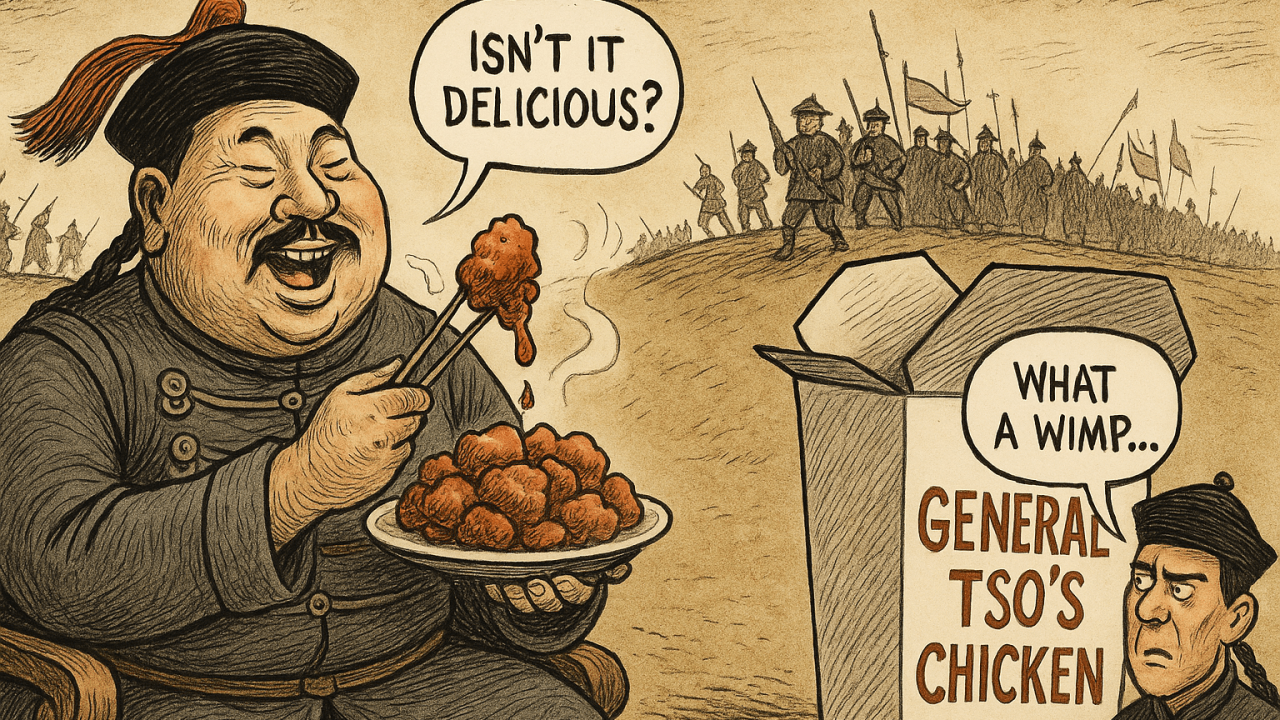
It all began at a lavish banquet in Hunan province. While enemy troops gathered just miles away, General Tso, resplendent in ornate armor and smug self-importance, was focused not on strategy but on a steaming platter of spicy chicken.
Two of his officers, frustrated by yet another evening of poultry instead of planning, whispered among themselves. One leaned over and muttered, “General Tso’s chicken.”
What he meant was, “General Tso is chicken.” A simple contraction. A battlefield-level insult.
Unfortunately, Mandarin does not come with an apostrophe key, and a servant—apparently fluent in misunderstanding—overheard the remark. She believed the officers were praising the dish itself, as if Michelin stars were being awarded in real time. Sadly, she didn’t hear the subsequent sentence: “That chicken is spicier toward the enemy than he is!”
She rushed to the cook and announced:
“The general’s chicken is so beloved, it should be forever known as General Tso’s Chicken!”
The cook, a man far more interested in not being conscripted than in clarifying grammar, immediately adopted the name. And thus, one of history’s most enduring culinary lies was born.
Chicken by Name, Chicken by Nature
While the general happily licked chili oil off his fingers, word of the dish spread quickly through his army. Soldiers, masters of gallows humor long before the U.S. military perfected it, understood the double meaning instantly.
Every bite was rebellion disguised as compliance. The general thought he was being honored; the rank and file knew he was being roasted. Literally.
Historians note that General Tso’s battlefield strategy consisted mainly of:
- Delaying action until the enemy got bored.
- Ordering more chicken.
- Taking credit for victories he had nothing to do with.
- Slowing everything to a snail’s pace through bureaucracy and endless clarification of orders.
One contemporary chronicler wrote:
“His courage was like the soy sauce—thin, salty, and always poured over someone else’s meal.” [1]

From Battlefield to Buffet
Fast forward a millennium or so, and Chinese immigrants arriving in America began adapting traditional recipes for Western palates. Somewhere along the line, the mockery-dish of a cowardly general was rediscovered. American diners, blissfully unaware of the joke, embraced it.
In strip malls across the country, neon signs began glowing with promises of “AUTHENTIC GENERAL TSO’S CHICKEN.” Authentic, of course, in the same way that fortune cookies are authentic ancient Chinese prophecies and Panda Express is an authentic cultural exchange program.
The irony is delicious: the most popular “Chinese” dish in America is really an inside joke at the expense of a general who never fought a meaningful battle in his life.
The Apostrophe That Changed the World
The true hero—or villain—of this saga is not the general, nor the cook, nor even the officers brave enough to mutter insults within earshot. It is the apostrophe.
The misunderstood contraction “Tso’s” has probably caused more confusion than any battlefield maneuver. In fact, the apostrophe may be the most dangerous weapon in history, capable of altering reputations, treaties, and military legacies with one misplaced squiggle.
Thanks to that, we got spicy fried chicken—and a general’s cowardice preserved in deep fryer oil.
Troop Morale and Chicken Morale
It’s worth noting how quickly soldiers rallied around the dish. Food has always been central to morale, and in this case, mocking their leader with every bite gave Tso’s troops a psychological edge.
When morale slumps in today’s armed forces, we get PowerPoint slides, resiliency workshops, and mandatory fun days. When morale slumped in Tso’s army, they got chicken and the sweet satisfaction of privately calling their general a coward to his face. [2]
A General Without a Battle, But With a Buffet
The cruelest twist of fate is that General Tso, who spent his life avoiding battles, ended up fighting the one war he couldn’t win: the war against indigestion in American suburbs.
He is remembered not for tactics, courage, or statesmanship, but for a dish that college freshmen order at 2 a.m. and regret by 2:30.
Every carton of General Tso’s Chicken is a reminder that history doesn’t just repeat itself—it reheats it, smothers it in sauce, and serves it over rice.
Conclusion: The Spiciest Insult in History
Next time you order General Tso’s Chicken, pause before you dig in. Consider the layers of irony coating each sticky piece:
- A cowardly general who ducked combat.
- Officers whose muttered insult became a menu item.
- A servant whose grammar fail launched a culinary empire.
- A reminder of cowardice in the form of spicy fried battered chicken, available for $8.99 with a side of fried rice.
General Tso avoided every battle, but thanks to a misplaced apostrophe and centuries of misunderstanding, he marches on. Not as a hero, not as a strategist, but as the only general in history to be both chicken and chicken.
I wonder what dishes are favorites among our current bevy of generals. It boggles the mind.

References
[1] Chronicles of Cowardice: The Collected Failures of Tso Zongtang, translated by Dr. Ling Wei of the Institute for Culinary Warfare.
[2] Morale Through Meals: From Ancient Banquets to the DFAC Taco Bar, U.S. Army War College, Satire Department, 2023.
____________________________________

Before joining the Article 107 News Team, Untactic Al endured a controversial, checkered 36-year career in the United States Air Force. He now clutches his DD-214 blankie, a reminder that his rise through the ranks says more about the incompetence of his leadership than his own merit.
*Article 107 News: The Facts, Before They Happen
Article 107 of the Uniform Code of Military Justice covers “false official statements.” As the name implies, Art107 News is Havok Journal’s satire wing, and you shouldn’t take anything published under this byline seriously. You should., however, mercilessly mock anyone who does.
Buy Me A Coffee
The Havok Journal seeks to serve as a voice of the Veteran and First Responder communities through a focus on current affairs and articles of interest to the public in general, and the veteran community in particular. We strive to offer timely, current, and informative content, with the occasional piece focused on entertainment. We are continually expanding and striving to improve the readers’ experience.
© 2026 The Havok Journal
The Havok Journal welcomes re-posting of our original content as long as it is done in compliance with our Terms of Use.


