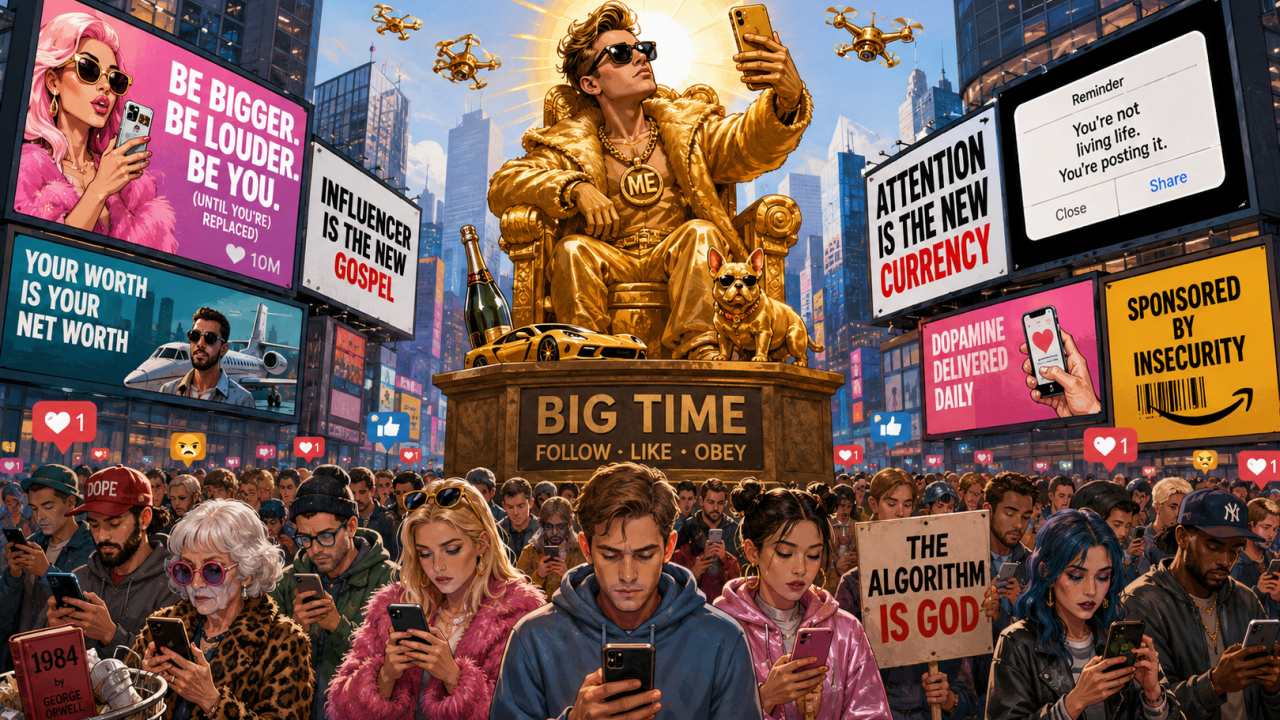
In 1986, Peter Gabriel looked at the swollen fantasy of success, gave it a fabulous beat, and quietly slid a scalpel between the ribs. “Big Time,” taken from his album So, wasn’t just a funky little parade float of ambition. It was a warning label for the human ego after it discovers mirrors, applause, and financing. Gabriel saw the sickness before it got Wi-Fi, brand deals, and a ring-shaped shrine clipped to a tripod.
The song’s narrator wants everything bigger. Bigger status, bigger house, bigger smile, bigger everything, including the head where a conscience used to rent a modest room. He’s the spiritual ancestor of today’s influencer who describes a smoothie as “transformational,” films himself being generous, and then waits for the internet to clap like a trained seal with a data plan.
Social media didn’t invent narcissism. Please. Humanity had vanity before indoor plumbing. What social media did was take the village show-off, give him analytics, hand him a discount code, and tell him he was “building community” while he begged strangers to admire his jawline from twelve angles.
And now everyone is “big time.” Everyone is a thought leader. Everyone is a brand. Everyone has a journey, a launch, a platform, a newsletter, a podcast, a healing arc, and a blurry photo of a latte standing in for a personality. The old big city Gabriel sang about has been replaced by a glowing rectangle where people go to become famous to people they’d cross the street to avoid in real life.
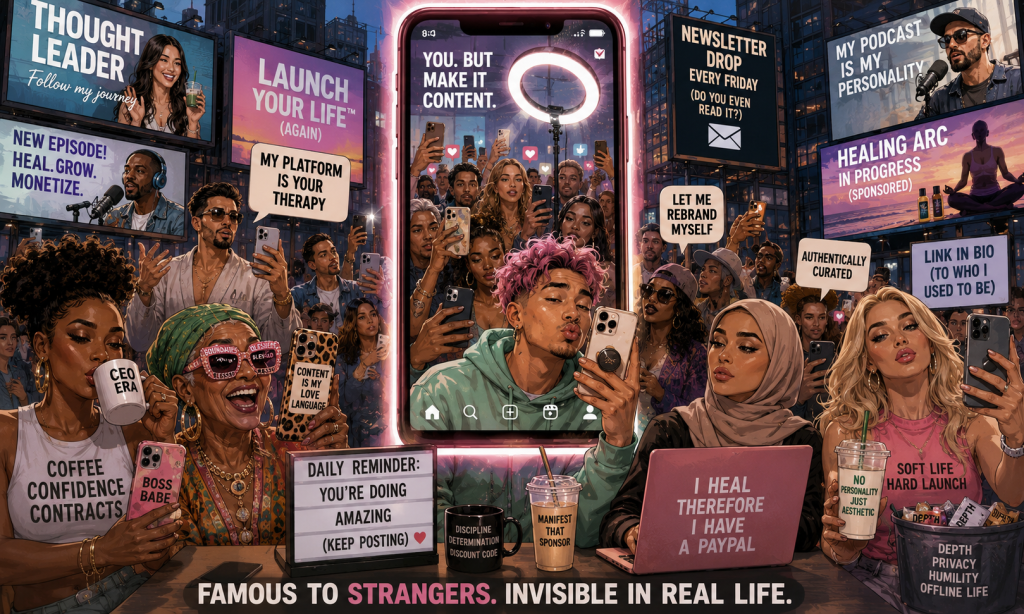
The numbers are grotesque enough to deserve their own tiny opera. Pew found in 2025 that 84 percent of U.S. adults use YouTube, 71 percent use Facebook, half use Instagram, and 37 percent use TikTok. Translation, the town square is now a casino where the slot machines compliment your haircut while selling your nervous system to advertisers.
The big God in the big church is now the algorithm. We kneel before it daily. We bring offerings of outrage, cleavage, grief, pets, trauma, abs, opinions, children, and vacation photos arranged to imply emotional superiority. In return, it grants us little digital pellets of approval. Like lab rats with eyebrow pencils, we press the lever again.
And don’t start with “it’s just harmless fun,” because that excuse has been working overtime with the moral stamina of a damp napkin. The U.S. Surgeon General has said up to 95 percent of teens ages 13 to 17 report using a social media platform, with one third reporting use “almost constantly.” The same advisory says young people spending more than three hours a day on social media face double the risk of mental health problems, including symptoms of depression and anxiety.
Meanwhile, the adults are barely doing better. We’ve turned insecurity into content and content into identity. A person can now spend forty minutes editing a post about authenticity. That’s not authenticity. That’s a hostage video directed by Sephora lighting and unresolved childhood applause hunger.
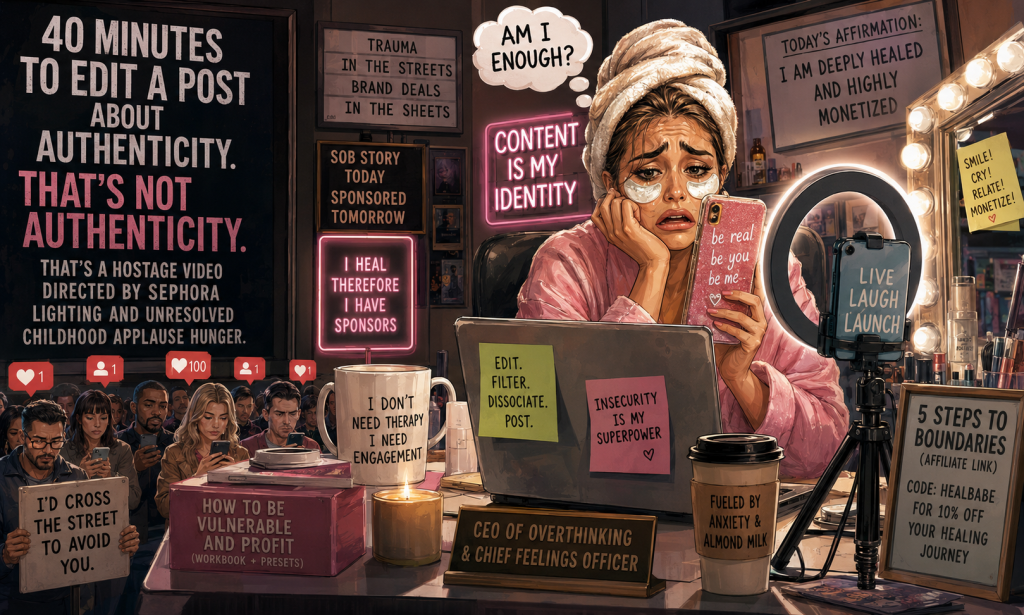
The Federal Trade Commission said in 2024 that major social media and video streaming companies engaged in “vast surveillance” of users to monetize personal information, with inadequate safeguards for children and teens. So yes, please tell me again how your favorite app is “free.” Free like cheese in a trap, darling.
Here’s the hideous truth. The system rewards whatever keeps you staring. Beauty works. Rage works. Envy works. Fear works. Humiliation works. Nuance performs like a substitute teacher with a sinus infection. That’s why the internet keeps turning adults into mascots for their own worst impulses. It makes loud people louder, lonely people lonelier, anxious people twitchier, and vain people absolutely unbearable at airports.
So what do we do, besides move to a cave and communicate exclusively through suspiciously judgmental owls?
First, stop conflating visibility with value. Before posting, ask one brutal question: would I still do this if nobody could like it? If the answer is no, congratulations, you’ve located the little fame tapeworm. Name it Trevor and starve it.
Second, put friction between yourself and the slot machine. Turn off push alerts. Move social apps off your home screen. Set app limits and honor them like a court order. Keep the first thirty minutes of the morning and the last hour before sleep away from feeds. Your brain is an organ, not a 24-hour comment motel.
Third, replace performance with contact. Call one person. Visit one person. Join one real group. Take one walk without documenting it like National Geographic just discovered your calves. If you need support, get support from humans with faces, voices, and the ability to notice when you’re faking “fine.”
Fourth, stop feeding rage vendors. Unfollow accounts that turn your attention into bile. Mute people who make you feel spiritually sticky. Block the professional panic merchants. The internet is full of people selling emotional food poisoning with a side of moral superiority.
Fifth, demand rules with teeth. Platforms should limit data collection, restrict targeted advertising to minors, share meaningful data with independent researchers, and design for safety instead of endless compulsion. The Surgeon General and FTC have both pointed toward stronger safeguards, privacy protections, and transparency. The companies can whine into their diamond-studded ergonomic chairs. They’ll survive.
Finally, build actual community like your sanity depends on it, because it does. VA’s Veterans Socials program says social support is important to overall veteran health, and its resources encourage local, peer-connected gatherings to reduce isolation.
Peter Gabriel warned us about the bloated dream of being larger than life. Social media made it available on installment payments with filters. The joke is that everyone got the microphone and somehow the conversation got dumber, crueler, and more desperate. The bigger we made the self, the smaller we made the soul.
For veterans, this matters because a person trained to survive chaos deserves real community and privacy, not an algorithm poking old bruises for engagement while calling the wound a trend.
For anyone clutching a pearl hard enough to make geology, here are the adult sources Tammy used before the comment section starts chewing drywall.
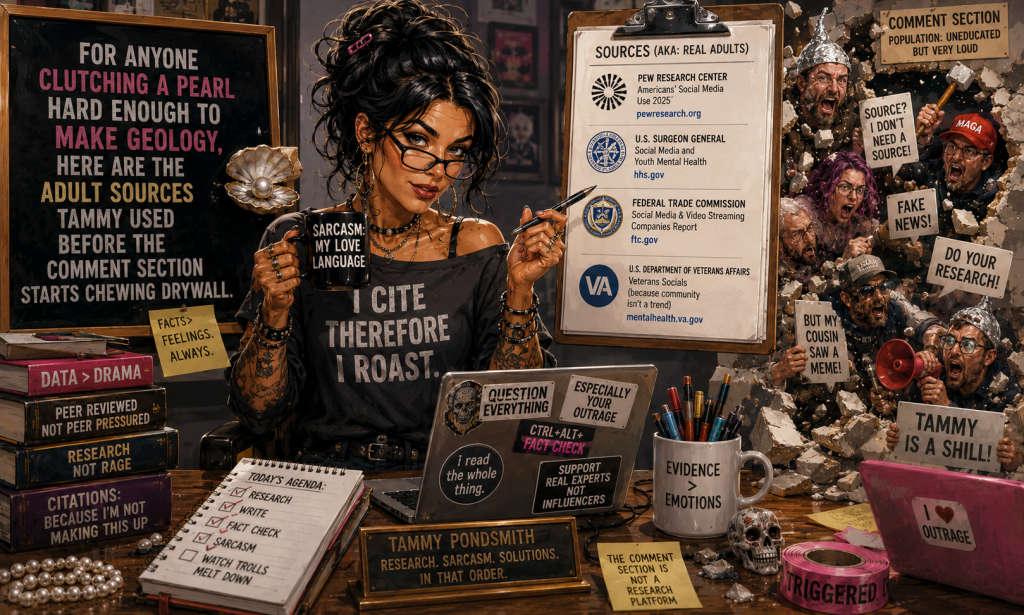
Peter Gabriel official page for “Big Time”
https://petergabriel.com/video/peter-gabriel-big-time/
Pew Research Center, Americans’ Social Media Use 2025
https://www.pewresearch.org/internet/2025/11/20/americans-social-media-use-2025/
U.S. Surgeon General, Social Media and Youth Mental Health
https://www.hhs.gov/surgeongeneral/reports-and-publications/youth-mental-health/social-media/index.html
Federal Trade Commission, Social media and video streaming companies report
https://www.ftc.gov/news-events/news/press-releases/2024/09/ftc-staff-report-finds-large-social-media-video-streaming-companies-have-engaged-vast-surveillance
VA Veterans Socials
https://www.mentalhealth.va.gov/socials/
_____________________________
Tammy Pondsmith is a recovering oracle of suburban doom who once got banned from a neighborhood app for diagnosing a casserole as a cry for help.
As the Voice of the Veteran Community, The Havok Journal seeks to publish a variety of perspectives on a number of sensitive subjects. Unless specifically noted otherwise, nothing we publish is an official point of view of The Havok Journal or any part of the U.S. government.
Buy Me A Coffee
The Havok Journal seeks to serve as a voice of the Veteran and First Responder communities through a focus on current affairs and articles of interest to the public in general, and the veteran community in particular. We strive to offer timely, current, and informative content, with the occasional piece focused on entertainment. We are continually expanding and striving to improve the readers’ experience.
© 2026 The Havok Journal
The Havok Journal welcomes re-posting of our original content as long as it is done in compliance with our Terms of Use.