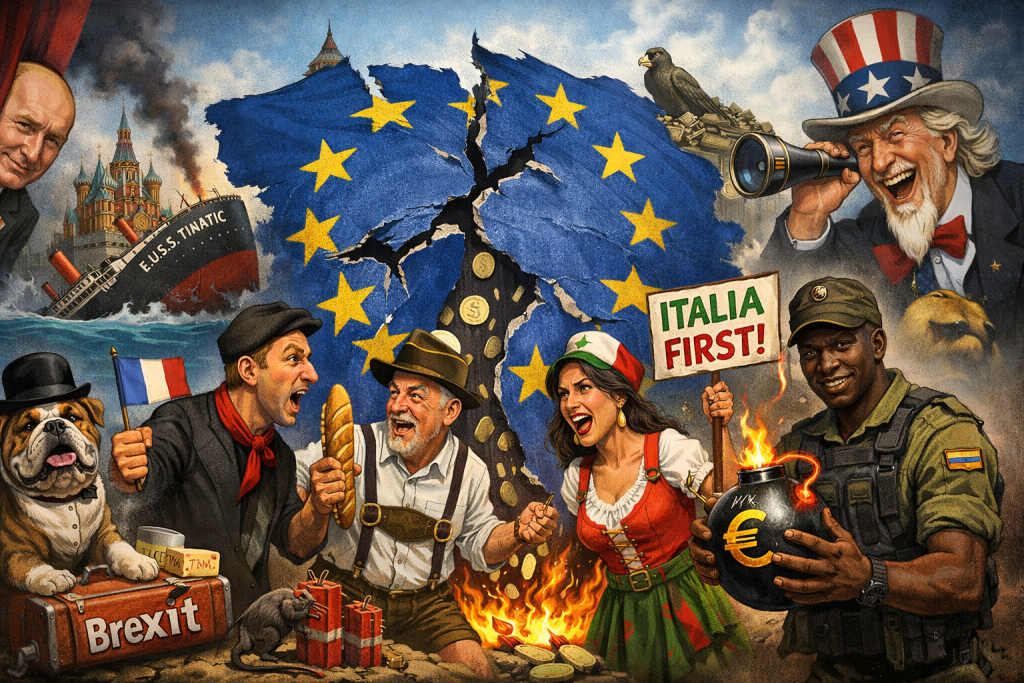
The European Union has a marketing problem, but that’s not the real emergency. The real emergency is that half of Europe’s political class treats the EU like a combination ATM, scapegoat, and drunk uncle with a good credit score. They take the money, enjoy the market, hide under the security umbrella, dump their exports into the single system, and then go home to campaign against Brussels as though they’re leading a brave anti-colonial uprising instead of whining about the house rules in a club they refuse to stop billing.
That is the broad European scam now. The EU was built for an almost embarrassingly sensible reason: to make it harder for the continent to relapse into its old hobby of turning grievances, borders, and national vanity into funerals. It linked economies, laws, and interests tightly enough that old enemies would have to behave like trading partners instead of amateur undertakers. And because it worked, generations of politicians inherited peace and prosperity like spoiled heirs inheriting a vineyard. They never had to build the thing, so naturally they treat it like a bureaucratic annoyance rather than one of the few political inventions on the continent that actually earned its keep.
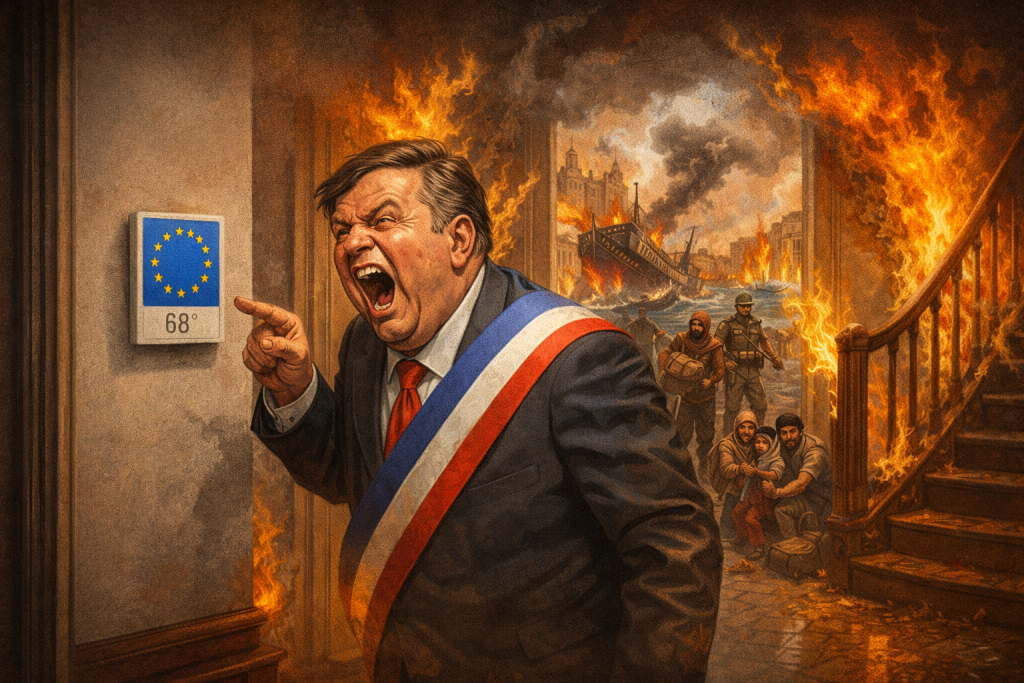
Now every crisis becomes an audition for some velvet-jowled patriot who claims the real problem is not war on Europe’s edge, economic shocks, migration strain, Russian sabotage, or global instability. No, apparently the real villain is the European Union asking adults to cooperate across borders. Amazing. A house is on fire and the man in the foyer is screaming about the thermostat.
The anti-EU pitch is always the same cheap perfume sprayed over the same old rot. Brussels is undemocratic. Brussels is intrusive. Brussels is out of touch. Brussels is taking away sovereignty. This is very rich coming from politicians who are perfectly happy to let Brussels absorb blame for hard decisions while they keep the benefits of membership flowing into their countries. They want access to the single market, development funds, free movement when it suits them, legal protections, investment stability, and collective bargaining power. What they do not want is constraint. They do not want courts, standards, obligations, or the faintest suggestion that membership in a union might require conduct befitting a grown civilization.
That is not patriotism. That is freeloading in a flag pin.
Brexit should have ended this fantasy for good. Britain was sold a glorious recovery of control, national vigor, and sovereign destiny. What it got was a long, expensive lesson in the difference between a slogan and a supply chain. The great liberation ended up looking suspiciously like more friction, less leverage, and the peculiar national embarrassment of realizing too late that it is better to understand a system before setting it on fire. Brexit was not a triumph of self-government. It was a continental infomercial for buyer’s remorse.
And yet the lesson didn’t cure the disease, because the disease was never really about evidence. It was about emotional convenience. The EU is useful, complicated, distant, and difficult to explain in a chant. That makes it perfect for opportunists. When growth slows, blame Brussels. When courts object to corruption, blame Brussels. When voters are angry, blame Brussels. When you want subsidies, call Brussels. It is one of the great achievements of modern European nonsense that leaders can take money from the Union with one hand and slap the Union in the face with the other, then call this courage.
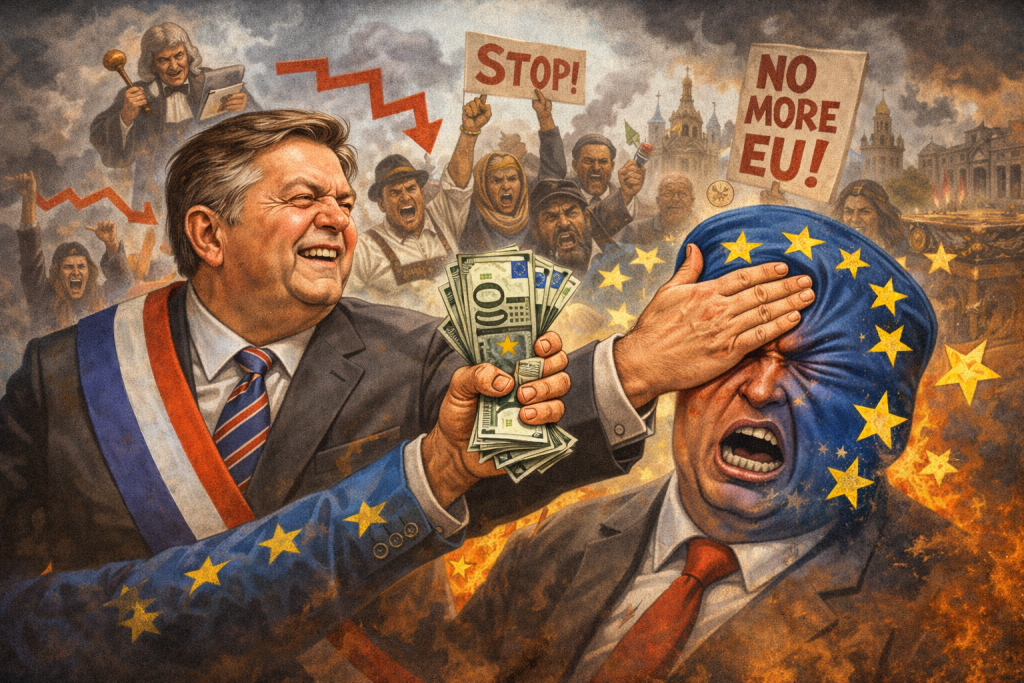
Hungary turned this into political performance art. Plenty of nationalist parties elsewhere have tried the same act in varying costumes. The formula is consistent: feed on European integration, denounce European integration, hollow out democratic norms at home, and then present any pushback from the EU as proof that the EU is tyrannical. It is the logic of a vandal suing the building for resisting his crowbar.
The truly maddening part is that the European Union makes this sabotage easier than it should. It still behaves too often like a grand moral seminar trapped inside a procedural maze. Too many veto points. Too much reluctance to punish chronic bad faith. Too much faith that history’s lessons sell themselves. They do not. Prevention is invisible. Peace is boring. Customs harmonization does not stir the blood. Men promising national rebirth through institutional arson, unfortunately, know how to work a microphone.
So the EU needs fewer hymns to values and more usable teeth.
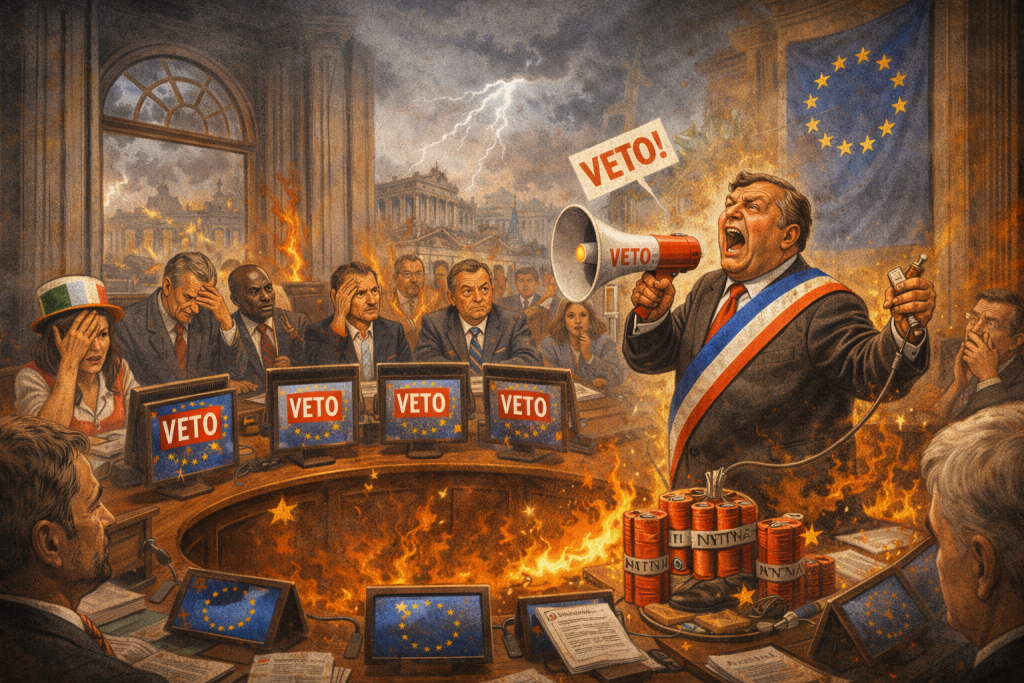
First, stop pretending every member state should be able to hold the whole project hostage whenever a domestic huckster needs campaign footage. On major security and foreign policy matters, the Union needs far fewer vetoes and many more qualified-majority decisions. An institution that can be paralyzed by its least serious participant is not a union. It is group work run by extortionists.
Second, tie European money brutally and transparently to legal compliance, judicial independence, and basic democratic conduct. Not through theatrical scolding. Through cash. If governments want the benefits of EU membership, they meet EU standards. Otherwise the funds stop. Amazing how quickly lofty theories about sovereignty become more nuanced when invoices are involved.
Third, the EU needs to speak honestly about power. Europe cannot spend every decade discovering anew that moral aspiration without hard capacity is just expensive stationery. A more integrated defense posture, common procurement, and real strategic coordination are not warmongering. They are what serious adults do when they live next to danger and would prefer not to be dictated to by Moscow, Washington, or whichever strongman is currently mistaking disruption for genius.
Finally, Brussels should make the case for the Union in plain language. Not sacred language. Not managerial sludge. Tell Europeans what the EU is for: fewer internal enemies, more shared leverage, lower economic self-harm, and a continent that does not have to relearn every century why nationalism becomes grotesque the moment it decides cooperation is emasculating.
The European Union is flawed, cumbersome, sanctimonious, and often allergic to clarity. Fine. So is every large human arrangement that isn’t a biker gang. But the choice in Europe is not between Brussels and some romantic paradise of sovereign competence. It is between an imperfect union and a return to the old continental tradition of vanity, panic, and competitive stupidity in tailored suits. Europe’s deadbeat patriots are selling the second option as freedom. That’s adorable. Nothing says liberty like burning down the guardrail and calling the crash a cultural revival.
_____________________________
Tammy Pondsmith is Executive Director of Strategic Eye-Rolling at the Center for Continental Delusions, where she tracks how cowards turn grift into doctrine and call the invoice oppression.
As the Voice of the Veteran Community, The Havok Journal seeks to publish a variety of perspectives on a number of sensitive subjects. Unless specifically noted otherwise, nothing we publish is an official point of view of The Havok Journal or any part of the U.S. government.
Buy Me A Coffee
The Havok Journal seeks to serve as a voice of the Veteran and First Responder communities through a focus on current affairs and articles of interest to the public in general, and the veteran community in particular. We strive to offer timely, current, and informative content, with the occasional piece focused on entertainment. We are continually expanding and striving to improve the readers’ experience.
© 2026 The Havok Journal
The Havok Journal welcomes re-posting of our original content as long as it is done in compliance with our Terms of Use.