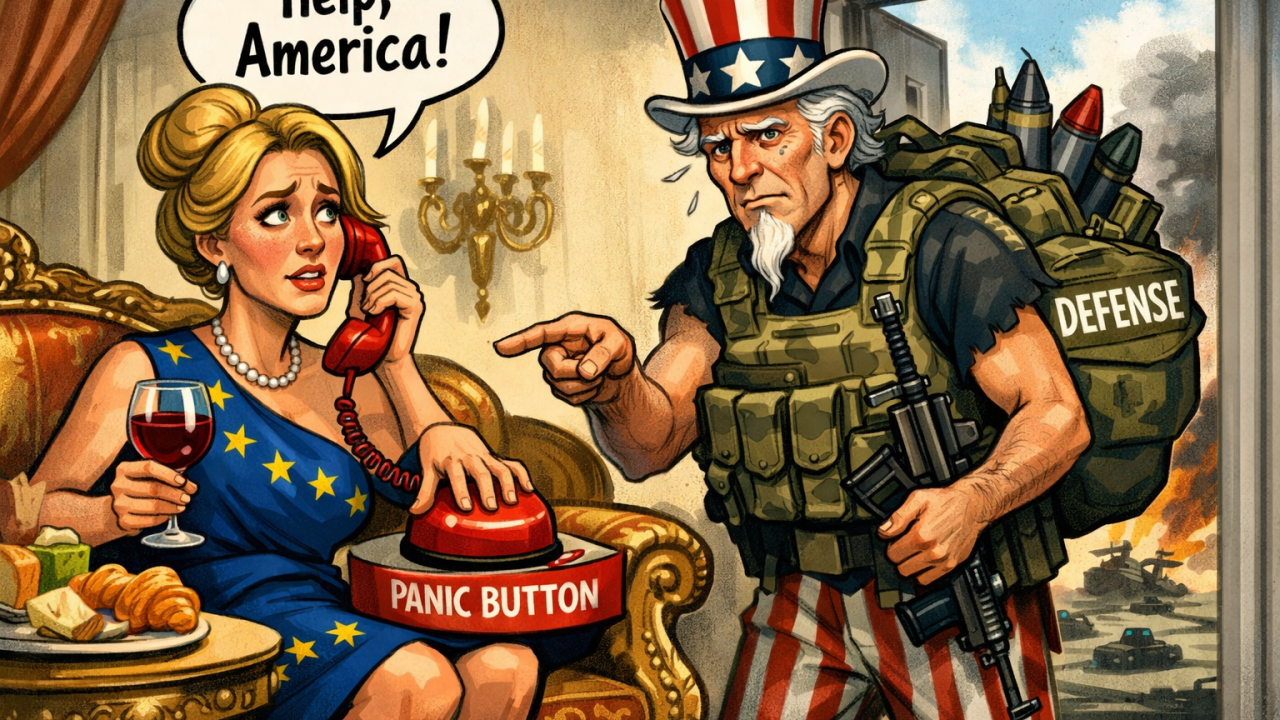
Europe has spent years pretending that dependency is a sophisticated moral posture. It isn’t. It’s dependency. Put a silk scarf on it, seat it on a panel in Brussels, hand it a briefing paper about shared values and resilient democracies, and it is still a rich continent waiting for the Americans to come downstairs with a gun when the windows start rattling.
That’s the whole scam.
The scandal here is not that Washington is rude about it. Washington is rude about everything. The scandal is that Europe still acts shocked every time the Americans say, in one vulgar dialect or another, that the free ride is over. By now this should not come as a revelation. It should come as a calendar reminder. The United States has been complaining about Europe’s defense habits for so long that the complaint itself is practically a NATO capability.
And Europe, naturally, has responded in the most European way possible. It has held meetings. It has issued concerns. It has arranged grave little conversations in excellent rooms with very expensive mineral water. What it hasn’t done, at anything like the necessary scale, is build the blunt and boring machinery of survival. Not the slogans. Not the declarations. The actual stuff. Shells. Air defense. Logistics. Command structures. Readiness. The ugly plumbing that keeps countries from being invaded while editorial boards discuss norms.
Europe doesn’t have a resource problem. It has a nerve problem.
This is what makes the whole performance so embarrassing. We are not talking about some helpless archipelago of candle makers and goat herders. Europe is wealthy. Europe is educated. Europe is industrial. Europe can regulate a dishwasher into a state of metaphysical exhaustion. It can absolutely figure out how to manufacture enough ammunition to avoid looking like a museum with a banking sector. The obstacle is not inability. The obstacle is that too much of the European political class has treated hard power as morally beneath them, like chewing with your mouth open or admitting you need a fence.
For years, military seriousness was handled as a kind of embarrassing lower body function. Necessary in theory, regrettable in tone, and best outsourced to the loud relative across the Atlantic who likes aircraft carriers and says inappropriate things at dinner. Europe got to enjoy the status of being protected while also enjoying the vanity of acting faintly superior to the people doing the protecting. Lovely arrangement. Very flattering. Completely unserious.
Now reality has returned, as it tends to do, with all the tact of a brick through glass.
Russia is not an academic concept. It is not a graduate seminar in post-imperial grievance. It is a revanchist power with artillery, appetite, and a demonstrated willingness to turn neighboring countries into rubble. At that point, dependence on American political moods stops looking like alliance management and starts looking like what it is: national survival balanced on another electorate’s attention span. That isn’t strategy. That’s roulette with subtitles.
And yet Europe still talks about defense spending the way people talk about flossing. Yes, yes, very important, absolutely, we must all do better, perhaps next quarter after the conference. There is always some reason the serious thing cannot be done seriously. Budgets are difficult. Coalitions are fragile. Public opinion is complicated. It’s amazing how often entire civilizations become too delicate to defend themselves right around the moment a bill comes due.
The funniest part, if you enjoy this kind of institutional self-exposure, is that Europe desperately wants the prestige of being a power. It loves the language of strategic autonomy. Loves it. Rolls it around in the mouth like a wine tasting note. You hear phrases like geopolitical actor and pillar of stability and rules-based leadership and think, marvelous, perhaps somebody has purchased some missile defense. But no. Mostly what’s been purchased is vocabulary.
Europe wants to be taken seriously without paying the cover charge of seriousness.
It wants the pose of adulthood with the habits of a protected child. It wants sovereignty as branding, not as burden. It wants to speak in the language of history while outsourcing the bill for history’s return. That arrangement was always degrading, even when it was convenient. It made the Americans resentful, the Europeans complacent, and the whole alliance feel like a codependent marriage held together by mutual eye-rolling and one partner’s military credit card.
So yes, if Washington says Europe needs to carry the load, the correct response is not outrage. It’s overdue embarrassment. It’s the sort of embarrassment a person should feel after realizing they’ve been giving TED Talk answers to a problem that requires concrete, steel, fuel, discipline, and the unfashionable willingness to admit that force still runs a large part of the world.
This will cost money. Obviously. Defense is expensive because defeat is more expensive. A continent that can fund lavish welfare states, green transition plans, industrial subsidies, cultural ministries, and endless bureaucratic barnacles can fund its own defense. Not because tanks are more poetic than social programs. Because all the civilized priorities Europe likes to advertise exist downstream of security. You don’t get to preserve your enlightened model if somebody else has to keep your skies safe while you workshop the language of resilience.
What Europe needs now is not another sermon about values. It needs warehouses, factories, recruitment, training, stockpiles, and politicians willing to say the least fashionable sentence in modern public life, which is this: if you want peace, you have to make yourself difficult to attack.
Anything less is just a luxurious form of denial.
And denial, however elegantly furnished, is still a form of begging.
_____________________________
Tammy Pondsmith is a columnist who has spent years watching powerful people confuse jargon with courage and invoices with civilization.
As the Voice of the Veteran Community, The Havok Journal seeks to publish a variety of perspectives on a number of sensitive subjects. Unless specifically noted otherwise, nothing we publish is an official point of view of The Havok Journal or any part of the U.S. government.
Buy Me A Coffee
The Havok Journal seeks to serve as a voice of the Veteran and First Responder communities through a focus on current affairs and articles of interest to the public in general, and the veteran community in particular. We strive to offer timely, current, and informative content, with the occasional piece focused on entertainment. We are continually expanding and striving to improve the readers’ experience.
© 2026 The Havok Journal
The Havok Journal welcomes re-posting of our original content as long as it is done in compliance with our Terms of Use.


