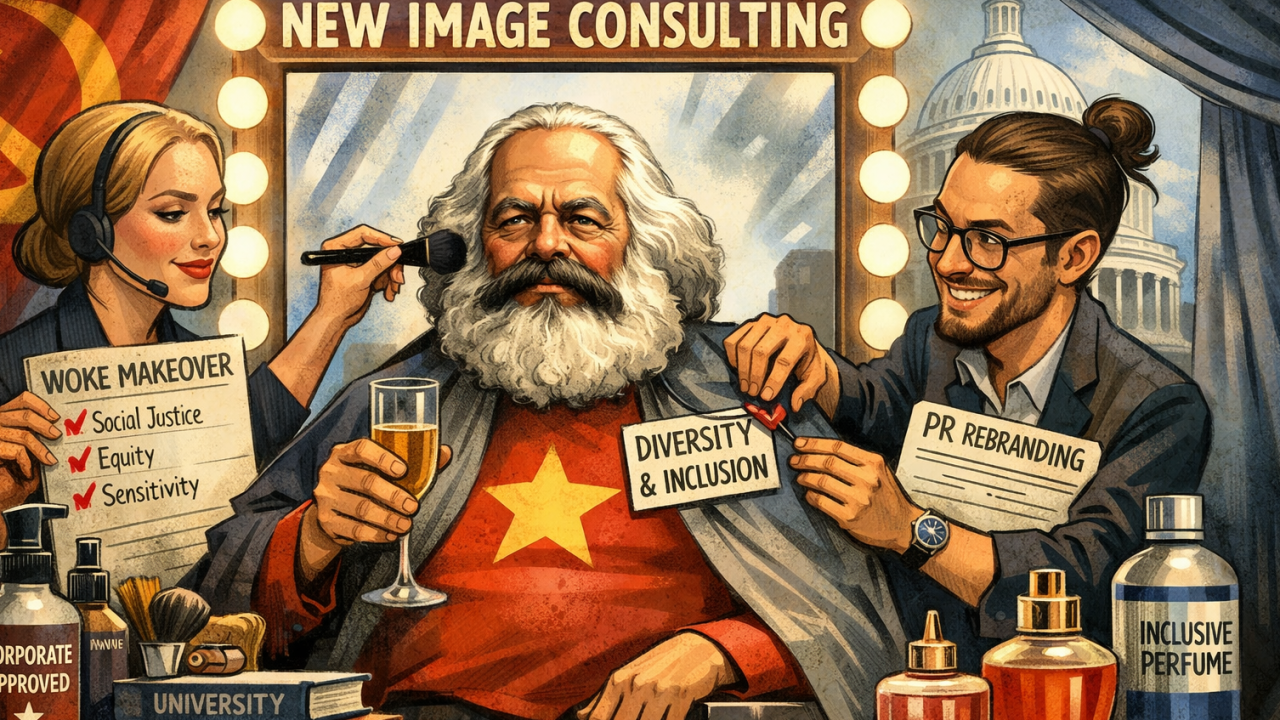
For an ideology that allegedly died in disgrace, communism’s had a fantastic second act. Not a comeback exactly. More like a wardrobe change, a media scrub, and a nice little spa treatment so people could pretend the corpse looked rested.
That’s the trick, really. Communism didn’t disappear. It re-entered public life the way disgraced aristocrats always do, under a new name, with softer lighting and a fresh set of moral accessories. It stopped arriving in jackboots and started showing up in faculty lounges, HR trainings, nonprofit mission statements, and corporate language guides written by people who look like they’ve never lifted anything heavier than a grievance.
Same old appetite for control. Much better branding.
The original model was at least honest in its ugliness. It hated markets because markets reward competence, which is intolerable if your whole worldview runs on envy and administrative fantasy. It hated religion because religion answers to something higher than the state, and every totalizing ideology eventually gets jealous of God. It hated family because family creates loyalties the political class can’t fully supervise. It hated excellence because excellence is offensive to people who’ve built their identity around resenting it.
And it hated the West because the West, for all its flaws, kept producing the one thing communist systems could never tolerate for long: free people making choices without permission from a panel of humorless mediocrities.
That much hasn’t changed. What’s changed is the sales pitch.
The old communists promised revolution. The new ones promise sensitivity. The old ones barked about seizing the means of production. The new ones talk about equity, lived experience, decolonizing systems, and creating safe spaces for approved feelings. It’s the same moral architecture in a different paint color. Divide the world into oppressors and oppressed. Treat success as evidence of theft. Turn grievance into a credential. Turn guilt into policy. Turn every normal human distinction into a political crime unless it flatters the correct constituency.
Then call the whole thing compassion and wait for applause.
And people do applaud, because the updated version figured out something the Soviet bloc never quite mastered. In modern Western life, you don’t need to drag people into ideological conformity if you can flatter them into it. You don’t need everyone reading Marx by candlelight. You just need enough of them to believe that self-loathing is sophistication, that moral confusion is depth, and that the highest form of civic virtue is reciting whatever pious nonsense keeps them in good standing with their manager, their niece, and the woman in compliance who speaks like a hostage note.
That’s why academia matters so much. Universities didn’t just absorb radical ideas. They refined them. They laundered them. They took old class resentment, stripped off the industrial grime, sprayed it with therapeutic perfume, and repackaged it as enlightened social consciousness. Suddenly, the point of education wasn’t to pursue truth, build judgment, or cultivate serious citizens. It was to train emotionally overwrought hall monitors to detect invisible systems in every corner of life and report them with trembling moral urgency.
Then those students graduated, and naturally they spread out into every institution soft enough to host them.
Media got them. Bureaucracies got them. Publishing got them. Human resources practically built a terrarium for them. And corporate America, which would outsource its own mother for a half-point improvement in quarterly earnings, discovered that it could cover itself in moral language and present its greed as ethics. So now the same giant companies that depend on opaque supply chains, disposable labor, and market domination would like you to believe they’re also the guardians of justice.
That’s adorable.
It would be easier to laugh off if it weren’t so effective. Because this new version doesn’t need gulags on every corner. It doesn’t even need formal censorship most of the time. It captures the language first. Once it controls the approved vocabulary, it controls what can be safely said. Once it controls what can be safely said, it starts shaping what people are willing to think. And once you’ve got millions of people censoring themselves before they finish a sentence, the heavy lifting is done.
The old communists nationalized industry. The new communists nationalize conscience.
That’s why everything now comes wrapped in the same weird moral plastic. Fairness. Inclusion. Justice. Belonging. Diversity. Nobody objects to fairness in the abstract. Nobody sane opposes real justice. That’s what makes the disguise so effective. The language is decent. The uses are not. The point isn’t equal treatment. The point is permanent moral asymmetry. One class gets innocence by inheritance. Another gets guilt by inheritance. One group’s motives are presumed noble. Another group’s motives are presumed suspect. And over all of it sits a managerial priesthood whose main qualification is that it can say absurd things with a straight face.
That isn’t liberation. It’s a secular version of original sin run by people with lanyards.
And of course ordinary people can feel it. They may not always have the jargon for it, but they know something’s off. They can hear every institution using the same antiseptic language to justify the same narrowing of speech, the same flattening of standards, the same pressure to mouth slogans nobody would say in a normal human voice. They can see that what’s being sold as empathy often looks a lot like coercion with better manners.
That’s the whole scam. Communism didn’t survive because its record improved. God knows it didn’t. It survived because it adapted to a culture that’s deeply vulnerable to moral theater. It learned that in a decadent age, the quickest route back to power isn’t through barricades or manifestos. It’s through etiquette. Through credentialed guilt. Through institutions staffed by people who think saying “problematic” in a sorrowful tone counts as political philosophy.
So no, it never died. It just stopped dressing like a revolutionary and started dressing like your employer’s values statement.
Which, if we’re being honest, is probably even creepier.
_____________________________
Tammy Pondsmith is a recovering idealist with a lifelong allergy to elite fraud, moral vanity, and expensive nonsense masquerading as principle.
As the Voice of the Veteran Community, The Havok Journal seeks to publish a variety of perspectives on a number of sensitive subjects. Unless specifically noted otherwise, nothing we publish is an official point of view of The Havok Journal or any part of the U.S. government.
Buy Me A Coffee
The Havok Journal seeks to serve as a voice of the Veteran and First Responder communities through a focus on current affairs and articles of interest to the public in general, and the veteran community in particular. We strive to offer timely, current, and informative content, with the occasional piece focused on entertainment. We are continually expanding and striving to improve the readers’ experience.
© 2026 The Havok Journal
The Havok Journal welcomes re-posting of our original content as long as it is done in compliance with our Terms of Use.


