
There’s a special little circus tent in American politics where adults in tailored jackets pretend that asking whether a voter is legally eligible to vote is somehow the first goose-step toward national ruin. You ask for citizenship verification, and suddenly half the room clutches its pearls so hard the oysters file a workplace complaint.
Let’s get the kindergarten lesson out of the way before someone faints into a tote bag. Noncitizens cannot vote in federal elections. That’s already federal law. It’s also illegal for a noncitizen to vote in an election that includes president, vice president, senator, representative, or other federal offices, except under narrow local-election carveouts that must be kept separate from federal contests. Violations can bring fines or imprisonment. This is not a vibes-based suggestion from Uncle Gary’s Facebook bunker. It’s law.
So when people say, “We should make sure only citizens register and vote,” the normal response should be, “Yes, obviously, where do we put the stapler?” Instead, opponents of the SAVE Act often behave as if citizenship verification is a rabid raccoon loose in the nursery. The melodrama is exhausting. If the rule is that only citizens vote, then verifying citizenship is not fascism. It’s administration. Glamorous? No. Necessary? Yes. A threat to democracy? Only if your democracy is built on the structural integrity of a wet napkin.
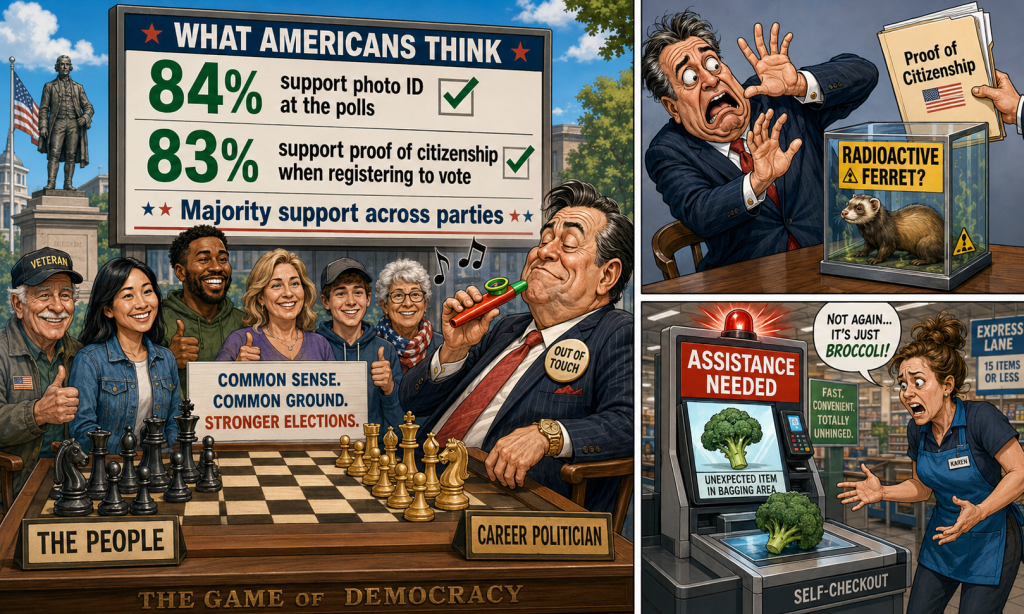
And here’s the part that makes the anti-SAVE crowd look like it came to a chess match carrying a kazoo. The public likes voter verification. Gallup found that 84 percent of U.S. adults favored photo identification at the voting place, and 83 percent favored proof of citizenship when registering to vote for the first time. Even Democrats showed majority support for both ideas, just at lower levels than Republicans. So if you’re a politician treating proof of citizenship like a radioactive ferret, congratulations, you’ve managed to be less relatable than a self-checkout machine that screams for assistance every time it sees broccoli.
The pro-SAVE argument is morally and politically strongest when it says this: secure citizenship verification without blocking legal voters. That’s the whole sermon. That’s the hymn. That’s the little laminated card in the pew. Only citizens should vote in federal elections, and the system should verify that fact with enough muscle to mean something and enough brains not to flatten lawful voters under a bureaucratic parade float.
But the anti-SAVE argument becomes weakest, and frankly ridiculous, when it refuses to offer an equally strong alternative and instead treats verification itself as sinister. “Noncitizen voting is rare,” they say. Fine. Wonderful. Then help keep it rare. Build the system. Improve the data. Create fast appeals. Fund election offices. Give voters free documents. Make the process idiot-resistant, fraud-resistant, and lawsuit-resistant. Don’t just stand there shrieking “suppression” like a parakeet with a law degree.
Because yes, the concerns about paperwork burdens are real. A Brennan Center survey found that 9.1 percent of voting-age American citizens, about 21.3 million people, lacked ready access to a citizenship document such as a birth certificate, passport, naturalization certificate, or citizenship certificate. At least 3.8 million did not have such documents at all. That matters. You don’t defend lawful voting by telling Grandma, “Sorry, Ethel, democracy loved your cookies, but your birth certificate is in a courthouse basement that flooded during the Nixon administration.”
And the current SAVE Act debate has real implementation questions. Critics argue that the bill could require documentary proof not only for first-time registration but also for updates such as address or party changes, and that many drivers licenses alone would not satisfy citizenship proof because they generally do not show citizenship status. That’s not a fake problem. It’s the kind of problem grown-ups solve instead of using it as an excuse to do nothing.
So here’s the Tammy Doctrine, since apparently Washington needs a chaperone with a taser and a thesaurus.
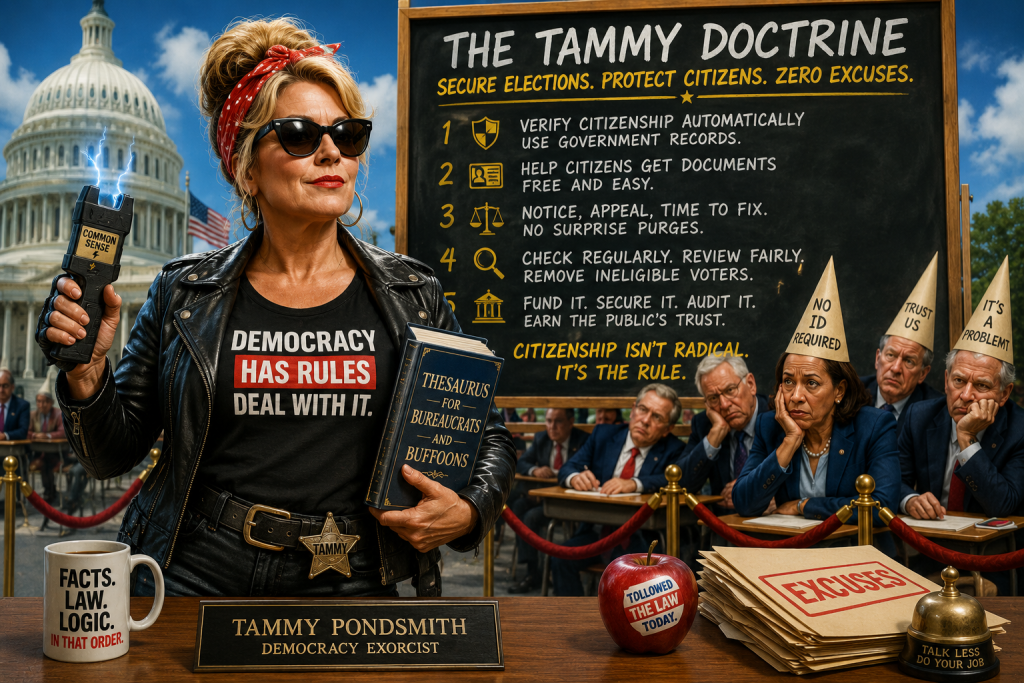
First, citizenship verification should be automatic wherever possible, using secure government records before registration becomes a public brawl. Social Security data, passport data, naturalization records, state vital records, and DMV citizenship indicators should talk to one another like civilized adults, with privacy protections strong enough to survive a congressional intern with a thumb drive.
Second, if government requires documents, government should help citizens get them for free. Mobile document units should visit rural areas, VA hospitals, nursing homes, shelters, tribal communities, campuses, disability centers, and county fairs where people are already eating something questionable on a stick. No citizen should lose the vote because paperwork went feral.
Third, every flagged voter gets written notice, a plain-language explanation, a real appeal, and enough time to fix errors before Election Day. No surprise purges. No data goblins. No “our spreadsheet says your middle initial looks foreign, good luck fighting the state.”
Fourth, states should run regular citizenship checks with human review before removal, because databases make mistakes and some of them have the bedside manner of a parking meter. If someone is confirmed ineligible, remove them. If they voted illegally, prosecute them. If the system made an error, fix it fast and apologize like an adult who knows where the fire exits are.
Fifth, election offices need funding, training, cybersecurity support, transparent audits, and public reporting. If the republic can afford seventeen consultants to rename a highway, it can afford systems that know the difference between a noncitizen, a naturalized citizen, and a typo wearing a fake mustache.
Here’s the uncomfortable truth. Some opponents of the SAVE Act sound less interested in solving the citizenship-verification problem than in making the question socially illegal. That’s political malpractice with lip gloss. Voters are not insane for wanting proof that only eligible citizens are voting. They are asking for the entry-level promise of a sovereign democracy, which is that citizenship has civic meaning beyond getting summoned for jury duty and yelled at by airport kiosks.
But some supporters also need to stop acting like paperwork is magic. A birth certificate is not a policy. A passport is not a plan. Verification has to be accurate, accessible, funded, secure, and appealable. Otherwise, you’re not protecting lawful votes. You’re just making a red-white-and-blue obstacle course and calling the bruises patriotism.
The real answer is not panic and it is not denial. It is citizenship verification with teeth, guardrails, speed, accountability, and a working brain. Only citizens should vote in federal elections. Every legal voter should be able to prove eligibility without needing a genealogist, a sherpa, and three Tuesdays off work. Anyone who can’t hold both truths at once should be gently removed from the policy table and handed a coloring book labeled “My First Republic.”
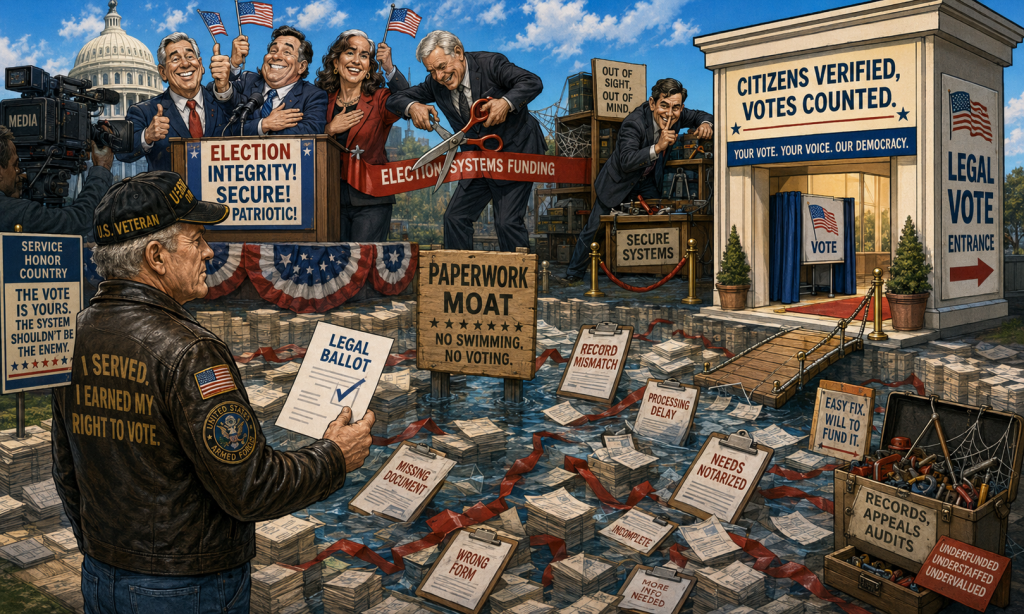
This matters to veterans specifically because people who served this country should never come home to find their legal vote trapped behind a paperwork moat dug by politicians who salute the flag on camera and then cheap out on the systems that protect the republic.
For the fact-allergic, here are the little pebbles of reality in the national shoe:
U.S. House Office of the Law Revision Counsel, 18 U.S.C. § 611, Voting by aliens
https://uscode.house.gov/view.xhtml?req=granuleid:USC-prelim-title18-section611
Gallup, Americans Endorse Both Early Voting and Voter Verification
https://news.gallup.com/poll/652523/americans-endorse-early-voting-voter-verification.aspx
Bipartisan Policy Center, Four Things to Know about Noncitizen Voting
https://bipartisanpolicy.org/article/four-things-to-know-about-noncitizen-voting/
Brennan Center, 21.3 Million American Citizens of Voting Age Don’t Have Ready Access to Citizenship Documents
https://www.brennancenter.org/our-work/analysis-opinion/213-million-american-citizens-voting-age-dont-have-ready-access
Campaign Legal Center, What You Need to Know About the SAVE Act
https://campaignlegal.org/update/what-you-need-know-about-save-act
_____________________________
Tammy Pondsmith is a part-time democracy exorcist, full-time menace to fraudulent certainty, and the only woman banned from three town halls for asking follow-up questions with cheekbones.
As the Voice of the Veteran Community, The Havok Journal seeks to publish a variety of perspectives on a number of sensitive subjects. Unless specifically noted otherwise, nothing we publish is an official point of view of The Havok Journal or any part of the U.S. government.
Buy Me A Coffee
The Havok Journal seeks to serve as a voice of the Veteran and First Responder communities through a focus on current affairs and articles of interest to the public in general, and the veteran community in particular. We strive to offer timely, current, and informative content, with the occasional piece focused on entertainment. We are continually expanding and striving to improve the readers’ experience.
© 2026 The Havok Journal
The Havok Journal welcomes re-posting of our original content as long as it is done in compliance with our Terms of Use.


