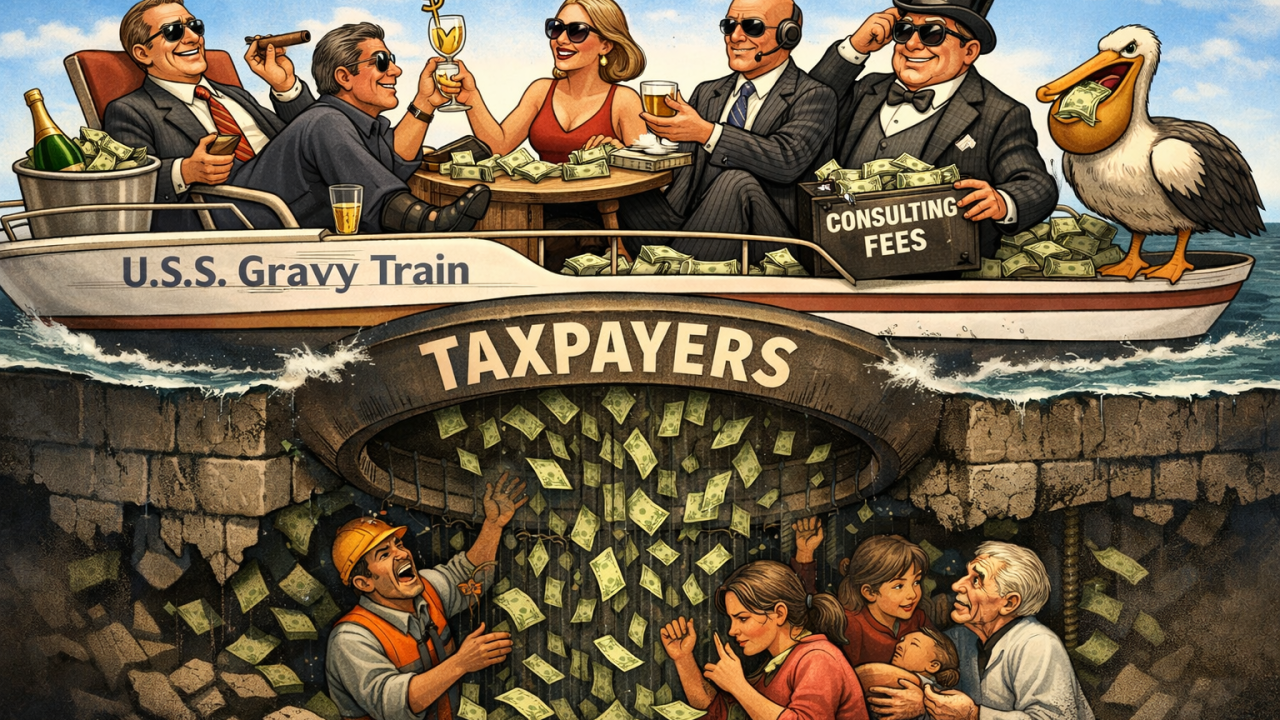
Here’s the first rule of modern American economics: if you can light taxpayer money on fire and warm three adjacent zip codes, somebody in a navy suit will call it growth. Yes, there are citations for this, because we now live in a country where satire has to show up with receipts just to keep pace with the audited insanity.
That is where we are. Not metaphorically. Spiritually. Officially. We’re now a country so drenched in borrowed money, institutional leakage, subsidized nonsense, and white-collar pilfering that the minute anyone suggests shutting down the obvious scams, a chorus of credentialed cowards appears to explain that the fraud is unfortunate but also, regrettably, woven into the fabric of national prosperity. In other words, yes, the money may be fake, stolen, wasted, or hurled into a pit by people with six passwords and a mission statement, but it still circulates. It still buys cars, condos, software subscriptions, artisanal lunch, and the occasional second boat for a man whose business model is invoicing the public in PowerPoint. Therefore, it counts. Apparently. (GAO says federal fraud losses are estimated at $233 billion to $521 billion a year, and CBO projects a $1.9 trillion federal deficit in fiscal 2026)
This is the kind of reasoning you get when we conflate circulation with value. By that logic, a septic backup is a water feature.
The economy is still upright, which is the problem. In March, employers added 178,000 jobs and unemployment was 4.3 percent. Real GDP grew at a 0.7 percent annual rate in the fourth quarter of 2025. So the people who break out in hives at the mention of accountability are technically correct when they say the machine is still moving. Yes. So does a shopping cart with one wheel screeching in a CVS parking lot. The question isn’t whether it moves. The question is whether any dignified adult should call that performance “healthy.” (BLS Employment Situation, April 3, 2026; BEA GDP second estimate for Q4 2025)
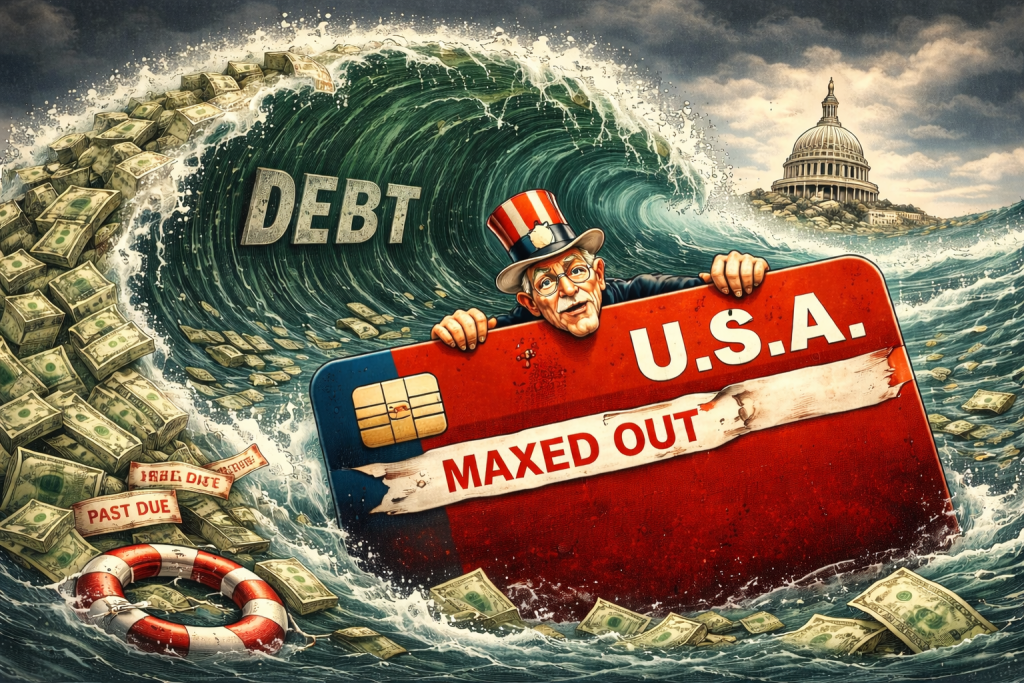
And look at what is keeping the beast fed. CBO says the federal budget deficit already totaled $1.0 trillion in the first five months of fiscal year 2026. For the full year, it projects a $1.9 trillion deficit, or 5.8 percent of GDP, with debt held by the public rising to 120 percent of GDP by 2036. Net interest alone is projected at about $1.0 trillion in 2026 and $2.1 trillion by 2036. Imagine inheriting a country where one of the fastest-growing public expenditures is paying interest on the privilege of having made terrible decisions at scale. That’s not fiscal policy, it’s Klarna for empires. (CBO Monthly Budget Review, March 2026; CBO Budget and Economic Outlook 2026 to 2036)
Now add the fraud. GAO’s government-wide estimate says the federal government loses between $233 billion and $521 billion annually to fraud. Separately, GAO says cumulative improper payment estimates reported by executive agencies since fiscal 2003 total about $2.8 trillion. That’s not “some waste,” it’s an operating environment. That’s a business climate for parasites. It’s enough money to make every professional fraudster in America feel seen, heard, and eligible for a leadership fellowship. (GAO fraud and improper payments updates)
And this is where the real obscenity begins. Because the minute you point to those numbers and say, perhaps with the understandable edge of a taxpayer who enjoys not being mugged by spreadsheet, “Fine, shut it down,” some bloodless consultant emerges from a conference room that smells like printer toner and treason to explain that it’s not so simple. Why? Because the fake money has entered the real economy. It gets spent. It ripples. It props up local demand. It fattens asset values. It keeps contractors busy, landlords cheerful, luxury dealerships humming, and certain regional economies from having to face the humiliating possibility that they don’t, in fact, produce anything anybody would buy without government distortion.
Exactly. That is the scandal.
A healthy country can remove fraud and survive. A sick country defends fraud as stimulus.
And don’t miss the moral racket here. The same people who can watch ordinary families get sandblasted by housing costs, medical bills, tuition, fees, taxes, inflation, and administrative sadism without so much as smudging their lip gloss will suddenly discover the language of human suffering the moment someone threatens a favored racket. What about the workers? What about the communities? What about stability? Funny how the vulnerable are always wheeled out like decorative hostages whenever somebody proposes interrupting a theft ring with a logo. The poor are treated like disposable scenery right up until it is time to use them as a shield for the well-connected.
Meanwhile, the labor market itself is giving off the emotional tone of a dog that heard a noise in the basement. BLS says federal government employment kept declining in March and is down 355,000 since October 2024. Payroll growth has been decent in pockets, but BLS also says employment has changed little on net over the prior 12 months. In other words, the country is still producing enough upbeat headline copy to calm cable-news adults, but not enough genuine strength to make anyone with a functioning frontal lobe feel serene. (BLS Employment Situation, April 3, 2026)
So, what’s the adult response? Not the theatrical one. The adult one.
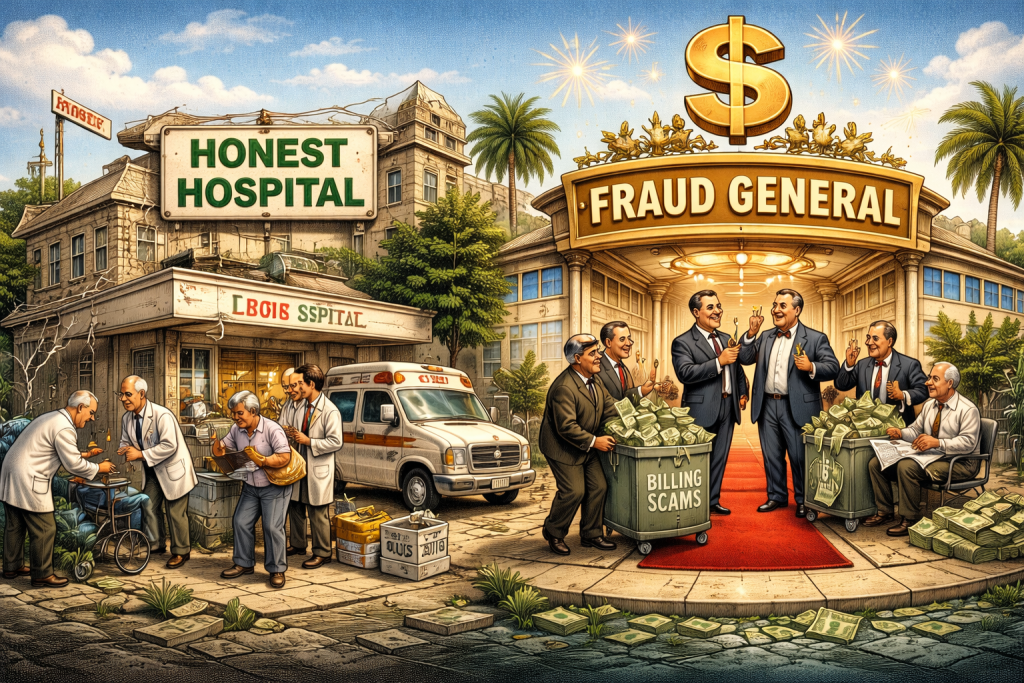
First, stop pretending all spending is morally interchangeable because it passed through a government account. A bridge is not the same thing as a phantom invoice. Research isn’t the same thing as consultant mulch. Actual care isn’t the same thing as billing fraud in a necktie. Money moving isn’t a sacrament. It’s just movement.
Second, treat fraud like sabotage, not a paperwork oopsie. Claw back the money. Ban repeat offenders from future contracts. Unmask shell ownership. Prosecute the organizers. Stop imposing fines that function as coupons for the next scam. If the crime paid, the punishment failed.
Third, if whole regions have become dependent on garbage flows, then help them transition into useful work instead of preserving the garbage out of pity and laziness. Build things. Repair things. Train people to do things a civilized country might someday need. The choice isn’t fraud or collapse. That’s the bedtime story told by everyone feeding at the trough.
Because that’s the real diagnosis. America isn’t merely tolerating corruption. It’s increasingly organized around it. We’ve become a nation that conflates debt with wealth, activity with value, and leakage with prosperity. We don’t just have waste. We have constituencies for waste. We don’t just have fraud. We have a philosophical defense of fraud as macroeconomic lubrication. We don’t just have decline. We have people marketing decline as sophistication.
That’s the part that should terrify you. Not that thieves exist. They always will. It’s that the respectable class now speaks about the theft the way medieval priests spoke about rain. Mysterious. Necessary. Not to be tampered with by the laity.
A country that starts calling grift “demand” isn’t heading for trouble. It’s already living inside it, with nice countertops and a bullish market note.
_____________________________
Tammy Pondsmith is Senior Fellow for Applied Contempt at the Institute for National Side-Eye, where she researches how collapsing empires rebrand looting as stimulus and then ask for another panel discussion.
As the Voice of the Veteran Community, The Havok Journal seeks to publish a variety of perspectives on a number of sensitive subjects. Unless specifically noted otherwise, nothing we publish is an official point of view of The Havok Journal or any part of the U.S. government.
Buy Me A Coffee
The Havok Journal seeks to serve as a voice of the Veteran and First Responder communities through a focus on current affairs and articles of interest to the public in general, and the veteran community in particular. We strive to offer timely, current, and informative content, with the occasional piece focused on entertainment. We are continually expanding and striving to improve the readers’ experience.
© 2026 The Havok Journal
The Havok Journal welcomes re-posting of our original content as long as it is done in compliance with our Terms of Use.


