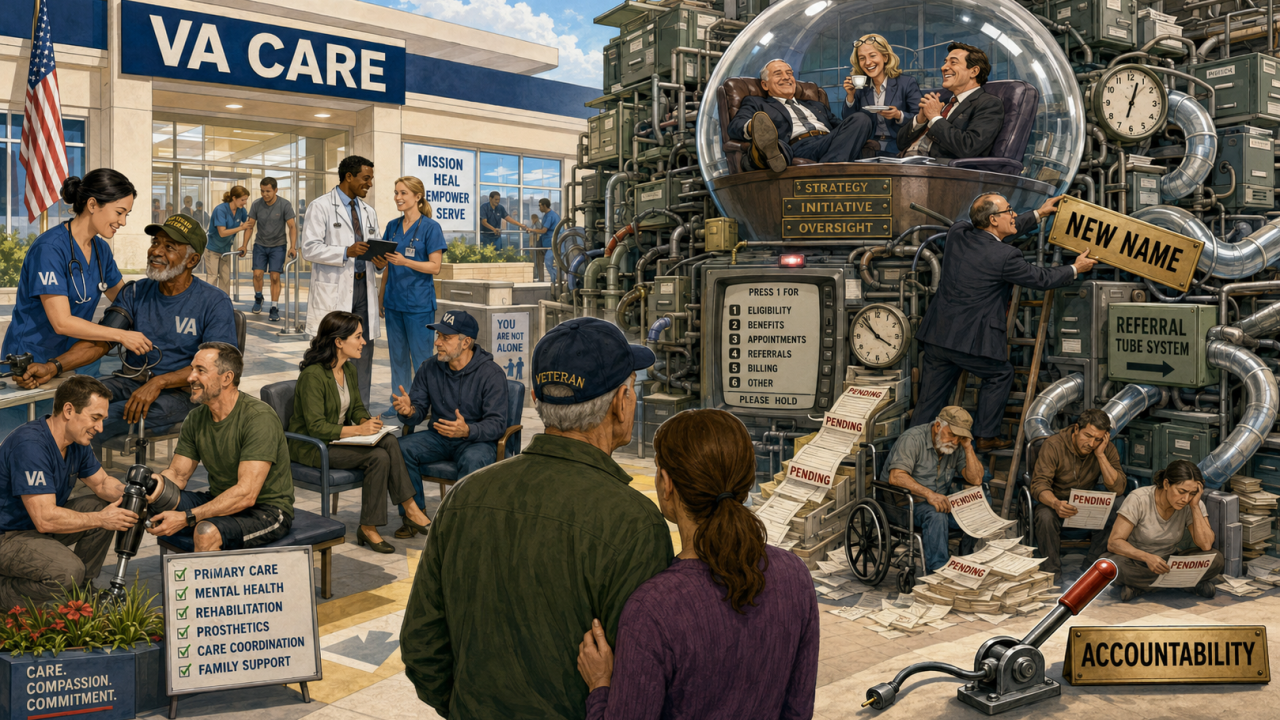
America has reached that invigorating stage of institutional failure when somebody suggests abolishing the Department of Veterans Affairs, because apparently the surest way to repair a hospital is to remove the hospital and introduce veterans to the warm humanitarian embrace of commercial insurance.
The proposal has undeniable political appeal. Erase three letters, unveil a new logo, distribute commemorative lanyards, and name the replacement Freedom Patriot Eagle Warrior Care. Congress can declare victory before lunch while the first veteran spends forty-seven minutes listening to pan-flute music and a recording explaining that his call matters deeply to an entity presently refusing to answer it.
Here’s the problem. The VA’s clinical system frequently delivers good medicine. Its bureaucracy frequently delivers the emotional experience of being questioned by a parking meter.
A 2023 study covering 593,578 hospitalizations found that VA hospitals had lower mortality for heart failure and stroke, plus lower readmission rates for most conditions examined. A systematic review found VA care generally performed as well as or better than outside care in safety and effectiveness. The VA can manage traumatic brain injuries, prosthetics, spinal-cord damage, PTSD, toxic exposure, and complicated conditions involving fifteen prescriptions without immediately asking whether the patient has tried yoga.
That’s worth preserving.
Unfortunately, reaching that care may require a veteran to penetrate an administrative perimeter designed by Franz Kafka after a traumatic head injury. The doctor may be excellent. The appointment system behaves like it was created by raccoons trapped inside a fax machine.

Naturally, Washington’s answer is another reorganization. Federal agencies reorganize the way failing restaurants rename appetizers. Suddenly the potato skins are “deconstructed heritage tubers,” nobody has fixed the freezer, and the cook is crying beside a pallet of expired sour cream.
VA health care has occupied the Government Accountability Office’s High-Risk List since 2015. GAO reported in 2024 that it had made more than 200 recommendations since 2010 concerning the safety, quality, and timeliness of VA care. Disability compensation has been on the high-risk list since 2003.
A federal program remaining “high risk” for twenty-three years has stopped being an emergency. It’s achieved tenure. At this point, the warning label should receive a pension and its own reserved parking space.
Privatizing everything wouldn’t exorcise bureaucracy. It would simply give bureaucracy shareholders. About 2.8 million veterans received community care in 2023, yet GAO continues finding problems involving scheduling, contractor oversight, provider availability, and coordination. As of February 2025, seventeen of GAO’s twenty-seven recommendations concerning community care remained unresolved.
The private sector has its own ceremonial maze of authorizations, denials, unavailable specialists, incompatible records, and representatives who are “experiencing unusually high call volume” every hour since the invention of the telephone. Handing a veteran a plastic insurance card and pointing toward that carnival isn’t liberation. It’s outsourcing the abandonment.
The real disease is institutional immunity. When an appointment disappears, a claim stalls, or a referral dies between offices, responsibility evaporates faster than congressional concern after the cameras leave. Everyone followed procedure. Nobody accomplished the mission. The veteran becomes project manager, courier, medical historian, appeals specialist, and unpaid detective. His spouse becomes the backup system for the backup system.
That arrangement needs radical surgery.
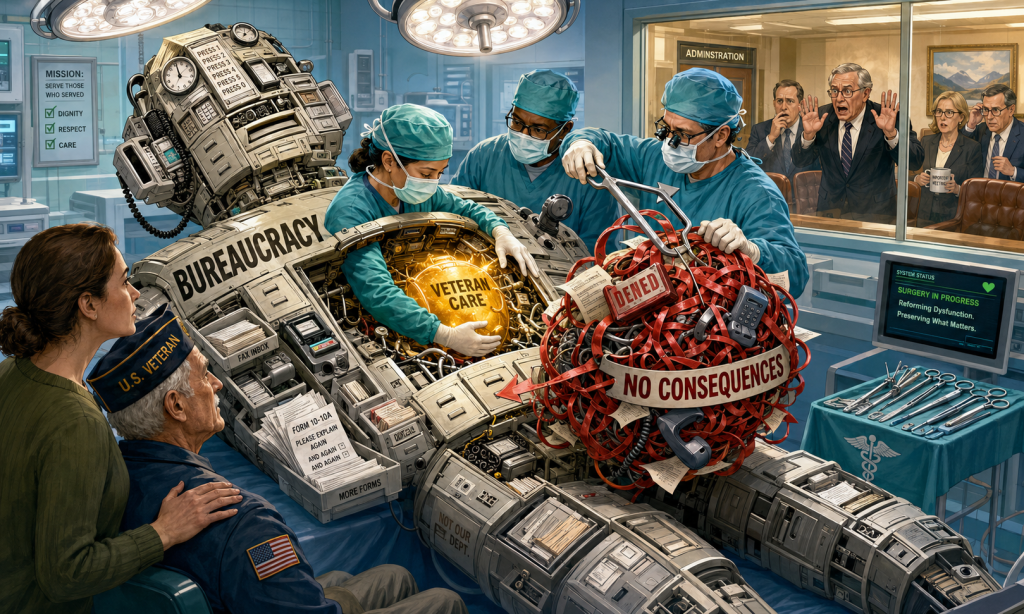
First, access standards must carry automatic consequences. When the VA misses a treatment deadline, community care authorization should activate immediately. Veterans shouldn’t have to complete another application proving that the government failed to provide the service it already promised.
Second, responsibility must follow the patient. If the VA sends someone outside its system, the VA should remain accountable for transferring records, reconciling medications, receiving test results, scheduling follow-up care, and ensuring somebody actually read the specialist’s report. A referral isn’t completed when a bureaucrat presses “send.”
Third, every facility needs a public performance dashboard measuring treatment outcomes, referral-to-appointment time, medication errors, overturned decisions, preventable hospitalizations, and unresolved complaints. Counting scheduled appointments as successful care is like counting wedding invitations as successful marriages.
Fourth, senior administrators should work under performance agreements tied to those measurements. Persistent failure should affect employment, promotion, and compensation. Accountability loses some of its mystical complexity once failure becomes personally inconvenient.
Fifth, disability claims require enforceable decision deadlines, automatic collection of government-held evidence, stronger presumptions for established service-related conditions, and independent review of recurring errors. A veteran shouldn’t repeatedly prove that the military knew where it deployed him, what happened there, and which body parts he brought home in altered condition.
Finally, caregivers deserve compensation, respite, training, mental-health services, and direct participation in care planning. Families currently absorb medication management, crisis intervention, appointment coordination, and bureaucratic combat while the system records another successful day. Love shouldn’t function as an undisclosed federal appropriation.
The VA’s clinical system deserves preservation because it possesses expertise America would be criminally foolish to discard. Its administrative machinery deserves reconstruction because gratitude printed on a banner doesn’t compensate for incompetence embedded in policy.
A new name would buy fresh stationery. A new operating structure could buy accountability. Veterans have already sacrificed enough without being drafted into another war, this one against the agency created to serve them.
Sources for readers who think I invented all this after licking a congressional hearing transcript

- Outcomes of Veterans Treated in Veterans Affairs Hospitals vs Non-Veterans Affairs Hospitals, by Jean Yoon and others (JAMA Network Open)
- Comparing VA and Non-VA Quality of Care, by Claire E. O’Hanlon and others (RAND Corporation)
- Veterans Health Care Opportunities to Improve Access to Care Through the Veterans Community Care Program, by the U.S. Government Accountability Office
- Veterans Health Administration Additional Actions Needed to Improve Oversight of Health Care System, by the U.S. Government Accountability Office
- VA Disability Benefits Agency Has Taken Steps, but Challenges Remain with Managing and Modernizing Its Program, by the U.S. Government Accountability Office
_____________________________
Tammy Pondsmith audits America’s sacred cows, assigns each a federal pension, and remains permanently ineligible for committees that consider eye contact an ethics policy.
As the Voice of the Veteran Community, The Havok Journal seeks to publish a variety of perspectives on a number of sensitive subjects. Unless specifically noted otherwise, nothing we publish is an official point of view of The Havok Journal or any part of the U.S. government.
Buy Me A Coffee
The Havok Journal seeks to serve as a voice of the Veteran and First Responder communities through a focus on current affairs and articles of interest to the public in general, and the veteran community in particular. We strive to offer timely, current, and informative content, with the occasional piece focused on entertainment. We are continually expanding and striving to improve the readers’ experience.
© 2026 The Havok Journal
The Havok Journal welcomes re-posting of our original content as long as it is done in compliance with our Terms of Use.


