
By Lt Col (ret), US Army, Darin Gaub
Editor’s Note: This article began as a Father’s Day sermon/reflection submitted by the author. The Havok Journal adapted it for publication by removing the sermon-style structure, editing for clarity and flow, and formatting it as a faith-based commentary article while preserving the author’s core message, Christian perspective, and main themes.
Father’s Day lands differently for different people.
Some remember fathers who protected, guided, sacrificed, and loved well. Others carry wounds from fathers who were absent, harsh, distant, addicted, angry, or simply broken. Some men are biological fathers. Others serve as grandfathers, stepfathers, foster fathers, adoptive fathers, mentors, coaches, or spiritual fathers. Some men have stepped into a gap they did not create and offered steadiness where it was badly needed.
That range of experience matters, because fatherhood is not merely a title. It is a responsibility. At its best, fatherhood gives children a living picture of strength, courage, compassion, and sacrificial love.
For Christians, the clearest model of those traits is Jesus Christ. Not the shallow version of strength sold by culture. Not the performative masculinity of politics, entertainment, or social media. Christ offers something deeper: strength without cruelty, courage without arrogance, compassion without weakness, and love that costs something.
A father will never reflect that perfectly. No man does. But he can reflect it intentionally.
Strength That Creates Safety

Strength is often misunderstood.
Too many people confuse strength with dominance, control, intimidation, volume, or the ability to win every argument. But Christ’s example points in a different direction. Jesus calmed storms, confronted evil, endured betrayal, and walked willingly toward suffering. Yet He also welcomed children, washed feet, healed the broken, and showed patience toward the weak.
That is not softness. That is disciplined strength.
A father reflects Christ not by making his family afraid of him, but by becoming someone they can depend on. His strength is seen in responsibility, restraint, consistency, and sacrifice. It is the willingness to stand between danger and his family. It is going to work when tired. It is staying when things are hard. It is remaining steady when the house feels chaotic.
Any man can lose his temper. Strong men control it.
Any man can walk away. Strong men stay.
Any man can create children. Strong men raise them.
A father’s strength should make a home safer, not smaller. Children should be able to say, “Dad is here. Dad is steady. Dad can be trusted.” Not because he is perfect, but because he is present and committed.
The image of a lighthouse fits. A lighthouse does not chase ships. It does not panic when the storm comes. It stands, shines, and guides. That kind of strength is rarely flashy. It is not always applauded. But it is faithful, and families need it.
Courage Beyond the Battlefield
Courage is not the absence of fear. It is doing what is right despite fear.
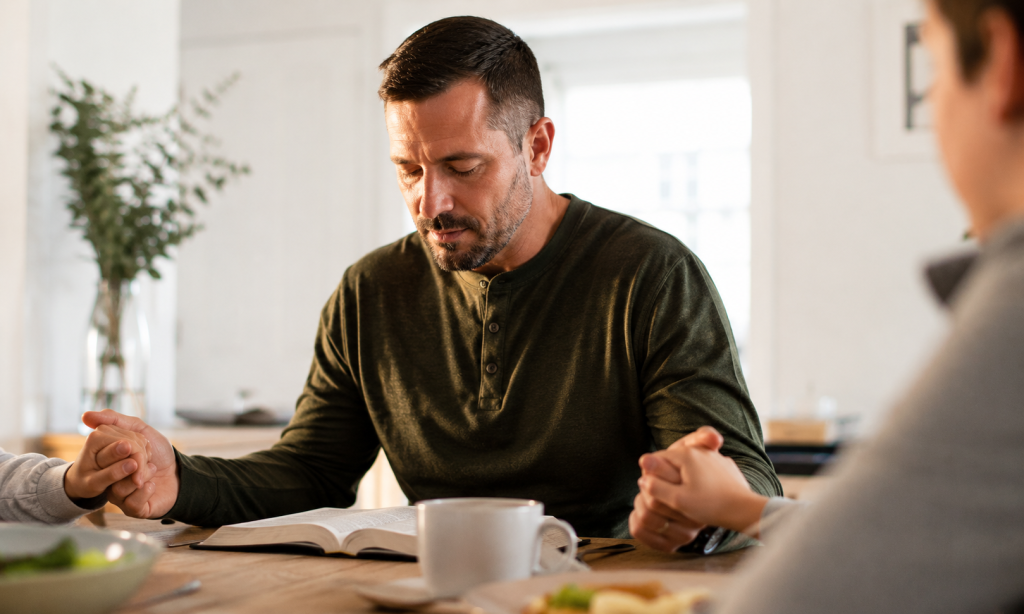
That matters because fatherhood requires far more than physical courage. It requires moral courage, spiritual courage, and emotional courage. It takes courage to admit, “I was wrong.” It takes courage to repent. It takes courage to apologize to a child. It takes courage to rebuild trust after damaging it.
For Christian fathers, courage also includes spiritual leadership. Not perfection. Not a polished theological performance. Leadership.
Some men can command a boardroom, brief a unit, run a company, or negotiate a contract, but they freeze when it comes time to pray with their family, open Scripture, or speak plainly about faith. That is not a lack of intelligence or ability. Often, it is fear.
Children do not need a father who has every answer. They need one whose faith is real enough to be seen. They need to see him pray. They need to see him wrestle honestly with truth. They need to see him choose conviction over convenience.
Courage also means standing for truth without becoming harsh or arrogant. Jesus never bent truth to gain approval, but He also did not confuse cruelty with conviction. Fathers should not either.
There is another kind of courage many men avoid: vulnerability.
A lot of men were raised to believe that emotion is weakness. Don’t cry. Don’t talk about pain. Don’t admit fear. Don’t ask for help. But Jesus wept. He grieved. He expressed anguish. He asked His disciples to stay with Him in His darkest hour.
There are fathers who do not need more aggression. They need the courage to soften. To listen. To reconnect. To tell the truth about old wounds. To pursue healing instead of hiding behind silence.
That, too, is courage.
Compassion That Does Not Quit
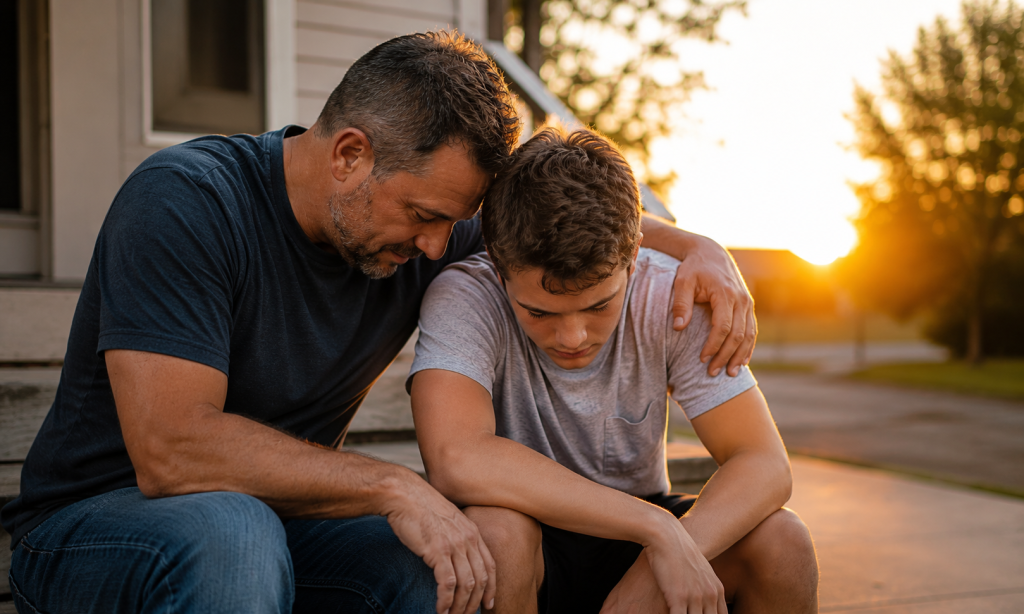
Compassion is not weakness. It is strength under control.
Jesus showed compassion to the sick, the grieving, the sinful, the outcast, and the overlooked. He saw people others ignored. He listened. He restored dignity. He corrected when necessary, but He did not crush the broken.
Fathers reflect that same character when compassion marks their homes.
Compassion listens before it lectures. Many children do not need an immediate solution every time they speak. They need presence. They need eye contact. They need patience. They need to know that their father is not merely waiting for his turn to talk.
Children spell love with time.
Compassion also corrects. A loving father does not ignore destructive behavior, excuse rebellion, or pretend that discipline is unnecessary. But correction should be aimed at restoration, not humiliation. Discipline given in anger can leave scars. Discipline given with love can build character.
A father who never corrects is not being compassionate. A father who only corrects, and never shows tenderness, also misses the mark. The balance is truth and grace.
Compassion is especially tested when a child wanders.
Many fathers know the pain of strained relationships, distant adult children, broken trust, divorce, addiction, resentment, or years of silence. In those cases, compassion keeps the porch light on. It keeps praying. It keeps loving. It keeps hoping. It leaves room for repentance, reunion, and redemption.
That does not mean pretending nothing happened. It does not mean erasing consequences. But it does mean refusing to let bitterness become the final word.
Sacrifice Is the Center
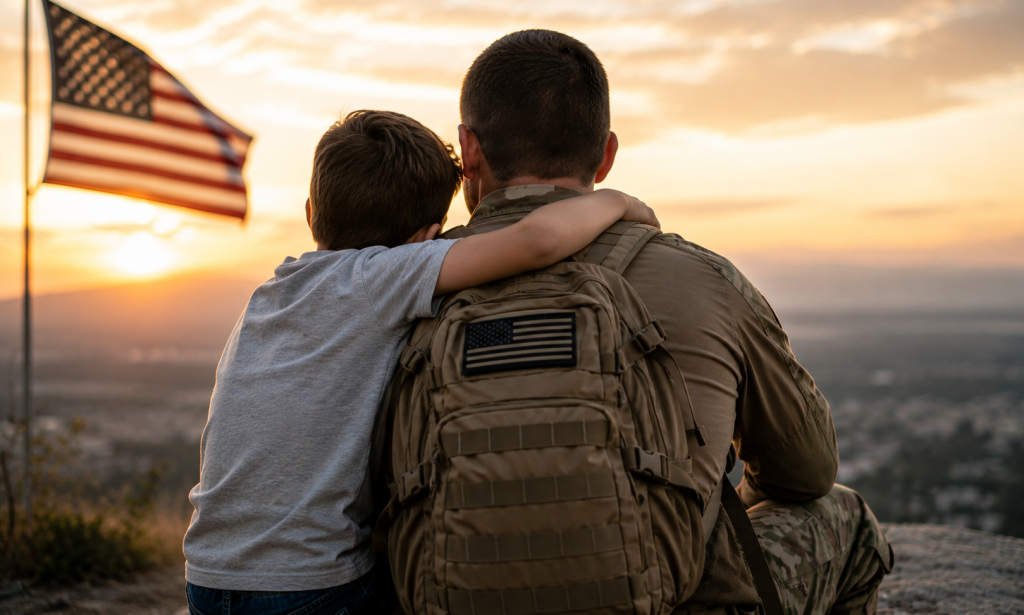
At the center of fatherhood is sacrifice.
Fatherhood costs something. It costs sleep, money, comfort, convenience, energy, personal ambition, and sometimes dreams. It requires a man to place others ahead of himself again and again, often without recognition.
That is holy work.
A father reflects Christ most clearly not through authority, but through sacrifice. Authority is easy to claim. Sacrifice is harder to fake.
He reflects Christ when he chooses family over selfishness, presence over distraction, prayer over passivity, faithfulness over escape, and service over ego.
The strongest fathers are not the ones who demand the most from everyone else. They are the ones who willingly carry what love requires.
For Fathers Who Know They Have Failed
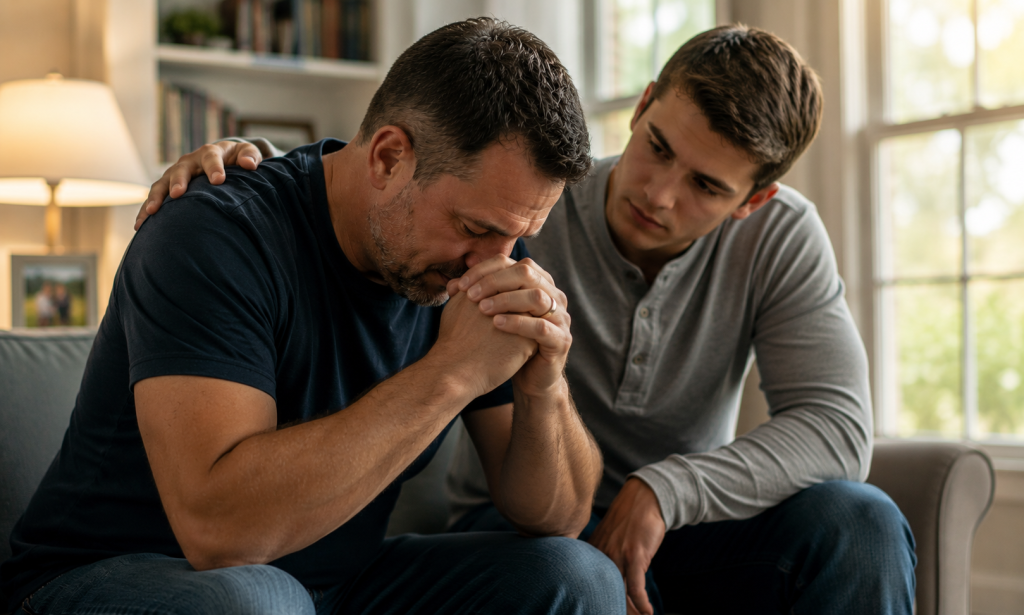
Any honest discussion of fatherhood has to make room for failure.
Some men read words like strength, courage, compassion, and sacrifice and feel immediate regret. Maybe anger marked the home. Maybe work mattered more than family. Maybe divorce happened. Maybe a relationship with a child is fractured. Maybe years were lost. Maybe the thought is simple and painful: “I failed.”
The Christian faith does not deny that failure. It also does not end there.
Peter failed. David failed. Moses failed. Scripture is full of broken men whom God corrected, humbled, and restored. Jesus is not only the model for fathers. He is the Redeemer of fathers.
A man’s past does not have to define the rest of his life. Repentance matters. Apologies matter. Changed behavior matters. Healing is possible. Relationships can be restored, though not always quickly and not always on our preferred timeline.
No father can rewrite yesterday. But by God’s grace, he can choose a different path today.
The Charge
Children may forget many of their father’s words. They will remember his example.
They will remember how he treated their mother. They will remember how he handled pressure. They will remember whether he apologized. They will remember whether his faith was real. They will remember whether his love was steady.
Fatherhood is a heavy calling. No earthly father fulfills it perfectly. But fathers can still offer glimpses of something greater: strength that protects, courage that leads, compassion that restores, and love that sacrifices.
That is the kind of father worth honoring.
That is the kind of father worth becoming.

_____________________________
Lieutenant Colonel (Retired) Darin Gaub is a Senior Strategic Analyst, Black Hawk helicopter pilot and commander, and author of VERITAS VINCIT. He spent more than twenty years training military forces in drone operations, counter-drone tactics, and Combat Search and Rescue. He is a frequent guest on Fox News, NTD News, Newsmax, and Canadian TV news, and his writing has appeared in The Epoch Times, Armed Forces Press, RealClearPolitics, and RealClear Defense. You can also follow his latest analysis and commentary on Substack at daringaub.substack.com.
As the Voice of the Veteran Community, The Havok Journal seeks to publish a variety of perspectives on a number of sensitive subjects. Unless specifically noted otherwise, nothing we publish is an official point of view of The Havok Journal or any part of the U.S. government.
Buy Me A Coffee
The Havok Journal seeks to serve as a voice of the Veteran and First Responder communities through a focus on current affairs and articles of interest to the public in general, and the veteran community in particular. We strive to offer timely, current, and informative content, with the occasional piece focused on entertainment. We are continually expanding and striving to improve the readers’ experience.
© 2026 The Havok Journal
The Havok Journal welcomes re-posting of our original content as long as it is done in compliance with our Terms of Use.


