
There’s a fascinating little magic trick modern Western culture performs every day. A woman can live in the most legally protected, socially cushioned, economically accessible environment in female human history, then hop online and announce she’s basically one denied promotion away from being dragged through a medieval village square by men with torches and opinions.
And the room nods solemnly, because apparently perspective is now hate speech.
Let’s begin with the obvious fact everybody keeps tiptoeing around like it’s a land mine with a gender studies degree. By any historical or global standard worth respecting, women in the modern West have it extraordinarily good. Not perfect. Not friction-free. Not handed a jeweled scepter and a spa voucher at birth. But extraordinarily good.
Women in the West can vote, own property, open businesses, sue employers, outnumber men in college, initiate divorce, control enormous portions of household spending, build careers, shape culture, and influence institutions at every level. In many elite environments, they’re not voiceless outsiders clawing at the gates. They are inside the gates, on the board, in the HR office, in the university administration, in media, in law, in medicine, and often in the position to define what counts as acceptable speech for everybody else.
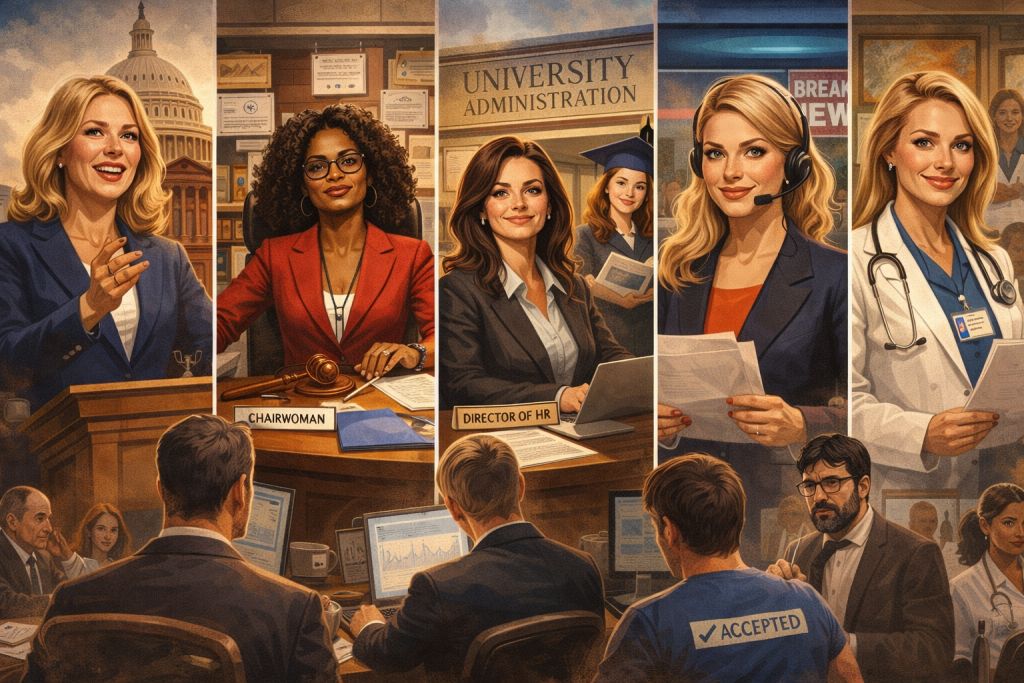
That’s not oppression. That’s access. That’s influence. That’s leverage.
And naturally, because humans are human and power never remains morally pure for longer than six minutes, some people abuse it.
There it is. The sentence that sends the room into cardiac arrest.
Not all women. Not most women. But some women absolutely exploit the current moral and cultural climate as leverage. They use the language of harm, trauma, misogyny, emotional safety, and structural injustice not as descriptions of reality, but as tactical instruments. A disagreement becomes intimidation. A consequence becomes abuse. An awkward interaction becomes a power crime. A man’s boundaries become cruelty. A woman’s manipulation becomes healing.
It’s a hell of a racket.
And because modern institutions are terrified of being seen as insufficiently enlightened, they often reward the performance before they verify the facts. In some settings, the accusation alone is enough to trigger social panic. Careers get damaged. Reputations get kneecapped. Men learn very quickly that in certain environments, actual innocence matters less than whether they look symbolically guilty.

Again, nobody honest is saying false or exaggerated claims are the norm. But nobody honest should pretend they never happen, or that the current culture gives women zero incentive to weaponize moral language when it works so beautifully.
This is what makes the conversation unbearable. One side insists every complaint from a woman is sacred truth. The other side insists women never face real disadvantage. Both positions are intellectually lazy, emotionally self-serving, and about as useful as a smoke detector in a forest fire.
The truth is uglier and much more interesting.
The West spent decades expanding women’s rights, opportunities, and protections, and that was, in large part, a civilizational good. It corrected real injustices. It opened doors that should have been opened long ago. It gave women room to develop talent, autonomy, and genuine independence. Good. That was necessary.
But somewhere along the line, a chunk of the culture stopped being interested in equality and became obsessed with permanent female innocence. That’s where the gears started grinding.
Because once a class of people is treated as perpetually aggrieved, morally superior, and presumptively harmed, some members of that class will learn to cash the check. That’s not a female defect. That’s a human one. Give anyone social immunity and a vocabulary of sanctified grievance, and a percentage of them will absolutely use it to dominate softer targets while calling it justice.

Meanwhile, men are told to sit down, soften up, speak more carefully, take up less space, apologize more often, and interrogate every natural masculine impulse like they’re disarming a bomb in a daycare. Strength gets recoded as menace. Assertiveness becomes toxicity. Stoicism becomes repression. Leadership becomes domination with better shoes.
So men adapt. They become hesitant. Diffuse. Approval-addicted. The modern soft male arrives right on schedule, tenderized by years of moral suspicion, eager to offend nobody and stand for nothing too firmly. Then, because irony is undefeated, the same culture that helped produce him starts mocking him for being weak, passive, and sexually uninteresting.
Spectacular. We’ve now managed to insult men both for being masculine and for no longer being masculine enough. That takes talent.
And no, the answer is not some idiotic cartoon where women are villains and men are innocent farm animals wandering into feminist bear traps. The point is simpler. Civilizations need balance. They need men who are strong without being brutal and women who are powerful without turning power into manipulation wrapped in therapeutic jargon.
Which brings us to the family, that old-fashioned institution modern culture keeps trying to bury under piles of self-invented chaos.
The dirty secret nobody can quite manage to kill is that stable, low-conflict, two-parent homes tend to be very good for children. Not because marriage is holy magic. Not because every traditional household is a Norman Rockwell painting with better casseroles. But because stability matters. Predictability matters. Shared duty matters. Children generally do better when the adults raising them are committed, cooperative, and not auditioning their personal brand identity every eleven minutes.

The data keep committing the unforgivable offense of refusing to flatter fashionable nonsense: kids usually benefit from stable two-parent homes, which is deeply irritating to people who think structure is oppression and chaos becomes wisdom if you accessorize it with enough self-care language.
And yes, mothers still end up with most custody in practice, though the reasons are more tangled than lazy slogans allow. But the downstream effect is still real. When fathers are treated as optional, peripheral, or disposable, children pay for that fantasy long after the adults have moved on to their next enlightenment podcast.
The larger point is this. Freedom is not the absence of restraint. Freedom is the ability to handle power without becoming insufferable with it. The West gave women extraordinary freedom, and that was right. But a culture that cannot admit some women exploit that freedom as social leverage is not mature enough to keep it healthy.
A serious culture would tell women the truth. You are strong. You are capable. You have rights your great-grandmothers could barely imagine. Now act like adults, not permanent plaintiffs. Do not confuse being protected with being persecuted. Do not confuse influence with helplessness. Do not confuse leverage with virtue.
And a serious culture would tell men the truth too. Grow a spine. Strength is not a sin. Responsibility is not oppression. Families, institutions, and societies do not hold together because everyone becomes softer, safer, and more emotionally curated. They hold together because enough people are willing to be sturdy.
That’s the word the age hates most. Sturdy.
Too bad. Sturdy built the world that today’s professional victims complain from.

When leverage dresses as virtue, accountability quietly leaves the room.
_____________________________
Tammy Pondsmith once got accused of lacking sensitivity, then sent back a notarized note explaining that reality was under no legal obligation to flatter anyone’s delusions.
As the Voice of the Veteran Community, The Havok Journal seeks to publish a variety of perspectives on a number of sensitive subjects. Unless specifically noted otherwise, nothing we publish is an official point of view of The Havok Journal or any part of the U.S. government.
Buy Me A Coffee
The Havok Journal seeks to serve as a voice of the Veteran and First Responder communities through a focus on current affairs and articles of interest to the public in general, and the veteran community in particular. We strive to offer timely, current, and informative content, with the occasional piece focused on entertainment. We are continually expanding and striving to improve the readers’ experience.
© 2026 The Havok Journal
The Havok Journal welcomes re-posting of our original content as long as it is done in compliance with our Terms of Use.


