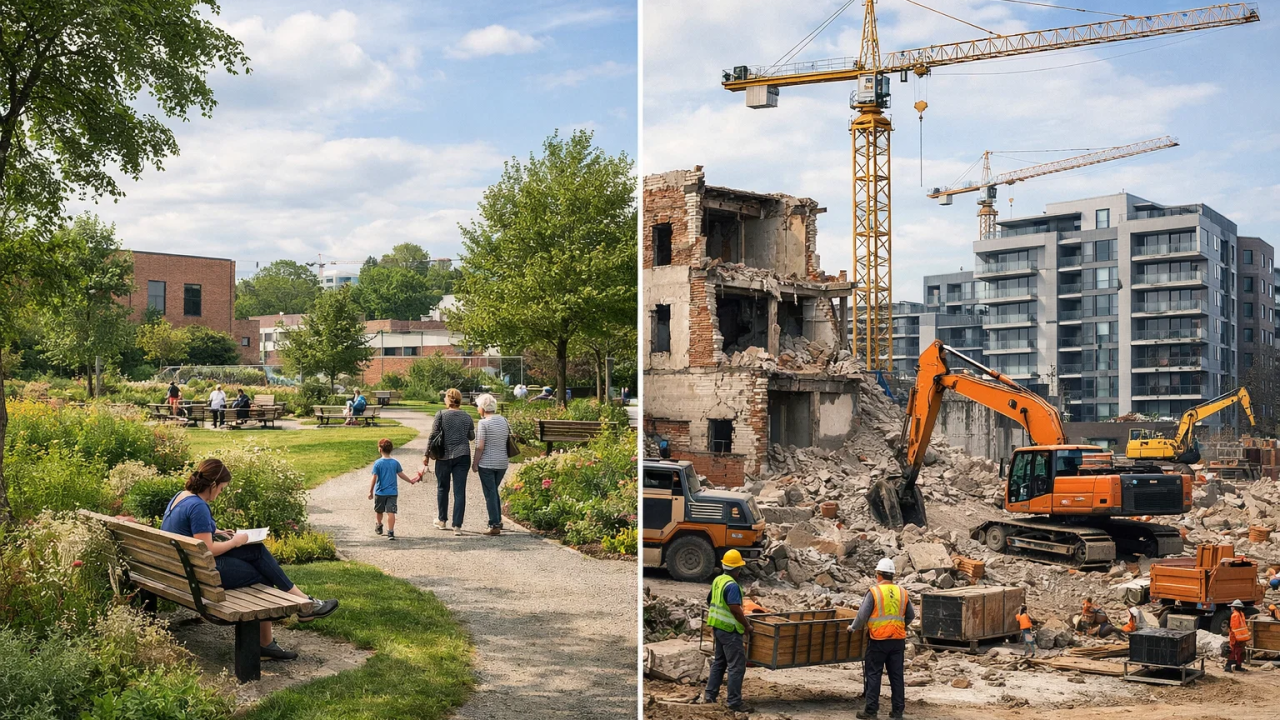
With the growth in urbanization and soaring of population, land has become a major asset to the world. The issue that cities are always confronted with is the efficient use of land as cities strive to satisfy economic, environmental, and social needs. It has resulted in two significant approaches to urban development, that is, land repurposing and land redevelopment. Although they might be similar, they tackle different strategies, goals, and effects to communities.
Knowledge of these differences is very important to developers, city planners and investors who wish to exploit land to its fullest potential and maintain sustainable growth. In the following paper we will discuss the meaning of each of these terms, their difference and why the two strategies are essential in the contemporary urban planning.
What Is Land Repurposing?
Land repurposing is a process of reusing land that is either underutilized, idle or set aside to a particular use and adapting that land to another use without any substantial structural modification. This is a strategy that is aimed at making the most out of the available land and resources.
As an example, the defunct parking lot can be turned into a community park or unused industrial land into an outdoor marketplace. Repurposing tends to focus on low-construction and provide short-term social or economic advantages.
The benefit of land repurposing is that it is usually quicker and less expensive than redevelopment on a large scale. It is also in line with the sustainability objectives because it uses the same land instead of disrupting the undisturbed land. A number of developers will combine with established engineering companies to determine the viability of such projects. For instance, Pape-Dawson civil engineering in Dallas often assists with evaluating the structural and environmental considerations of repurposing urban sites, ensuring safe and efficient transformations.
Image 1: One of the proposed pictures is a pre-and-after image of an empty lot that has now been turned into a community garden or park, which demonstrates urban repurposing.
What Is Land Redevelopment?
Comprising of extensive construction, renovation, or demolition, as compared with repurposing, land redevelopment is a huge process. It is a more rigorous method used to enhance or entirely remodel a neighborhood, most frequently to serve new urban planning or business purposes.
Examples of redevelopment projects are the replacement of the old structures by new ones, the modernization of the infrastructure, or the total redesign of the residential areas. One such typical example is redeveloping old industrial areas to residential or mixed-use development. This is mainly necessary in areas where space is minimal as is the case in cities and the demand to have contemporary facilities is high.
The procedure is normally more time consuming, costly and must be in accordance with the zoning rules, environmental laws and community planning guidelines. Nevertheless, redevelopment is a trendy approach in sustainable urban development due to the long-term advantages such as rise in property values, better aesthetics, and better community services.
Image 2 proposed: A high-resolution photograph of the construction site with the redevelopment of the old buildings into contemporary apartments.
Major Differences in Repurposing and Redevelopment.
Although both strategies are intended to enhance land utility, it is evident that they differ in a number of ways:
Scope of Work:
Repurposing may be of a limited degree of modifications whereas redevelopment may entail extensive work of structural modifications or new constructions.
Cost and Time
Repurposing is typically cheaper and faster; redevelopment requires greater investment and increases the timelines.
Environmental Impact:
Repurposing generally is greener, since it reduces the amount of construction waste; redevelopment can be done with careful planning to reduce environmental impact.
Community Transformation:
Redevelopment may change an area dramatically, whereas repurposing often offers minor benefits.
Regulatory Requirements:
In most cases, redevelopment projects require more sophisticated approvals in the form of permitting and zoning than repurposing projects.
The two strategies are useful in urban planning and the decision made is based on the objectives of the project, budget, and needs of the community.
Recommended Image 3: Comparative side by side infographic between land repurposing and redevelopment with reference to cost, time and impact.
The rationale behind why the two strategies are important to the contemporary cities.
With the growing population in cities, new land acquisition is not the only way to meet the needs of cities. The reuse and redevelopment enable the municipalities to make the most out of available spaces. Repurposing offers short-term satisfaction and utilization of underused spaces, whereas redevelopment guarantees sustainability and development, improved infrastructure, and livability.
The timing of repurposing or redeveloping can be a great difference in ROI and project success to investors and developers. The collaboration with civil engineering specialists will guarantee that the two strategies will be implemented safely, cost-efficiency, and in accordance with local regulations.
Conclusion
Repurposing of land and land re-development are the two complements of urban development. Repurposing provides short-term pragmatic solutions through maximisation of existing spaces whereas redevelopment leads to long-term revolutionary growth. The two strategies need planning, technical skills and vision of sustainable development of the community.
As a city planner, developer, or even an investor, you will be able to make informed decisions by knowing these strategies so that you balance the economic, environmental, and social results. Cities will be able to prosper, land will be better utilized, and societies will be able to utilize modern, functional, and resilient spaces by making the correct choice of approach in the long-term.
Buy Me A Coffee
The Havok Journal seeks to serve as a voice of the Veteran and First Responder communities through a focus on current affairs and articles of interest to the public in general, and the veteran community in particular. We strive to offer timely, current, and informative content, with the occasional piece focused on entertainment. We are continually expanding and striving to improve the readers’ experience.
© 2026 The Havok Journal
The Havok Journal welcomes re-posting of our original content as long as it is done in compliance with our Terms of Use.


