The song “Time,” by Pink Floyd (Harvest Records), is about the way ordinary days slip past until a person suddenly realizes that years have gone by. I first listened to that Pink Floyd song when I was 23 years old, and I was a student in the U.S. Army flight school at Fort Rucker, Alabama. I was busy learning how to fly Hueys, and for me, the training was often stressful. Yet there was also a lot of dead time. Southeastern Alabama did not have a lot going for it at the time. Unless I chose to drive a couple of hours to a beach on Florida’s Gulf Coast, I was stuck in the local area watching the kudzu grow.
So the first part of the song rang true. It often happened that I concluded I had time to kill. I did a lot of drifting and wasting hours in an offhand way while I was in the Army. Being a soldier meant having long stretches of tedium interrupted by short bursts of intense activity. I was told once that a day wasted is not necessarily a wasted day. I probably goofed off more than I should have. On the other hand, if I had stayed busy all the time, I probably would never have met my wife, Karin, when I was stationed in Germany. The really crucial events in life sometimes occur in the gaps between the activities that the world tells you are important.
Later in the song, the meaning shifts. It is no longer just about killing time. It becomes about trying to catch up with a life that keeps moving, and realizing that age has changed the person doing the chasing.
Now that part resonates with me.
I have a friend who is in his 90s. He’s alert and in generally good health. He still has ambitions to do things, but he mourns the fact that he no longer has the time or energy to accomplish his objectives. His goals are simple. He just wants to work in his garden. He might like to go to the synagogue again. He wants to bake cookies. These are all ordinary tasks that now seem out of reach.
I am younger than my friend, yet sometimes I feel the same way. I feel tired quite often. I leave many things undone or half-done. I used to do volunteer work with vets and with migrants. Now I don’t. I start a project only to drop my tools, physical or mental, to deal with an unexpected problem. It is depressing at times.
I am reading a semi-autobiographical novel called Moonglow, by Michael Chabon (Harper). It is about a young man listening to the stories of his dying grandfather. In one section of the book, the elderly man looks back with disappointment. He feels that he only made it halfway through the things he tried to do, and that what remains is a story of things never started, never finished, built but lost, or fought against but still standing.
I can completely understand the old man’s regrets. Sometimes, late at night, when only I am awake, I have the same dark feelings. But the grandfather’s words in the novel are only partially true. I have failed in many respects, but success is not necessarily the meaning of life. As Tibetan Buddhist Chögyam Trungpa once said, “The path is the goal.” A person has to take risks and play the fool sometimes in order to truly live. A person has to give a damn about others. That’s what matters.
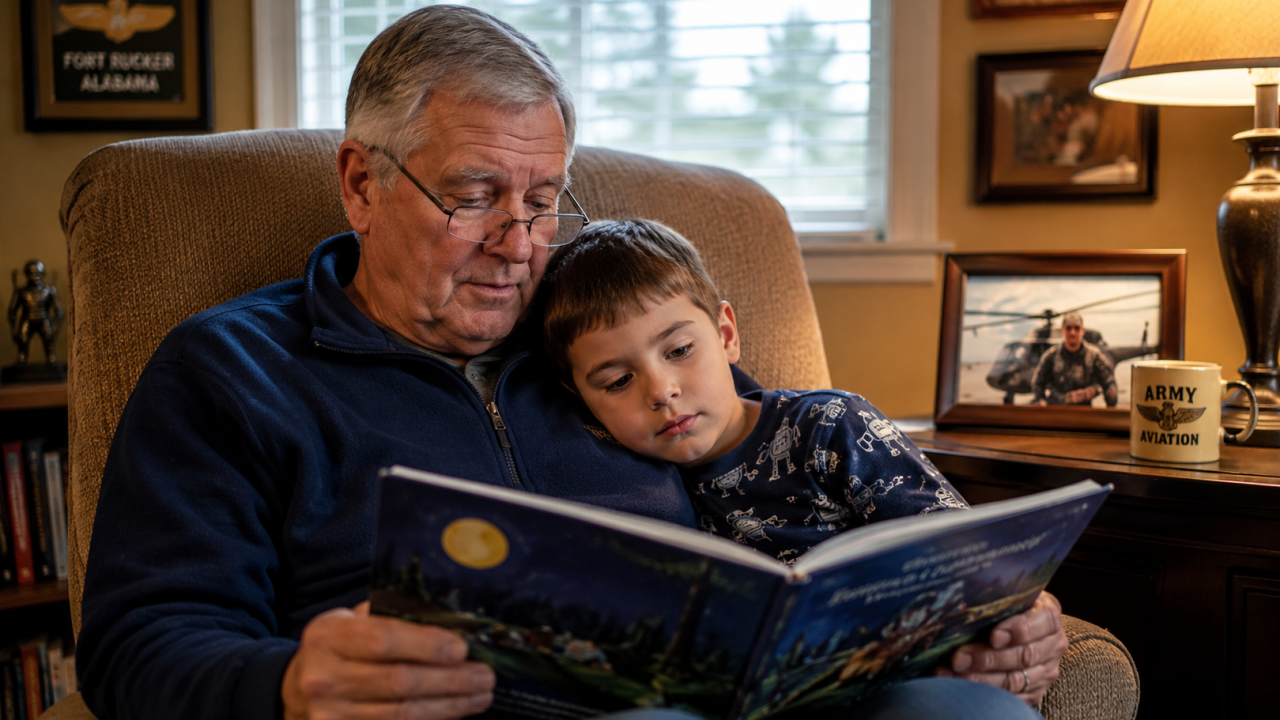
I cannot indulge in mourning the past. I don’t have time for that. I still have work to do. I have Asher, my 5-year-old grandson, to raise. I have a wife who needs me. I have other people who depend on me to some extent.
Hang on a minute. I hear Asher calling me.
“Grandpa! Come here!”
“What do you need?”
“Grandpa, come read to me.”
I will end here. I have important things to do.

_____________________________
Frank Pauc is a former Army aviator, a longtime trucking-company supervisor, and a contributor to The Havok Journal. A West Point graduate from the Class of 1980, he completed the Military Intelligence Basic Course and flight school, served with the 3rd Armored Division in West Germany and the 7th Infantry Division at Fort Ord, and left the Army in 1986. He later taught citizenship classes through Voces de la Frontera in Milwaukee, took part in peace and protest work, and writes largely about veterans, family, grief, and the long aftermath of military service.
As the Voice of the Veteran Community, The Havok Journal seeks to publish a variety of perspectives on a number of sensitive subjects. Unless specifically noted otherwise, nothing we publish is an official point of view of The Havok Journal or any part of the U.S. government.
Buy Me A Coffee
The Havok Journal seeks to serve as a voice of the Veteran and First Responder communities through a focus on current affairs and articles of interest to the public in general, and the veteran community in particular. We strive to offer timely, current, and informative content, with the occasional piece focused on entertainment. We are continually expanding and striving to improve the readers’ experience.
© 2026 The Havok Journal
The Havok Journal welcomes re-posting of our original content as long as it is done in compliance with our Terms of Use.


